
Close Menu
    Facebook X (Twitter) Instagram
    SciTechDaily
    • Biology
    • Chemistry
    • Earth
    • Health
    • Physics
    • Science
    • Space
    • Technology
    Facebook X (Twitter) Pinterest YouTube RSS
    SciTechDaily
    Home»Space»NASA’s Webb Space Telescope Makes Time Critical Mid-Course Correction Burn
    Space

    NASA’s Webb Space Telescope Makes Time Critical Mid-Course Correction Burn

    By NASADecember 25, 2021No Comments2 Mins Read
    Facebook Twitter Pinterest Telegram LinkedIn WhatsApp Email Reddit
    Share
    Facebook Twitter LinkedIn Pinterest Telegram Email Reddit
    Webb Thrusters
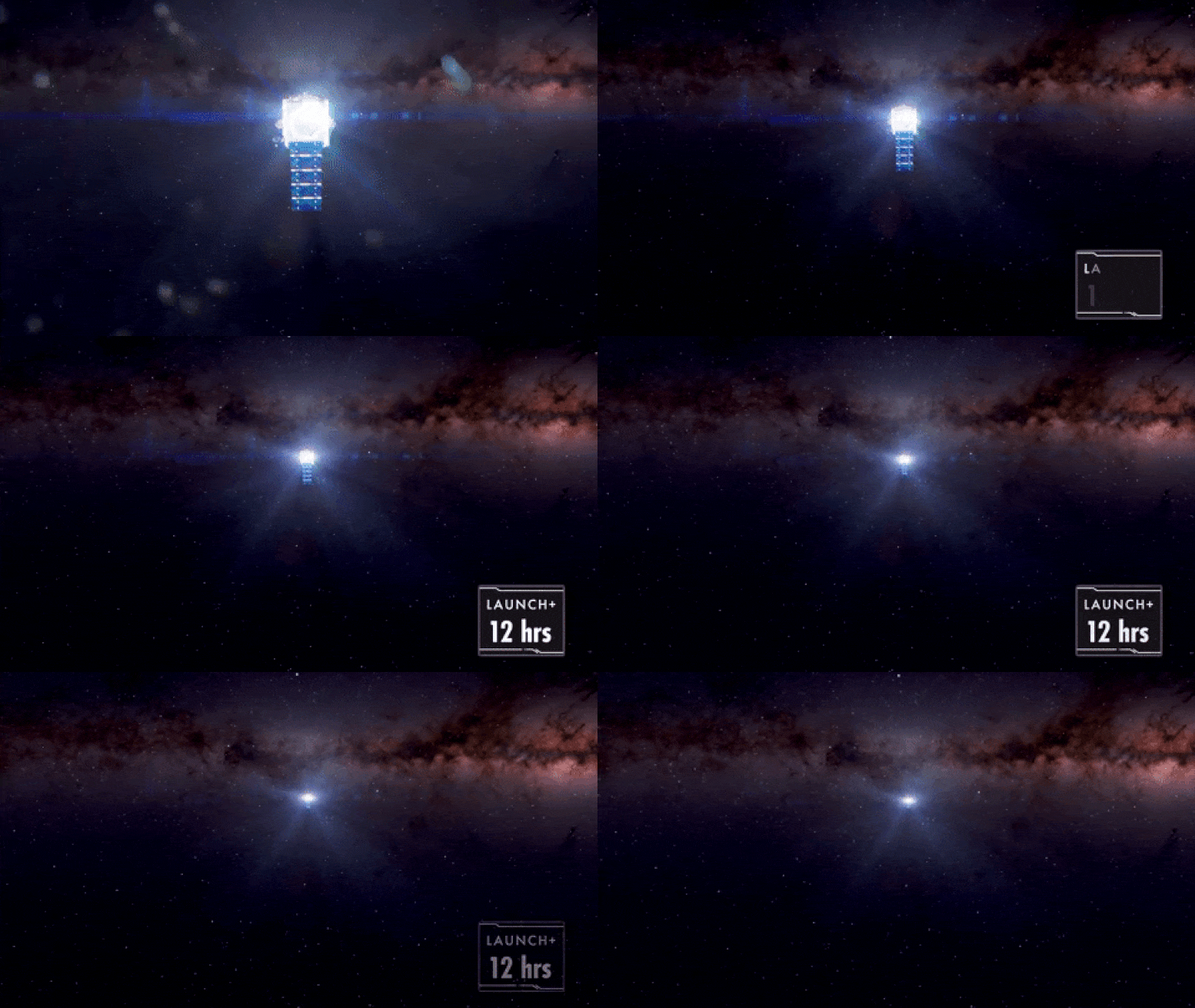
    At 7:50 pm EST, on December 25, 2021, the James Webb Space Telescope initiated its first course correction burn to adjust its trajectory toward its final orbit. Credit: NASA Goddard Space Flight Center

    At 7:50 pm EST, Webb’s first mid-course correction burn began. It lasted 65 minutes and is now complete. This burn is one of two milestones that are time critical — the first was the solar array deployment, which happened shortly after launch. 

    This burn adjusts Webb’s trajectory toward the second Lagrange point, commonly known as L2. After launch, Webb needs to make its own mid-course thrust correction maneuvers to get to its orbit. This is by design: Webb received an intentional slight under-burn from the Ariane-5 that launched it into space, because it’s not possible to correct for overthrust. If Webb gets too much thrust, it can’t turn around to move back toward Earth because that would directly expose its telescope optics and structure to the Sun, overheating them and aborting the science mission before it can even begin.  

    Therefore, we ease up to the correct velocity in three stages, being careful never to deliver too much thrust — there will be three mid-course correction maneuvers in total. 

    After this burn, no key milestones are time critical, so the order, location, timing, and duration of deployments may change.

    You can track where Webb is in the process and read about upcoming deployments.  NASA has a detailed plan to deploy the Webb Space Telescope over a roughly two-week period.The deployment process is not an automatic hands-off sequence; it is human-controlled. The team monitors Webb in real-time and may pause the nominal deployment at any time. This means that the deployments may not occur exactly in the order or at the times originally planned.

    Never miss a breakthrough: Join the SciTechDaily newsletter.
    Follow us on Google and Google News.

    James Webb Space Telescope NASA NASA Goddard Space Flight Center Popular
    Share. Facebook Twitter Pinterest LinkedIn Email Reddit

    Related Articles

    See the Birth of a New Star: Webb Space Telescope Captures Once-Hidden Features of a Protostar

    Webb Space Telescope’s Captures Incredible Star-Filled Portrait of Pillars of Creation

    Biden Releases Webb’s First Image: Deepest Infrared View of Universe Yet – Compare to Hubble

    Webb Space Telescope’s Glorious First Images: Fine Guidance Sensor Provides a Preview

    Another Primary Webb Space Telescope Instrument Gets the “Go for Science”

    NASA’s $10 Billion Webb Space Telescope Struck by Micrometeoroid

    Coming Soon: First Images From NASA’s Webb Space Telescope

    Webb Space Telescope’s Quest for Primeval Black Holes

    NASA’s James Webb Space Telescope Alignment Complete – Capturing Crisp, Focused Images

    Leave A Reply Cancel Reply

    • Facebook
    • Twitter
    • Pinterest
    • YouTube

    Don't Miss a Discovery

    Subscribe for the Latest in Science & Tech!

    Trending News

    Monster Storms on Jupiter Unleash Lightning Beyond Anything on Earth

    Scientists Create “Liquid Gears” That Spin Without Touching

    The Simple Habit That Could Help Prevent Cancer

    Millions Take These IBS Drugs, But a New Study Finds Serious Risks

    Scientists Unlock Hidden Secrets of 2,300-Year-Old Mummies Using Cutting-Edge CT Scanner

    Bread Might Be Making You Gain Weight Even Without Eating More Calories

    Scientists Discover Massive Magma Reservoir Beneath Tuscany

    Europe’s Most Active Volcano Just Got Stranger – Here’s Why Scientists Are Rethinking It

    Follow SciTechDaily
    • Facebook
    • Twitter
    • YouTube
    • Pinterest
    • Newsletter
    • RSS
    SciTech News
    • Biology News
    • Chemistry News
    • Earth News
    • Health News
    • Physics News
    • Science News
    • Space News
    • Technology News
    Recent Posts
    • Scientists Were Wrong About This Strange “Rule-Breaking” Particle
    • Webb Space Telescope Uncovers Unexpected Ice Clouds on a Jupiter-Like World
    • 289-Million-Year-Old Reptile Mummy Reveals Origin of Human Breathing System
    • New Brain Discovery Challenges Long-Held Theory of Teenage Brain Development
    • Sharks Are Overheating as Warming Oceans Push Them to the Edge
    Copyright © 1998 - 2026 SciTechDaily. All Rights Reserved.
    • Science News
    • About
    • Contact
    • Editorial Board
    • Privacy Policy
    • Terms of Use

    Type above and press Enter to search. Press Esc to cancel.