
Close Menu
    Facebook X (Twitter) Instagram
    SciTechDaily
    • Biology
    • Chemistry
    • Earth
    • Health
    • Physics
    • Science
    • Space
    • Technology
    Facebook X (Twitter) Pinterest YouTube RSS
    SciTechDaily
    Home»Science»How Tyrannosaurus Rex Ate Triceratops Horridus
    Science

    How Tyrannosaurus Rex Ate Triceratops Horridus

    By SciTechDailyOctober 25, 20121 Comment2 Mins Read
    Facebook Twitter Pinterest Telegram LinkedIn WhatsApp Email Reddit
    Share
    Facebook Twitter LinkedIn Pinterest Telegram Email Reddit
    t-rex-eating-t-horridus
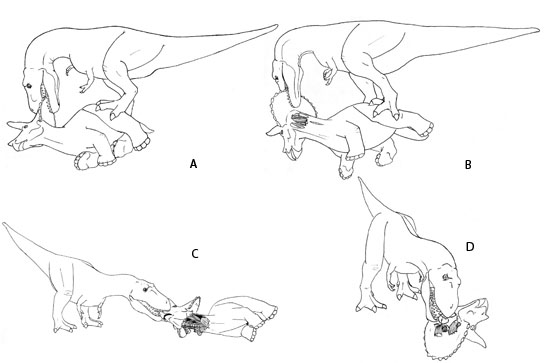
    A: get a good grip on the neck frill, B: tear the head off to expose the tasty neck muscles, C: nibble on the soft flesh of Triceratops’ face, D: feast on the delicacies beneath the frill. Credit: Nate Carroll

    Tyrannosaurus rex bite marks have been found on the fossilized bones of Triceratops horridus, but so far such fossils have been studied in an isolated manner. In new research, scientists worked on numerous specimens from Montana’s Hell Creek Formation to identify the tooth marks of T. rex and how it ate T. horridus.

    The scientists presented their findings at the Society of Vertebrate Paleontology last week in Raleigh, North Carolina. In total, they found 18 specimens that had teeth marks. None of the bones showed any signs of healing, indicating that the bites were inflicted on dead animals as they were in the process of being consumed.

    The bite marks included extensive puncture and pull marks on the neck frills on some of the specimens. The pulling action was probably not indicative of being eaten, but a repositioning of the prey. It suggests that T. rex was trying to get at the nutrient-rich neck muscles.

    This is probably the easiest way to pull the head off, explains Denver Fowler, from the Museum of the Rockies in Bozeman, Montana. T. horridus‘ occipital condyles had teeth marks as well. They could have only been made if the animal had been decapitated.

    This work shows the value of incomplete specimens and large samples for interpreting palaeobiology, states Andrew Farke, paleontologist at the Raymond M. Alf Museum of Paleontology in Claremont, California. There were precise, even delicate bites, along the front of several T. horridus skulls, suggesting that the nibbles were done on the meaty part of the face.

    This led Fowler to question whether the feeding behavior of T. rex changed as the animals grew. With thick teeth, adult T. rex would have been well-suited to tear apart T. horridus, whereas juveniles may have had to rely on different feeding strategies to avoid damaging their teeth.

    Never miss a breakthrough: Join the SciTechDaily newsletter.
    Follow us on Google and Google News.

    Dinosaurs Fossils Palaeobiology Paleontology Triceratops Tyrannosaurus
    Share. Facebook Twitter Pinterest LinkedIn Email Reddit

    Related Articles

    “Big John” Triceratops Specimen Has Skull Injuries That May Have Come From Combat With Another Dinosaur

    World’s Oldest Dinosaur Bonebed Reveals How Dinosaur Embryos Grew and Developed

    Stubby-Tailed Oviraptors Had Tails for Courtship Displays

    Xenoceratops, A New Species of Horned Dinosaur Discovered in Canada

    Fossils Reveal Headbutts May Have Been Used as a Dinosaur Courtship Behavior

    Cretaceous Period Sankofa Pyrenaica Fossilized Eggs Are Unusually Shaped

    Microraptor Feathers Were Black With Iridescent Sheen

    Jurassic Period Super-Sized Fleas Had Armored Mouthparts to Attack the Thick Hide of Dinosaurs

    Researchers Conclude Torosaurus and Triceratops Are Different Species of Horned Dinosaurs

    1 Comment

    1. Dorothy on July 26, 2026 1:21 pm

      Thank you !

      Reply
    Leave A Reply Cancel Reply

    • Facebook
    • Twitter
    • Pinterest
    • YouTube

    Don't Miss a Discovery

    Subscribe for the Latest in Science & Tech!

    Trending News

    Don’t Miss: A Brilliant Venus and Glowing Harvest Moon Light Up the Sky

    New Twist on the Einstein Problem Reveals Unexpected Physics

    JWST Captures Stunning Evidence of How Supermassive Black Holes Feed

    Early Exercise May Permanently Change How Much Energy the Body Uses To Move

    New Molecule Wipes Out Aggressive Lymphoma Tumors in Mice in Just 11 Days

    The Human Family Tree May Need a Major Rewrite

    Scientists Find a Surprising Cancer-Fighting Effect in Dark Sweet Cherries

    New AI Detects Hidden Warning Signs of Solar Eruptions Hours Before They Emerge

    Follow SciTechDaily
    • Facebook
    • Twitter
    • YouTube
    • Pinterest
    • Newsletter
    • RSS
    SciTech News
    • Biology News
    • Chemistry News
    • Earth News
    • Health News
    • Physics News
    • Science News
    • Space News
    • Technology News
    Recent Posts
    • Vagus Nerve Stimulation Could Unlock the Brain’s Hidden Learning Potential
    • Your Mother’s Age May Leave a Biological Mark That Lasts for Generations
    • Women Who Ate More Antioxidants Had Strikingly Lower Rates of Cervical Cancer
    • A Hidden Hormone Disorder May Be Driving Millions of High Blood Pressure Cases
    • This Self-Rebuilding Electrode Could Supercharge Green Hydrogen Production
    Copyright © 1998 - 2026 SciTechDaily. All Rights Reserved.
    • Science News
    • About
    • Contact
    • Editorial Board
    • Privacy Policy
    • Terms of Use

    Type above and press Enter to search. Press Esc to cancel.