
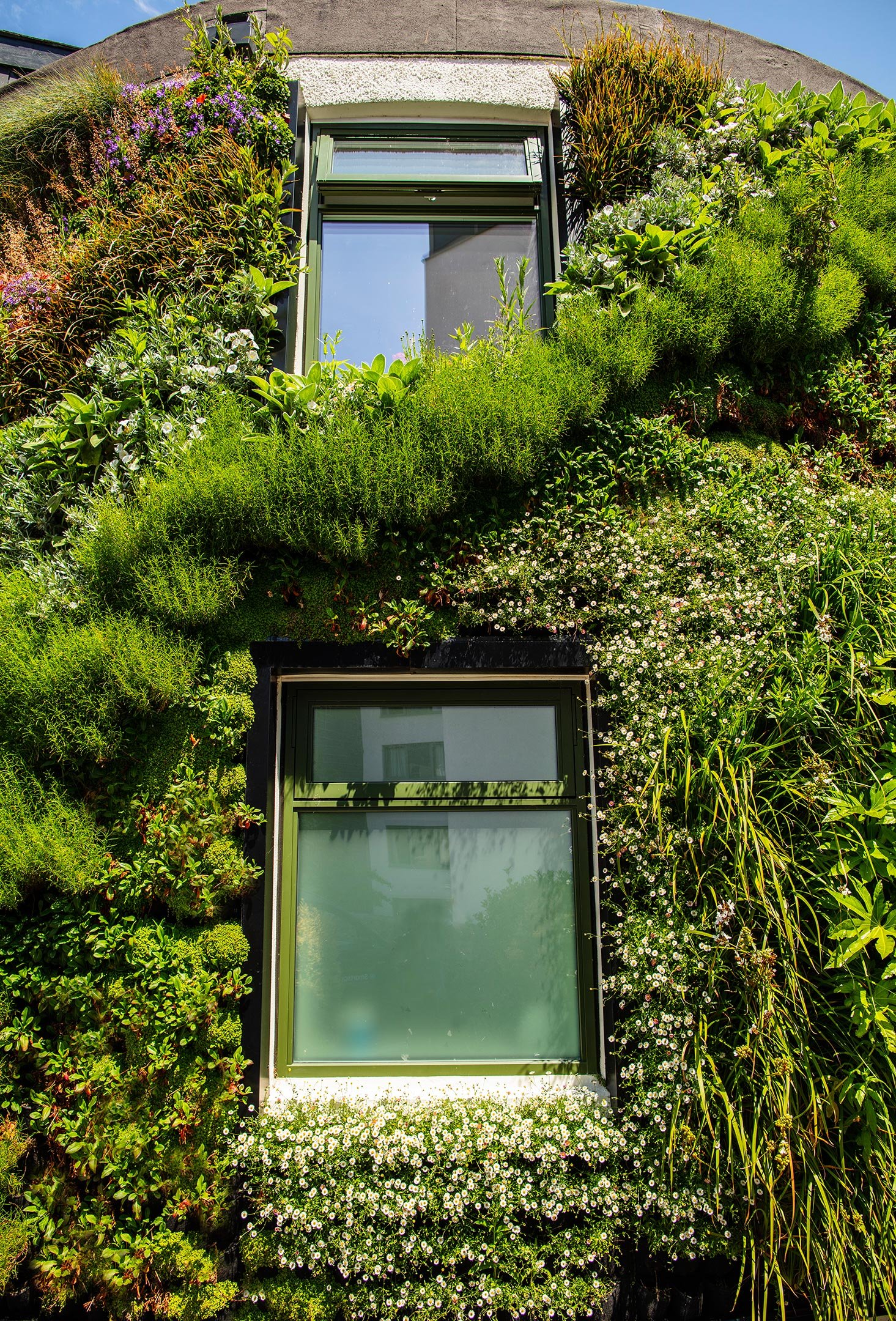
A study from the University of Plymouth demonstrates that living walls can cut heat loss by over 30%, providing a viable method to improve energy efficiency in older buildings.
Retrofitting an existing masonry cavity walled building with a green or living wall can reduce the amount of heat lost through its structure by more than 30%, according to new research.
The study, which was conducted at the University of Plymouth, centered around the Sustainability Hub – a pre-1970s building on the university campus. It compared how effectively two sections of its walls retained heat.
Despite being on the same west-facing elevation, one of those sections had been retrofitted with an exterior living wall façade, comprised of a flexible felt fabric sheet system with pockets allowing for soil and planting.
After five weeks of measurements, researchers found the amount of heat lost through the wall retrofitted with the living façade was 31.4% lower than that of the original structure.
They also discovered daytime temperatures within the newly-covered section remained more stable than the area with exposed masonry, meaning less energy was required to heat it.
Implications for Sustainable Architecture and Carbon Reduction
The study is one of the first to ascertain the thermal influence of living wall systems on existing buildings in temperate scenarios and was conducted by academics associated with the University’s Sustainable Earth Institute.
Writing in the journal Building and Environment, they say while the concept is relatively new, it has already been shown to bring a host of benefits, such as added biodiversity.
However, with buildings directly accounting for 17% of UK Greenhouse Gas Emissions – and space heating accounting for over 60% of all energy used in buildings – these new findings could be a game-changer in helping the UK achieve its net-zero commitments.
Dr. Matthew Fox, a researcher in sustainable architecture and the study’s lead author, said:
“Within England, approximately 57% all buildings were built before 1964. While regulations have changed more recently to improve the thermal performance of new constructions, it is our existing buildings that require the most energy to heat and are a significant contributor to carbon emissions. It is, therefore, essential that we begin to improve the thermal performance of these existing buildings if the UK is to reach its target of net zero carbon emission by 2050, and help to reduce the likelihood of fuel poverty from rising energy prices.”
The University is renowned globally for its research into sustainable building technologies, and this study’s findings are already being taken forward as part of the University’s Sustainability Hub: Low Carbon Devon project.
Future Directions and Ongoing Research
Supported by an investment from the European Regional Development Fund (ERDF), the three-year £2.6 million program is exploring low-carbon solutions through research and support for local enterprises.
Specifically, this aspect of the project is looking to optimize the performance and sustainability of external living walls in sustainable building design through research on the thermal properties, and carbon sequestration, offered by different plant and soil types.
Dr. Thomas Murphy, one of the study’s authors and an Industrial Research Fellow on the Low Carbon Devon project, added:
“With an expanding urban population, ‘green infrastructure’ is a potential nature-based solution which provides an opportunity to tackle climate change, air pollution and biodiversity loss, whilst facilitating low carbon economic growth. Living walls can offer improved air quality, noise reduction and elevated health and well-being. Our research suggests living walls can also provide significant energy savings to help reduce the carbon footprint of existing buildings. Further optimizing of these living wall systems, however, is now needed to help maximise the environmental benefits and reduce some of the sustainability costs.”
Reference: “Living wall systems for improved thermal performance of existing buildings” by Matthew Fox, Jack Morewood, Thomas Murphy, Paul Lunt and Steve Goodhew, 3 November 2021, Building and Environment.
DOI: 10.1016/j.buildenv.2021.108491
Never miss a breakthrough: Join the SciTechDaily newsletter.
Follow us on Google and Google News.