
Close Menu
    Facebook X (Twitter) Instagram
    SciTechDaily
    • Biology
    • Chemistry
    • Earth
    • Health
    • Physics
    • Science
    • Space
    • Technology
    Facebook X (Twitter) Pinterest YouTube RSS
    SciTechDaily
    Home»Technology»Scientists Work on Developing Computer Chips Made From Nanotubes
    Technology

    Scientists Work on Developing Computer Chips Made From Nanotubes

    By SciTechDailyOctober 30, 2012No Comments3 Mins Read
    Facebook Twitter Pinterest Telegram LinkedIn WhatsApp Email Reddit
    Share
    Facebook Twitter LinkedIn Pinterest Telegram Email Reddit
    carbon-nanotube-chip
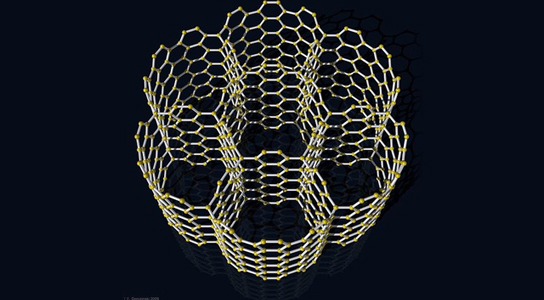
    Scientists have developed new methods for making higher-performance computer chips using carbon nanotubes. Credit: Image by TED-43 under Creative Commons license

    Scientists have developed new methods that could result in the production of higher-performance computer chips made from tiny straws of carbon nanotubes. It’s been known for a long time that these nanotubes have electronic properties superior to current silicon-based devices.

    The scientists published their findings in the journal Nature Nanotechnology. In the past, difficulties of manipulating nanotubes have hampered the development of nanotube-chips. In this new experiment, scientists report that a kind of two-part epoxy could place individual nanotubes at high densities.
    two-part-epoxy-nanotube
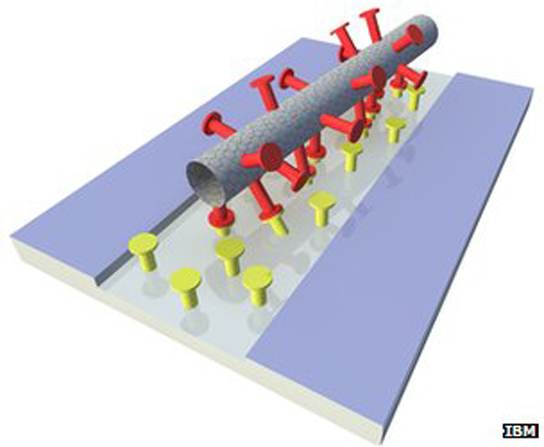
    The two molecules on the chip and nanotube work like a two-part epoxy.

    The race to replace the current silicon-based technology is on in the semiconductor chip industry. This would allow the development of smaller and faster devices, which place a burden on the physical limit on how small silicon devices can be. There are few realistic successors to silicon’s throne, states James Hannon, materials scientist and co-author of the study.

    These units need to be put into production on a 10 or 15 year time scale, so the kinks need to be worked out in the next few years. Right now there has been very few electronic devices produced that can actually outperform silicon.

    The main problem was integration, specifically getting billions of nanotubes placed onto a chip with high precision. Current chips use lithography, which uses large wafers of silicon layered with other materials of different electronic properties. The devices are etched onto them, using a focused beam of electrons or charged atoms.

    The solution involved a two-step process. First they used a chemical that coats the nanotubes and that makes them soluble in water. Then, they used a solution that binds to the first chemical and the element hafnium, but not silicon. Standard techniques were used to etch patterns in hafnium deposited onto silicon. The chips were double-dipped into the two solutions. One chemical stuck to the hafnium, and the other acted as the second part of a two-part epoxy, tightly binding the nanotubes to the hafnium regions on the chip but not the silicon.

    The process resulted in a series of neatly aligned nanotube devices, already wired up within the pattern, at a density of a billion per square centimeter. That’s not good enough to make a microprocessor yet, but it’s only a factor of 10 away, states Hannon. Before, it was a factor of 100.

    The etching process needs to be improved and the selection of the right nanotubes of the right length needs to be more efficient. The models suggest a 10-fold jump in performance where the chip runs at more than three times the frequency and consumes a third of the energy.

    Reference: “High-density integration of carbon nanotubes via chemical self-assembly” by Hongsik Park, Ali Afzali, Shu-Jen Han, George S. Tulevski, Aaron D. Franklin, Jerry Tersoff, James B. Hannon and Wilfried Haensch, 28 October 2012, Nature Nanotechnology.
    DOI: 10.1038/nnano.2012.189

    Never miss a breakthrough: Join the SciTechDaily newsletter.
    Follow us on Google and Google News.

    Computer Chips Nanomaterials Nanotechnology Nanotubes
    Share. Facebook Twitter Pinterest LinkedIn Email Reddit

    Related Articles

    Balancing Between Life and Research

    Graphene Center Laboratory is State of the Art “Nano-Factory”

    Cost Effective Sensor Measures Fruits’ Ripeness

    2-D Boron has Potential Advantages over Carbon Nanotubes

    Nanosponges May Help With Environmental Cleanup

    Analyzing the Environmental Costs and Impacts of Technology

    Nanoparticles in 3-D Atomic-Scale Resolution

    Carbon Nanotubes Increase the Speed of Biological Sensors

    Researchers Find Maximum Nanotube Brightness is Proportional to Length

    Leave A Reply Cancel Reply

    • Facebook
    • Twitter
    • Pinterest
    • YouTube

    Don't Miss a Discovery

    Subscribe for the Latest in Science & Tech!

    Trending News

    Giant Crocodylians Ruled South America’s Ancient Food Chain

    Breakthrough in a Bizarre Galaxy Could Help Unlock the Mystery of Dark Matter

    Just 4 Minutes of Daily Strength Training Can Quadruple Fitness in Older Adults

    Almost All Plant-Based Meat Alternatives Contain Mycotoxins, Study Finds

    Astronomers Detect a Record-Breaking “Cosmic Laser” From 8 Billion Light-Years Away

    A 47-Year-Old Scientist Tracked Himself for Months – His Biological Age Fell to 32

    Construction Crew Uncovers Giant 20-Meter Dinosaur in Brazil

    30 Years of Hurricane Data Reveal 4 Warning Signs Before Storms Strengthen

    Follow SciTechDaily
    • Facebook
    • Twitter
    • YouTube
    • Pinterest
    • Newsletter
    • RSS
    SciTech News
    • Biology News
    • Chemistry News
    • Earth News
    • Health News
    • Physics News
    • Science News
    • Space News
    • Technology News
    Recent Posts
    • Scientists Find a Clue to Making Brain Stimulation More Reliable
    • A Hidden Gut Reaction May Explain Why Vegetables Are So Good for You
    • New “Invisible” Cell Therapy Could Provide Side-Effect-Free Diabetes Treatment
    • Researchers Solve Two Major Problems Holding Back SiC Electronics
    • Physicists Hunted a Mysterious Particle – and Found Two Unexpected Structures Instead
    Copyright © 1998 - 2026 SciTechDaily. All Rights Reserved.
    • Science News
    • About
    • Contact
    • Editorial Board
    • Privacy Policy
    • Terms of Use

    Type above and press Enter to search. Press Esc to cancel.