
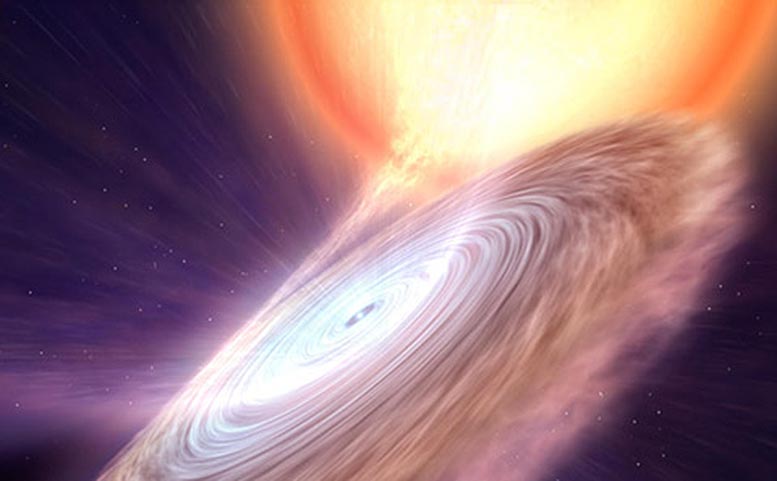
Astronomers observed for the first time hot, warm, and cold winds coming from a neutron star as it consumes a nearby star’s matter. The findings give new insights into how neutron stars interact with their environment and contribute to galaxy evolution.
Using the most powerful telescopes on Earth and in space, a team of astronomers has found for the first time blasts of hot, warm, and cold winds from a neutron star whilst it consumes matter from a nearby star. The discovery provides new insight into the behaviors of some of the most extreme objects in the universe.
Low-mass X-ray binaries (LMXBs) are systems containing a neutron star or black hole. They are fuelled by material ripped from a neighboring star, a process known as accretion. Most accretion occurs during violent eruptions where the systems brighten dramatically. At the same time, some of the material that spirals in is propelled back into space in the form of disc winds and jets.
The most common signs of outflowing material from astronomical objects are associated with “warm” gas. Despite this, only winds of “hot” or “cold” gas have been observed in transient X-ray binaries, until now.
Observing Swift J1858 Across the Electromagnetic Spectrum
In this new study, a team of researchers from eleven countries, led by the University of Southampton, studied the recent eruption of the X-ray binary known as Swift J1858. They used a combination of telescopes, including NASA’s Hubble Space Telescope (HST), the European Space Agency’s XMM-Newton satellite, the European Southern Observatory Organisation’s Very Large Telescope (VLT), and the Spanish Gran Telescopio Canarias (GTC).
The results, published in the journal Nature, showed persistent signatures of a warm wind at ultraviolet wavelengths occurring at the same time as signatures of a cold wind at optical wavelengths. This is the first time that winds from such a system have been seen across different bands of the electromagnetic spectrum.
Lead author Dr. Noel Castro Segura, of the University of Southampton said: “Eruptions like this are rare, and each of them is unique. Normally they are heavily obscured by interstellar dust, which makes observing them really difficult. Swift J1858 was special, because even though it is located on the other side of our galaxy, the obscuration was small enough to allow for a full multiwavelength study.”
“Only one other system — the black hole X-ray binary, V404 Cyg — has shown similar properties. However, our attempt to perform the same experiment on that system was unsuccessful, because the eruption ended before we could get the ground-based and space-based telescopes to observe it simultaneously,” co-author Dr. Hernández Santisteban from University of St Andrews said.
Extreme Variability in Swift J1858
Swift J1858 is a newly discovered X-ray transient event that displays extreme variability across the electromagnetic spectrum, which presented a rare opportunity.
“All the astronomers in the field were incredibly excited, to the point that we combined our efforts to cover the full spectrum, from radio to X-ray using state-of-art observatories on Earth and in space,” Dr. Castro Segura continued.
Co-author Nathalie Degenaar, from the University of Amsterdam added, “Neutron stars have an immensely strong gravitational pull that allows them to gobble up gas from other stars. The stellar cannibals are, however, messy eaters and much of the gas that neutron stars pull towards them is not consumed, but flung into space at high speed. This behavior has a large impact both on the neutron star itself, and on its immediate surroundings. In this paper we report on a new discovery that provides key information about the messy eating patterns of these cosmic cookie monsters.”
“This time we had cosmic luck on our side, as we were able to co-ordinate ten telescopes and point them towards the J1858, all while it was fully active. This allows us to obtain much more information, since we can use different techniques at different wavelengths,” Dr. Hernández Santisteban said.
Dr. Degenaar added, “Designing such an ambitious observing campaign – built around the best telescopes on Earth and in space – was a huge challenge. So, it is incredibly exciting that all this work has paid off and allowed us to make a key discovery that would not have been possible otherwise.”
Temporal Evolution and Dynamics of Gas Outflows
As well as discovering the different types of winds, the team were able to study the temporal evolution of the gas that flows out. They found that the warm wind was not affected by the strong variations in the brightness of the system. The absence of such a response had previously been an unconfirmed theoretical prediction based on sophisticated simulations.
“In this research we combined the unique capabilities of the HST with the best ground-based telescopes, such as the VLT and GTC, to obtain a complete picture of the dynamics of the gas in the system, from the near-infrared to ultraviolet wavelengths. This allowed us to unveil for first time the true nature of these powerful outflows,” Dr. Castro Segura said.
“The new insights provided by our results are key to understanding how these objects interact with their environment. By shedding energy and matter into the galaxy, they contribute to the formation of new generations of stars, and to the evolution of the galaxy itself,” Dr. Castro Segura concluded.
Reference: “A persistent ultraviolet outflow from an accreting neutron star binary transient” by N. Castro Segura, C. Knigge, K. S. Long, D. Altamirano, M. Armas Padilla, C. Bailyn, D. A. H. Buckley, D. J. K. Buisson, J. Casares, P. Charles, J. A. Combi, V. A. Cúneo, N. D. Degenaar, S. del Palacio, M. Díaz Trigo, R. Fender, P. Gandhi, M. Georganti, C. Gutiérrez, J. V. Hernandez Santisteban, F. Jiménez-Ibarra, J. Matthews, M. Méndez, M. Middleton, T. Muñoz-Darias, M. Özbey Arabacı, M. Pahari, L. Rhodes, T. D. Russell, S. Scaringi, J. van den Eijnden, G. Vasilopoulos, F. M. Vincentelli and P. Wiseman, 2 March 2022, Nature.
DOI: 10.1038/s41586-021-04324-2
The study was funded by grants from agencies including the Science and Technology Facilities Council (STFC) and NASA among others.
Never miss a breakthrough: Join the SciTechDaily newsletter.
Follow us on Google and Google News.
1 Comment
Interesting.
Accretion + Expulsion of Cosmic Rays from a Black Hole. Is the Black Hole a Cosmic Conversion Macchine fpr Converting Mater + Ene4rgy into Energy Plus Matt4?
As Conservation of Energy (Kinetic) + Matter (Potential) is a Law in the physical gross world, The Black Hole may be just be a convesion machine for changing the ratio or composition of energy and matter in the mix!
Views expressed are personal and not binding on anypne.