
Close Menu
    Facebook X (Twitter) Instagram
    SciTechDaily
    • Biology
    • Chemistry
    • Earth
    • Health
    • Physics
    • Science
    • Space
    • Technology
    Facebook X (Twitter) Pinterest YouTube RSS
    SciTechDaily
    Home»Space»A Bug’s Life: Mountains on Neutron Stars May Be Only Fractions of Millimeters Tall
    Space

    A Bug’s Life: Mountains on Neutron Stars May Be Only Fractions of Millimeters Tall

    By Royal Astronomical SocietyJuly 19, 20213 Comments3 Mins Read
    Facebook Twitter Pinterest Telegram LinkedIn WhatsApp Email Reddit
    Share
    Facebook Twitter LinkedIn Pinterest Telegram Email Reddit
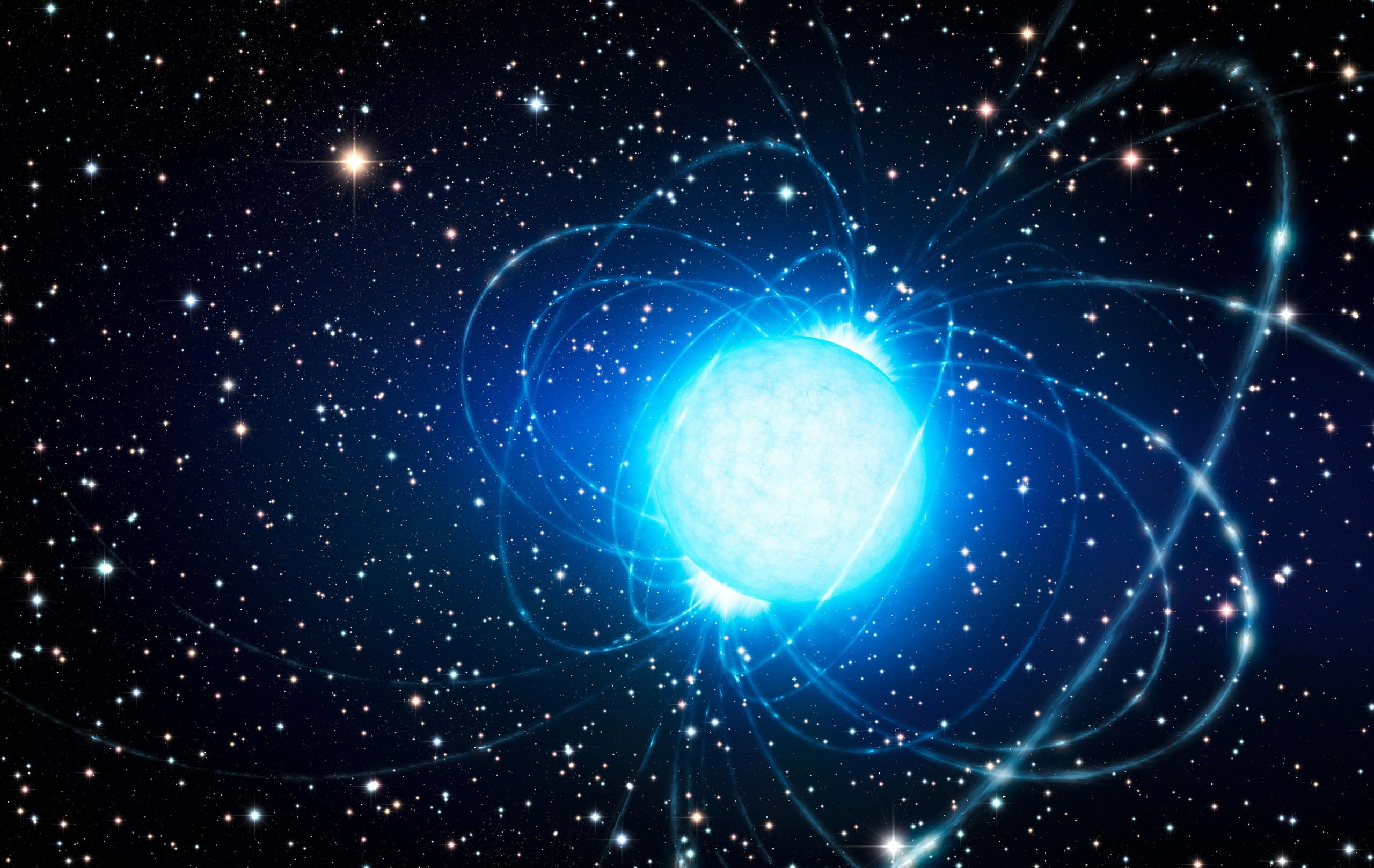
    Neutron Star Artist’s Depiction
    Artist’s depiction of a neutron star. Credit: ESO / L. Calçada

    New models reveal neutron star “mountains” are microscopic, making gravitational wave detection even more elusive.

    New models of neutron stars show that their tallest mountains may be only fractions of millimeters high, due to the huge gravity on the ultra-dense objects. The research is presented today at the National Astronomy Meeting 2021.

    Neutron stars are some of the densest objects in the Universe: they weigh about as much as the Sun, yet measure only around 10km (6 mi) across, similar in size to a large city.

    Because of their compactness, neutron stars have an enormous gravitational pull around a billion times stronger than the Earth. This squashes every feature on the surface to minuscule dimensions, and means that the stellar remnant is an almost perfect sphere.

    Modeling the Formation of Neutron Star Mountains

    Whilst they are billions of times smaller than on Earth, these deformations from a perfect sphere are nevertheless known as mountains. The team behind the work, led by PhD student Fabian Gittins at the University of Southampton, used computational modeling to build realistic neutron stars and subject them to a range of mathematical forces to identify how the mountains are created.

    The team also studied the role of the ultra-dense nuclear matter in supporting the mountains, and found that the largest mountains produced were only a fraction of a millimeter tall, one hundred times smaller than previous estimates.

    Fabian comments, “For the past two decades, there has been much interest in understanding how large these mountains can be before the crust of the neutron star breaks, and the mountain can no longer be supported.”

    Past work has suggested that neutron stars can sustain deviations from a perfect sphere of up to a few parts in one million, implying the mountains could be as large as a few centimeters. These calculations assumed the neutron star was strained in such a way that the crust was close to breaking at every point. However, the new models indicate that such conditions are not physically realistic.

    Fabian adds: “These results show how neutron stars truly are remarkably spherical objects. Additionally, they suggest that observing gravitational waves from rotating neutron stars may be even more challenging than previously thought.”

    Although they are single objects, due to their intense gravitation, spinning neutron stars with slight deformations should produce ripples in the fabric of spacetime known as gravitational waves. Gravitational waves from rotations of single neutron stars have yet to be observed, although future advances in extremely sensitive detectors such as advanced LIGO and Virgo may hold the key to probing these unique objects.

    Never miss a breakthrough: Join the SciTechDaily newsletter.
    Follow us on Google and Google News.

    Astronomy Astrophysics Neutron Star Popular Royal Astronomical Society
    Share. Facebook Twitter Pinterest LinkedIn Email Reddit

    Related Articles

    “Project Hail Mary” – These 45 Exoplanets Could Be Home to Alien Life, Scientists Say

    The Center of Our Galaxy May Not Be a Black Hole

    Breaking a 50-Year Law: New Evidence Challenges Fundamental Black Hole Physics

    Astronomers Uncover Hidden Rings of Light in the Deep Universe

    Webb Telescope Spots Sparkling Crystals and Life’s Ingredients in the Butterfly Nebula

    New Method for Measuring Black Hole Spin Could Provide a Greater Understanding of Galaxy Growth

    New e-MERLIN Image of Betelgeuse Reveals Mysterious Hot Spots

    Gravitational Microlensing Could Lead to the Discovery of 100 Billion Earth-Like Planets

    Astronomers Believe a Gamma-Ray Burst Hit Earth in the 8th Century

    3 Comments

    1. John Bayer on July 19, 2021 4:33 pm

      “The team also studied the role of the ultra-dense nuclear matter in supporting the mountains, and found that the largest mountains produced were only a fraction of a millimeter tall, one hundred times smaller than previous estimates.”

      Do we even know that such “mountains” exist?

      Reply
    2. Neil B on July 19, 2021 7:29 pm

      The word “may” was in the headline. Analysis shows they are the largest that can be supported.

      Reply
    3. Richard Bartley on July 20, 2021 3:49 am

      If the gravity is so strong as to pull the mountains down to fractions of a millimetre then why wouldn’t it be totally smooth and spherical, how would a mountain exist at all?

      Reply
    Leave A Reply Cancel Reply

    • Facebook
    • Twitter
    • Pinterest
    • YouTube

    Don't Miss a Discovery

    Subscribe for the Latest in Science & Tech!

    Trending News

    Breakthrough Bowel Cancer Trial Leaves Patients Cancer-Free for Nearly 3 Years

    Natural Compound Shows Powerful Potential Against Rheumatoid Arthritis

    100,000-Year-Old Neanderthal Fossils in Poland Reveal Unexpected Genetic Connections

    Simple “Gut Reset” May Prevent Weight Gain After Ozempic or Wegovy

    2.8 Days to Disaster: Scientists Warn Low Earth Orbit Could Suddenly Collapse

    Common Food Compound Shows Surprising Power Against Superbugs

    5 Simple Ways To Remember More and Forget Less

    The Atomic Gap That Could Cost the Semiconductor Industry Billions

    Follow SciTechDaily
    • Facebook
    • Twitter
    • YouTube
    • Pinterest
    • Newsletter
    • RSS
    SciTech News
    • Biology News
    • Chemistry News
    • Earth News
    • Health News
    • Physics News
    • Science News
    • Space News
    • Technology News
    Recent Posts
    • Powerful Antioxidant Found To Play a Key Role in Proper Protein Folding
    • MIT Laser Breakthrough Lets Scientists Watch Drugs Enter the Brain in Real Time
    • Study Reveals Malaria’s Hidden Role in Human Evolution
    • Scientists Print Artificial Neurons That Can Talk to the Brain
    • Bowel and Ovarian Cancers Are Dramatically Rising in Young Adults and Scientists Aren’t Sure Why
    Copyright © 1998 - 2026 SciTechDaily. All Rights Reserved.
    • Science News
    • About
    • Contact
    • Editorial Board
    • Privacy Policy
    • Terms of Use

    Type above and press Enter to search. Press Esc to cancel.