
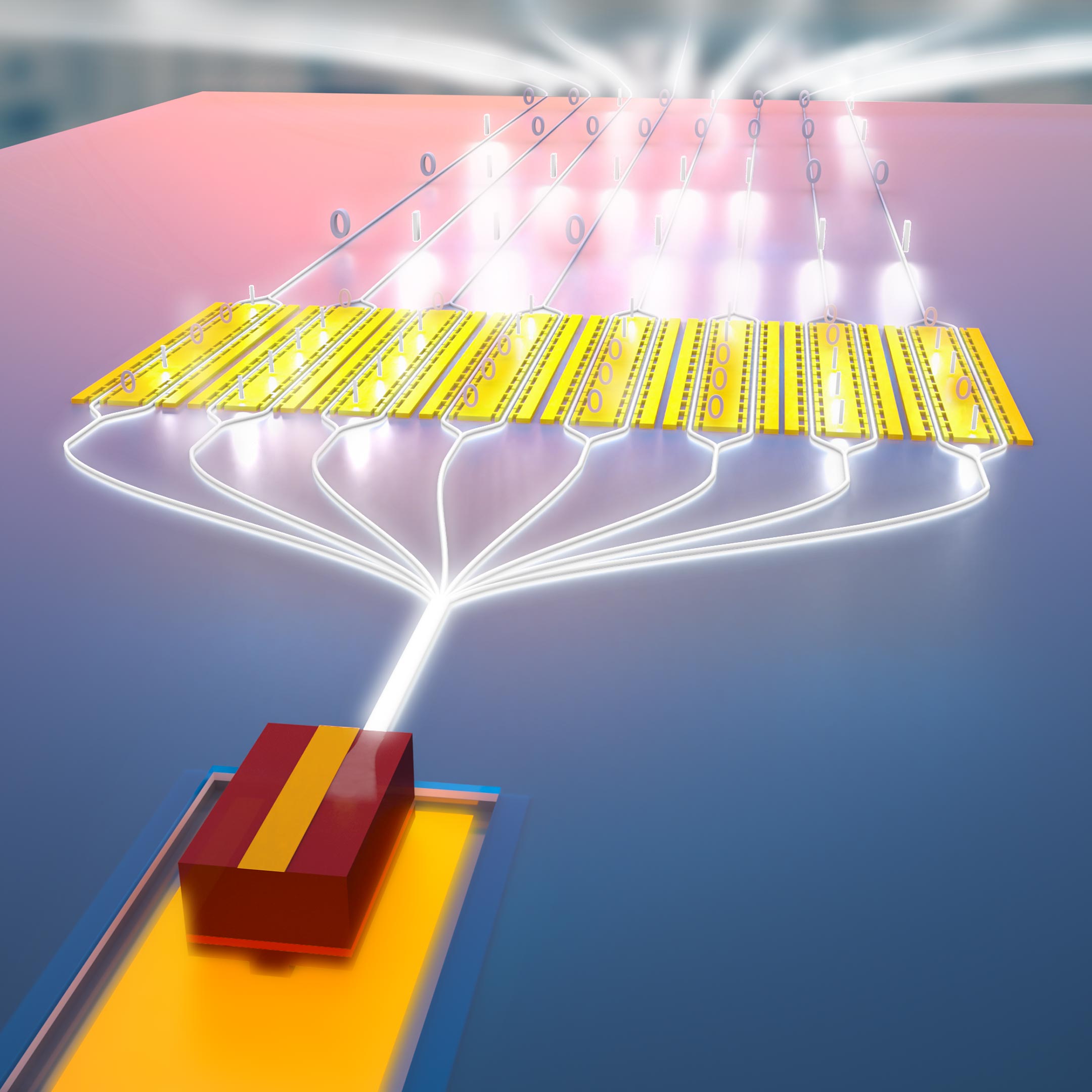
A breakthrough in integrating lasers onto lithium niobate chips could revolutionize optical systems, reducing costs and enhancing scalability.
For all the recent advances in integrated lithium niobate photonic circuits — from frequency combs to frequency converters and modulators — one big component has remained frustratingly difficult to integrate: lasers.
Long haul telecommunication networks, data center optical interconnects, and microwave photonic systems all rely on lasers to generate an optical carrier used in data transmission. In most cases, lasers are stand-alone devices, external to the modulators, making the whole system more expensive and less stable and scalable.
Breakthrough: First Fully Integrated Laser on Lithium Niobate Chip
Now, researchers from the Harvard John A. Paulson School of Engineering and Applied Sciences (SEAS) in collaboration with industry partners at Freedom Photonics and HyperLight Corporation, have developed the first fully integrated high-power laser on a lithium niobate chip, paving the way for high-powered telecommunication systems, fully integrated spectrometers, optical remote sensing, and efficient frequency conversion for quantum networks, among other applications.
“Integrated lithium niobate photonics is a promising platform for the development of high-performance chip-scale optical systems, but getting a laser onto a lithium niobate chip has proved to be one of the biggest design challenges,” said Marko Loncar, the Tiantsai Lin Professor of Electrical Engineering and Applied Physics at SEAS and senior author of the study. “In this research, we used all the nano-fabrication tricks and techniques learned from previous developments in integrated lithium niobate photonics to overcome those challenges and achieve the goal of integrating a high-powered laser on a thin-film lithium niobate platform.”
The research is published in the journal Optica.
Key Technical Innovations in Laser Integration
Loncar and his team used small but powerful distributed feedback lasers for their integrated chip. On chip, the lasers sit in small wells or trenches etched into the lithium niobate and deliver up to 60 milliwatts of optical power in the waveguides fabricated in the same platform. The researchers combined the laser with a 50 gigahertz electro-optic modulator in lithium niobate to build a high-power transmitter.
“Integrating high-performance plug-and-play lasers would significantly reduce the cost, complexity, and power consumption of future communication systems,” said Amirhassan Shams-Ansari, a graduate student at SEAS and first author of the study. “It’s a building block that can be integrated into larger optical systems for a range of applications, in sensing, lidar, and data telecommunications.”
By combining thin-film lithium niobate devices with high-power lasers using an industry-friendly process, this research represents a key step towards large-scale, low-cost, and high-performance transmitter arrays and optical networks. Next, the team aims to increase the laser’s power and scalability for even more applications.
Reference: “Electrically pumped laser transmitter integrated on thin-film lithium niobate” by Amirhassan Shams-Ansari, Dylan Renaud, Rebecca Cheng, Linbo Shao, Lingyan He, Di Zhu, Mengjie Yu, Hannah R. Grant, Leif Johansson, Mian Zhang and Marko Loncar, 6 April 2022, Optica.
DOI: 10.1364/OPTICA.448617
Harvard’s Office of Technology Development has protected the intellectual property arising from the Loncar Lab’s innovations in lithium niobate systems. Loncar is a cofounder of HyperLight Corporation, a startup which was launched to commercialize integrated photonic chips based on certain innovations developed in his lab.
The research was co-authored by Dylan Renaud, Rebecca Cheng, Linbo Shao, Di Zhu, and Mengjie Yu, from SEAS, Hannah R. Grant, Leif Johansson from Freedom Photonics and Lingyan He and Mian Zhang from HyperLight Corporation. It was supported by the Defense Advanced Research Projects Agency under grant HR0011-20-C-0137 and the Air Force Office of Scientific Research under grant FA9550-19-1-0376.
Never miss a breakthrough: Join the SciTechDaily newsletter.
Follow us on Google and Google News.