
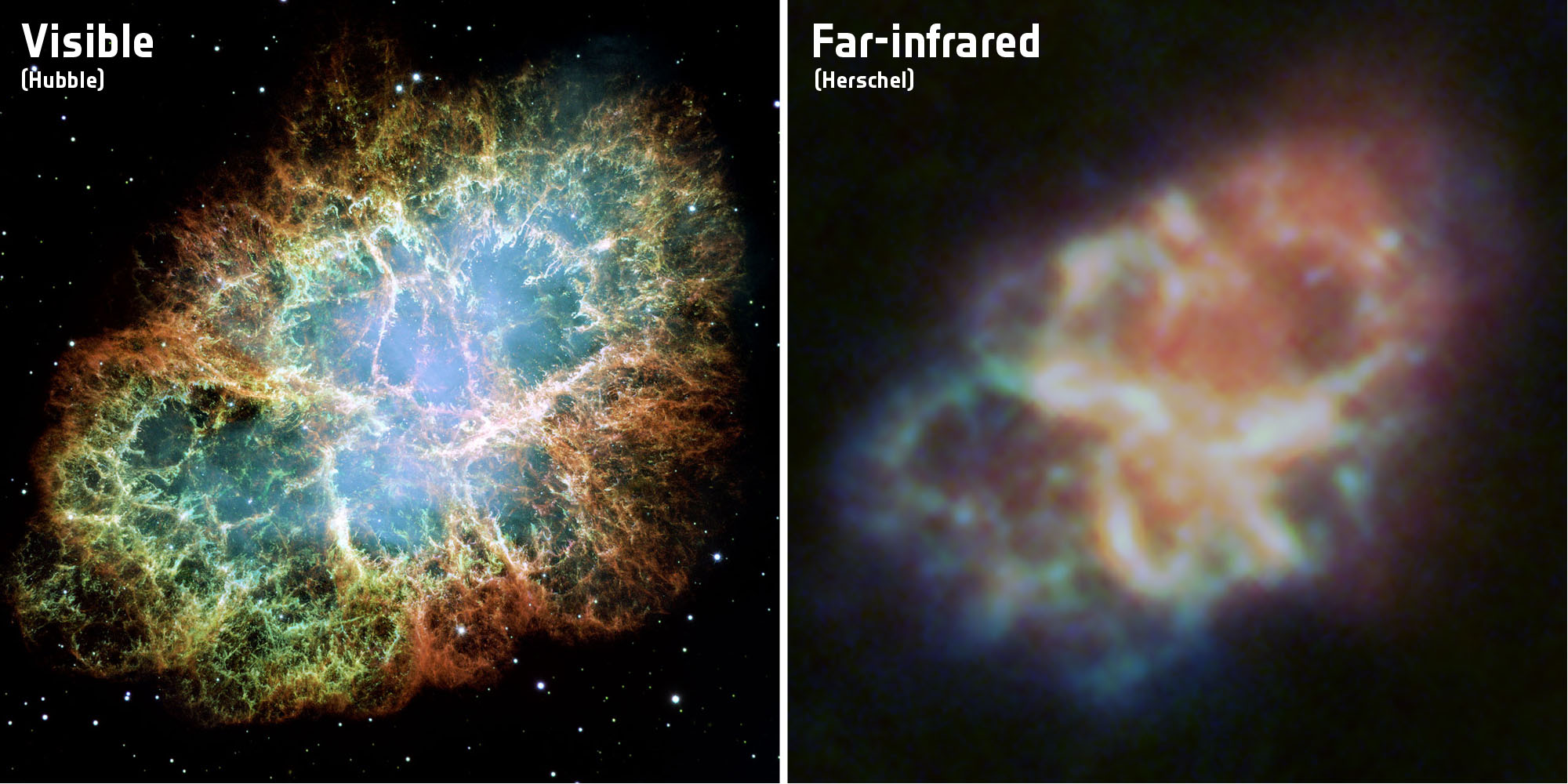
Using the Herschel Space Observatory, a team of astronomers discovered filaments of dust shining in the far-infrared region of the electromagnetic spectrum, providing definitive evidence that the Crab Nebula is an efficient dust factory and contains enough dust to make around 30,000-40,000 planet Earths.
The European Space Agency’s Herschel Space Observatory has produced an intricate view of the remains of a star that died in a stellar explosion a millennium ago. This new view provides further proof that the cosmic dust which lies throughout our Galaxy is created when massive stars reach the end of their lives.
The study, “A Cool Dust Factory in the Crab Nebula: A Herschel Study of the Filaments,” led by Dr. Haley Gomez of the School of Physics and Astronomy focused on the Crab Nebula which lies about six and a half thousand light years away from Earth and is the remnant of a dramatic explosion, called a supernova, originally seen by Chinese Astronomers in 1054 AD. Starting out at 12-15 times more massive than the Sun, all that was left after the dramatic death of the star is a tiny, rapidly rotating neutron star and a complex network of ejected stellar material.
The Crab Nebula is well known for its intricate nature, with beautiful filamentary structures seen at visible wavelengths. Now, for the first time, thanks to Dr. Gomez’s work astronomers can see exquisite filaments of dust shining in the far-infrared region of the electromagnetic spectrum.
After ruling out other sources, Dr. Gomez and a team of astronomers used Herschel’s ability to see in great detail, to show that these filaments are made of cosmic dust, found in the same place that we see the densest clumps of material ejected in the supernova. This provides definitive evidence that the Crab Nebula is an efficient dust factory, containing enough dust to make around 30,000-40,000 planet Earths. The dust may be made of mostly carbon materials, crucial for the formation of planetary systems like our own Solar System.
Previous infrared images of the Crab Nebula, using the Spitzer Space Telescope, used much shorter wavelengths and so only discovered warm dust in the filaments. Spitzer found much smaller amounts, simply because it missed the massive cloud of cool dust. Herschel, observing at longer wavelengths, is able to detect both warm and cool dust, even dust as cold as -240 Celsius, allowing astronomers to measure the total amount of dust for the first time.
Large amounts of cosmic dust have been seen in supernova remnants before, but the Crab Nebula provides the clearest view of what is going on. Unlike many other remnants, there is almost no dusty Galactic material in front of or behind the Crab Nebula, so the image is uncontaminated by material in between the remnant and the Earth. This also allows astronomers to rule out the possibility that the dust was swept up as the shockwave from the explosion expanded throughout the surrounding region.
In many supernova remnants, most of any dust freshly formed is destroyed as it plows into the surrounding gas and dust, crushed by the violent shock waves. A final treat is that the Crab Nebula is a much kinder environment for dust grains, so the dust does not seem to be destroyed. This may be the first observed case of dust being freshly “baked” in a supernova and surviving its outward journey carried along by the shock wave. Dr Gomez commented: “We now have definitive evidence that exploding stars created the raw materials for the first solid particles, the building blocks of rocky planets and life itself, in a blink of an eye.”
Reference: “A Cool Dust Factory in the Crab Nebula: A Herschel Study of the Filaments” by H. L. Gomez, O. Krause, M. J. Barlow, B. M. Swinyard, P. J. Owen, C. J. R. Clark, M. Matsuura, E. L. Gomez, J. Rho, M.-A. Besel, J. Bouwman, W. K. Gear, Th. Henning, R. J. Ivison, E. T. Polehampton and B. Sibthorpe, 6 November 2012, The Astrophysical Journal.
DOI: 10.1088/0004-637X/760/1/96
Never miss a breakthrough: Join the SciTechDaily newsletter.
Follow us on Google and Google News.