
Close Menu
    Facebook X (Twitter) Instagram
    SciTechDaily
    • Biology
    • Chemistry
    • Earth
    • Health
    • Physics
    • Science
    • Space
    • Technology
    Facebook X (Twitter) Pinterest YouTube RSS
    SciTechDaily
    Home»Space»Herschel Views Red Supergiant Star Betelgeuse
    Space

    Herschel Views Red Supergiant Star Betelgeuse

    By European Space AgencyJanuary 23, 20131 Comment3 Mins Read
    Facebook Twitter Pinterest Telegram LinkedIn WhatsApp Email Reddit
    Share
    Facebook Twitter LinkedIn Pinterest Telegram Email Reddit
    red-supergiant-star-Betelgeuse
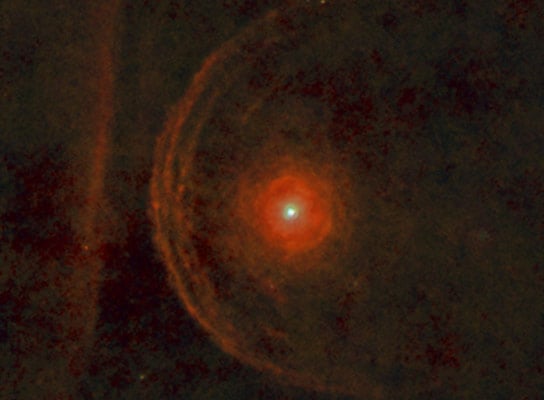
    The red supergiant star Betelgeuse is seen here in a new view from the Herschel Space Observatory, a European Space Agency mission with important NASA participation. Credit: ESA/Herschel/PACS/L. Decin et al.

    This new image from Herschel’s Photodetecting Array Camera and Spectrometer (PACS) shows the red supergiant star Betelgeuse, which is located in the Orion Constellation and appears to be on a collision course with a dusty “wall.”

    Multiple arcs are revealed around Betelgeuse, the nearest red supergiant star to Earth, in this new image from ESA’s Herschel Space Observatory. The star and its arc-shaped shields could collide with an intriguing dusty ‘wall’ in 5,000 years.

    Betelgeuse rides on the shoulder of the constellation Orion the Hunter. It can easily be seen with the naked eye in the northern hemisphere winter night sky as the orange–red star above and to the left of Orion’s famous three-star belt.

    Roughly 1,000 times the diameter of our Sun and shining 100,000 times more brightly, Betelgeuse’s impressive statistics come with a cost. For this star is likely on its way to a spectacular supernova explosion, having already swelled into a red supergiant and shed a significant fraction of its outer layers.

    The new far-infrared view from Herschel shows how the star’s winds are crashing against the surrounding interstellar medium, creating a bow shock as the star moves through space at speeds of around 30 km/s (67,000 mph).

    A series of broken, dusty arcs ahead of the star’s direction of motion testify to a turbulent history of mass loss.

    Closer to the star itself, an inner envelope of material shows a pronounced asymmetric structure. Large convective cells in the star’s outer atmosphere have likely resulted in localized, clumpy ejections of dusty debris at different stages in the past.

    An intriguing linear structure is also seen further away from the star, beyond the dusty arcs. While some earlier theories proposed that this bar was a result of material ejected during a previous stage of stellar evolution, analysis of the new image suggests that it is either a linear filament linked to the Galaxy’s magnetic field, or the edge of a nearby interstellar cloud that is being illuminated by Betelgeuse.

    If the bar is a completely separate object, then taking into account the motion of Betelgeuse and its arcs and the separation between them and the bar, the outermost arc will collide with the bar in just 5,000 years, with the red supergiant star itself hitting the bar roughly 12,500 years later.

    Never miss a breakthrough: Join the SciTechDaily newsletter.
    Follow us on Google and Google News.

    Astronomy Betelgeuse European Space Agency Herschel Space Observatory JPL NASA
    Share. Facebook Twitter Pinterest LinkedIn Email Reddit

    Related Articles

    Euclid’s First Glimpse: Peering Into Dark Matter and the Universe’s Expansion

    A Cosmic Tale of Death & Dust Revealed in Orion Constellation

    Skywatching Highlights You Don’t Want To Miss: Aldebaran, Betelgeuse, Mars, Saturn and Jupiter

    Astronomers Discover Some of the Youngest Stars Ever Seen

    Cassini Detects Particles Being Accelerated to Ultra-High Energies

    New Herschel Images of the Andromeda Galaxy

    Asteroid Apophis Will Make a Record Setting Close Approach to Earth

    Searching for Link Between Star Formation and Black Hole Activity

    New Images of Orion Nebula Show Young Stars Hidden in Gas and Dust Clouds

    1 Comment

    1. Madanagopal.V.C on January 23, 2013 9:46 pm

      The Red Giant Betelguese’s spectacular show presents mostly swelling of the red giant into supernova explosion, which is the reason for the arcs around them. These arcs are probably the cosmic stellar dust thrown by the star tself in the expansion process. The fact that they form an arc shows that they are under the gravity of the star rotating itself. the redness clearly is due to the illumination of dust from the radiating light of red giant. Thank You.

      Reply
    Leave A Reply Cancel Reply

    • Facebook
    • Twitter
    • Pinterest
    • YouTube

    Don't Miss a Discovery

    Subscribe for the Latest in Science & Tech!

    Trending News

    Largest-Ever Study Finds Medicinal Cannabis Ineffective for Anxiety, Depression, PTSD

    250-Million-Year-Old Egg Solves One of Evolution’s Biggest Mysteries

    Living With Roommates Might Be Changing Your Gut Microbiome Without You Knowing

    Century-Old Cleaning Chemical Linked to 500% Increased Risk of Parkinson’s Disease

    What if Your Memories Never Happened? Physicists Take a New Look at the Boltzmann Brain Paradox

    One of the Universe’s Largest Stars May Be Getting Ready To Explode

    Scientists Discover Enzyme That Could Supercharge Ozempic-Like Weight Loss Drugs

    Popular Sweetener Linked to DNA Damage – “It’s Something You Should Not Be Eating”

    Follow SciTechDaily
    • Facebook
    • Twitter
    • YouTube
    • Pinterest
    • Newsletter
    • RSS
    SciTech News
    • Biology News
    • Chemistry News
    • Earth News
    • Health News
    • Physics News
    • Science News
    • Space News
    • Technology News
    Recent Posts
    • Scientists Prove There Are Just Six Degrees of Separation in a Social Network
    • Bee Bacteria Could Fix a Major Flaw in Plant-Based Milk
    • Scientists Discover a Surprising Way To Make Bread Healthier and More Nutritious
    • Natural Compounds Boost Bone Implant Success While Killing Bacteria and Cancer Cells
    • After 60 Years, Scientists Uncover Unexpected Brain Effects of Popular Diabetes Drug Metformin
    Copyright © 1998 - 2026 SciTechDaily. All Rights Reserved.
    • Science News
    • About
    • Contact
    • Editorial Board
    • Privacy Policy
    • Terms of Use

    Type above and press Enter to search. Press Esc to cancel.