
Close Menu
    Facebook X (Twitter) Instagram
    SciTechDaily
    • Biology
    • Chemistry
    • Earth
    • Health
    • Physics
    • Science
    • Space
    • Technology
    Facebook X (Twitter) Pinterest YouTube RSS
    SciTechDaily
    Home»Biology»Periodical Cicadas Manipulate the Populations of Predatory Birds
    Biology

    Periodical Cicadas Manipulate the Populations of Predatory Birds

    By SciTechDailyDecember 27, 2012No Comments3 Mins Read
    Facebook Twitter Pinterest Telegram LinkedIn WhatsApp Email Reddit
    Share
    Facebook Twitter LinkedIn Pinterest Telegram Email Reddit
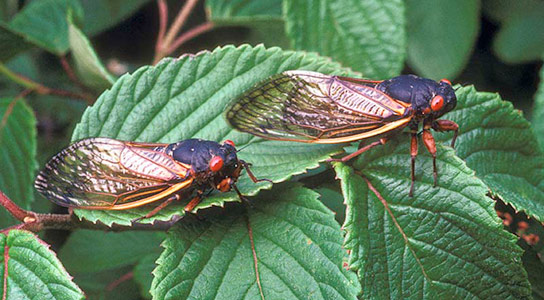
    Periodical cicadas manipulate the populations of birds that eat them
    Periodical cicadas manipulate the populations of birds that eat them. Credit: ARS/USDA

    Periodical cicadas emerge in North America every 13 or 17 years. Scientists think that the cicadas’ cycles are timed to “engineer” the number of predatory birds. The populations of these birds drop significantly the year that cicadas emerge.

    Walt Koenig, a behavioral ecologist at Cornell University and the lead author of the paper, published the findings in the journal The American Naturalist¹. American colonists first reported this strange behavior in the mid-1600s. All of the periodical cicadas species follow the same basic life cycle, living underground as nymphs for 13 or 17 years, and then emerging en masse in great numbers in the summer.

    The cicadas crawl up trees, shed their skin, and become glass-winged adults for a few weeks, that mate and lay eggs. After the eggs hatch, the nymphs once again descend into the ground. In the early 20th century, researchers had shown that avian predators could wipe out an entire population of cicadas that emerge out of sequence; so the scientists took a look at how bird populations might affect the insect cycles in this new study.

    15 bird species were targeted, including yellow-billed cuckoos, red-headed woodpeckers, and house sparrows. All of these species eat cicadas. The analysis showed that the birds’ populations reached their lowest point in the year that the insects emerged. This suggests that avian predators aren’t exerting much pressure on the cicadas. 12 years after the cicadas emerged, the birds went into decline, eventually reaching their lowest point at year 17, just as the cicadas were emerging again.

    The birds feeding on the 13-year-cycle cicadas followed a similar path. Their numbers also reached their lowest point at the time of emergence, and began to increase immediately after the cicadas appeared. “The cicadas are driving the birds’ populations; they’re setting the birds on a trajectory that leads to significantly lower populations at the time of the next emergence,” Koenig says. The timing of the cicadas’ cycles is all about manipulating their predators—and “may have nothing to do with these being prime numbers,” he emphasizes.

    The biomass of cicadas has an enormous effect on the environment, enriching everything from soils, trees, and birds. The aftermath of these emergences lasts longer than suspected. Avian predation has long been recognized as a factor in these cycles and Koenig suggests a way for it to work together with other ecological factors to produce the synchronized and long 13- and 17-year life cycles.

    The scientists still don’t have a good theory why the cicadas’ resource pulse causes the birds’ populations to reach their low point exactly at 13 and 17 years.

    Reference: “Avian Predation Pressure as a Potential Driver of Periodical Cicada Cycle Length” by Walter D. Koenig and Andrew M. Liebhold, 27 November  2012, The American Naturalist.
    DOI: 10.1086/668596

    Never miss a breakthrough: Join the SciTechDaily newsletter.
    Follow us on Google and Google News.

    Ecology Entomology Evolutionary Biology Wildlife
    Share. Facebook Twitter Pinterest LinkedIn Email Reddit

    Related Articles

    New Research Questions a Textbook Theory of How Insect Societies Evolve

    New Research Deciphers the Complex Diet of Desert Isopods

    Genetic Analysis Reveals New Family Tree for Ray-Finned Fish

    Insects Help Scientists Understand the Predictability of Evolution

    Extinctions Due to Habitat Loss are Proportional to the Area Destroyed

    Evolution Shapes Ecology of Dammed Connecticut Lakes

    Leaf Vein Architecture Allows Predictions of Past Climate

    Study Finds “Rare” Genetic Variants Aren’t So Rare

    “Map of Life” to Illustrate All Living Things Geographically

    Leave A Reply Cancel Reply

    • Facebook
    • Twitter
    • Pinterest
    • YouTube

    Don't Miss a Discovery

    Subscribe for the Latest in Science & Tech!

    Trending News

    A Hidden Sugar in Red Meat Linked to a 63% Higher Risk of Diabetes

    Something Strange Is Happening Beneath Nicaragua’s Masaya Volcano

    Scientists Discover Aspirin May Slash Dementia Risk by 70% – but Only for Certain People

    The World’s Oldest Land Animal Has a Remarkable Anti-Aging Secret Hidden in Its DNA

    Scientists Discover a Surprising Link Between Obesity and Dementia Survival

    The Fossil Record May Be Missing 200 Million Years of Animal History

    Scientists Predicted Humanity Would End on November 13, 2026. Should We Be Worried?

    Experimental Heart Drug Helps Patients Exercise More and Feel Better

    Follow SciTechDaily
    • Facebook
    • Twitter
    • YouTube
    • Pinterest
    • Newsletter
    • RSS
    SciTech News
    • Biology News
    • Chemistry News
    • Earth News
    • Health News
    • Physics News
    • Science News
    • Space News
    • Technology News
    Recent Posts
    • This “Lightsaber” Beam Is Actually a Working Radio Antenna
    • Webb Discovers Something Extraordinary in the Clouds of a World With No Sun
    • Scientists Discover a Surprising Shortcut to Nuclear Fusion
    • Vanilla’s Sweet Secret Could Help Heal Stubborn Wounds
    • Scientists Uncover a Longevity Hotspot Where Reaching 100 Is Surprisingly Common
    Copyright © 1998 - 2026 SciTechDaily. All Rights Reserved.
    • Science News
    • About
    • Contact
    • Editorial Board
    • Privacy Policy
    • Terms of Use

    Type above and press Enter to search. Press Esc to cancel.