
Close Menu
    Facebook X (Twitter) Instagram
    SciTechDaily
    • Biology
    • Chemistry
    • Earth
    • Health
    • Physics
    • Science
    • Space
    • Technology
    Facebook X (Twitter) Pinterest YouTube RSS
    SciTechDaily
    Home»Space»New Model Advances the Understanding of How Solar Wind Works
    Space

    New Model Advances the Understanding of How Solar Wind Works

    By Harvard-Smithsonian Center for AstrophysicsMarch 18, 20133 Comments2 Mins Read
    Facebook Twitter Pinterest Telegram LinkedIn WhatsApp Email Reddit
    Share
    Facebook Twitter LinkedIn Pinterest Telegram Email Reddit
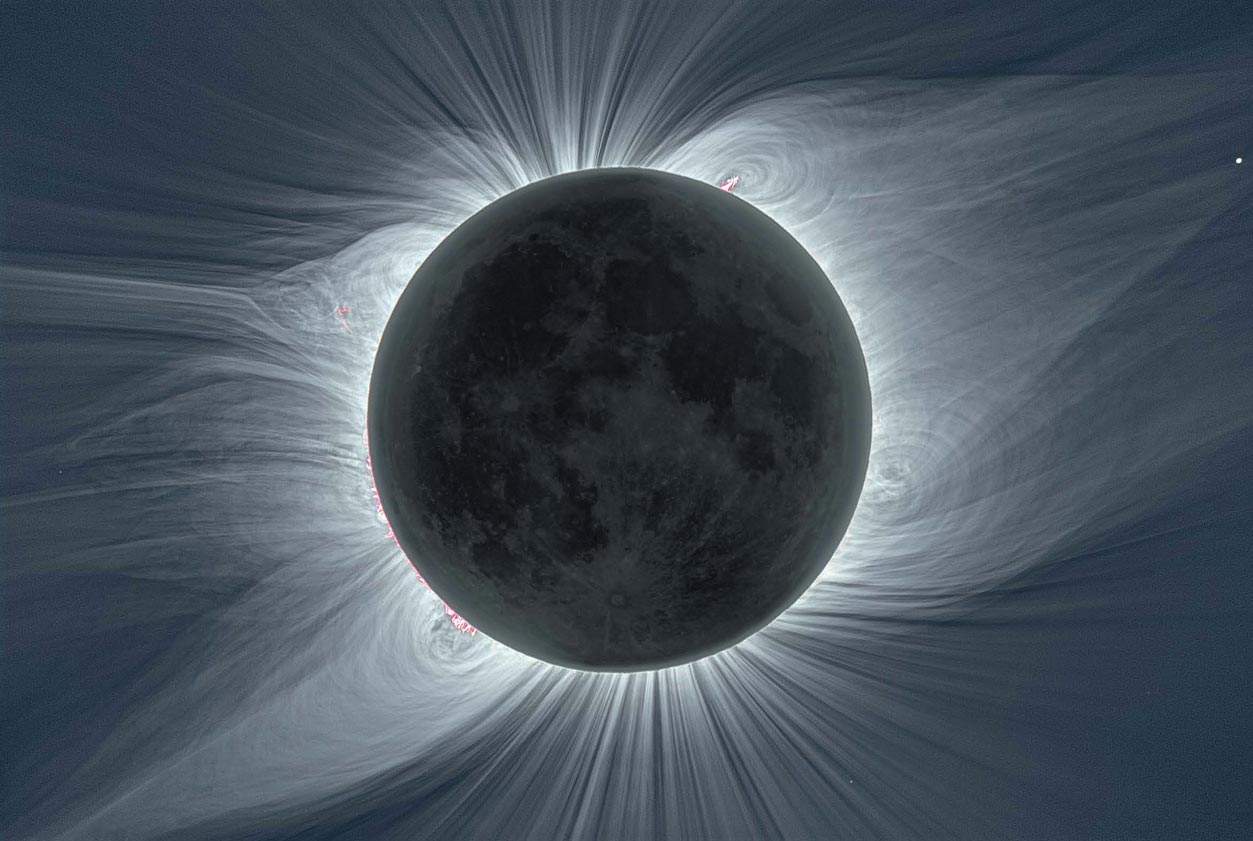
    Solar Corona During Total Solar Eclipse
    The solar corona viewed in white light during a total solar eclipse. A new paper presents a model that is able to explain previously puzzling aspects of the coronal wind. Credit: American Astronomical Society (AAS)

    A newly published study uses a new model to demonstrate ion-cyclotron resonant heating in solar wind; representing a major advance in the understanding of how solar wind works.

    The Sun glows with a surface temperature of about 5,500 degrees Celsius (9,900 degrees Fahrenheit). Meanwhile, its hot outer layer (the corona) has a temperature of over a million degrees, and ejects a wind of charged particles at a rate equivalent to about one-millionth of the moon’s mass each year. Some of these wind particles bombard the Earth, producing radio static, auroral glows, and (in extreme cases) disrupted global communications.

    There are two important, longstanding, and related questions about the corona that astronomers are working to answer: how is it heated to temperatures that are so much hotter than the surface? And how does the corona produce the wind? A related puzzle of the solar wind is why certain of its ions are hotter than others; one might naively expect uniform heating of the gas, but the temperature of helium ions, for example, is on average five times higher than that of the much lighter mass hydrogen ions.

    The answers to these questions appear to involve turbulence and magnetic fields in the Sun’s atmosphere. Writing in the latest issue of Physical Review Letters, CfA astronomers Justin Kasper and Michael Stevens, with their collaborators, present a new model that demonstrates how waves in the hot ionized gas, called “cyclotron waves,” will heat the gas, and do so preferentially for heavier ions. These waves correspond to oscillations in the circular motion of ions as they twist around the magnetic fields present. The new model explains how energy from these waves is transferred to the particles, thereby heating them. The astronomers were able to use their new model to explain successfully the measured ion temperatures over 17 years of data accumulated from the Wind spacecraft. The new results represent a major advance in our understanding of how the solar wind works.

    Reference: “Sensitive Test for Ion-Cyclotron Resonant Heating in the Solar Wind” by Justin C. Kasper, Bennett A. Maruca, Michael L. Stevens and Arnaud Zaslavsky, 28 February 2013, Physical Review Letters.
    DOI:10.1103/PhysRevLett.110.091102

    Never miss a breakthrough: Join the SciTechDaily newsletter.
    Follow us on Google and Google News.

    Astronomy Astrophysics Harvard-Smithsonian Center for Astrophysics Solar Wind Space Weather Sun
    Share. Facebook Twitter Pinterest LinkedIn Email Reddit

    Related Articles

    Satellites at Risk? New AI Predicts Space Weather With Breakthrough Accuracy

    New Simulations of Magnetic Reconnection in the Sun

    New Research Helps Explain Why the Sun’s Magnetic Field Reverses Every Eleven Years

    VLA Provides New Insights into Solar Flares

    Small-Scale Jets from the Solar Chromosphere Are Possible Sources of the Solar Wind

    NASA Spacecraft Observe Magnetic Reconnection in Action

    Sun’s Loops are Tapered, Wider at the Top and Narrower at the Ends

    New Observations Help Astronomers Learn How Young Stars Accrete Material and Grow

    TW Hydrae Provides Insight About the Birth of Our Sun

    3 Comments

    1. katesisco on March 18, 2013 1:38 pm

      Ions twisting in the magnetic field creates the waves that heat the gas, preferentially heavy ones.
      And the ions in the magnetic field are twisting why?

      Reply
    2. katesisco on March 18, 2013 1:46 pm

      From 1999: this may be why?
      For plasmas immersed in strong magnetic fields, electric currents tend to flow along the magnetic field lines, which act like wires guiding the current. The field-aligned current creates its own magnetic field, and, when added to the original magnetic field, results in a twisted or helical magnetic field.

      If two such helical magnetic fields happen to be beside each other, like two barber poles lying side by side, there is a sudden change in magnetic field angle at the interface, just like the sudden change in stripe direction in going from one barber pole to its neighbor.

      Reply
      • David Sussman on March 25, 2013 9:58 am

        Sounds like that dude in Connecticut. Whose wife has been beaten him lately. He’s got a 235 IQ…

        Reply
    Leave A Reply Cancel Reply

    • Facebook
    • Twitter
    • Pinterest
    • YouTube

    Don't Miss a Discovery

    Subscribe for the Latest in Science & Tech!

    Trending News

    JWST Finds a “Star” 100 Billion Times Brighter Than Any Star Should Be

    Scientists Find a Hidden Biological Link Across Different Forms of Autism

    Astronomers Discover a Ghostly River of Stars That Could Reveal Dark Matter

    Why Is Colorectal Cancer Rising in People Under 50? New Clues Point to the Environment

    Quantum Fluctuations Break a Crystal’s Symmetry Rules

    Why Does an Irregular Heartbeat Strike 40 Years Early in Some People?

    Scientists Reveal How ADHD Could Fuel Creative Thinking

    Scientists Find Just 3 Minutes of Sprinting Can Transform Blood Chemistry

    Follow SciTechDaily
    • Facebook
    • Twitter
    • YouTube
    • Pinterest
    • Newsletter
    • RSS
    SciTech News
    • Biology News
    • Chemistry News
    • Earth News
    • Health News
    • Physics News
    • Science News
    • Space News
    • Technology News
    Recent Posts
    • Cleaner Cars May Be Hiding a New Pollution Problem
    • Common Plant Chemical Linked to Widespread Organ Damage in Aquatic Animals
    • Scientists Discover a Hidden Baobab Species in Madagascar
    • Dogs and Humans May Share a Surprising Biological Secret to Longevity
    • A 150-Million-Year-Old Dinosaur Flight Mystery May Finally Have an Answer
    Copyright © 1998 - 2026 SciTechDaily. All Rights Reserved.
    • Science News
    • About
    • Contact
    • Editorial Board
    • Privacy Policy
    • Terms of Use

    Type above and press Enter to search. Press Esc to cancel.