
Close Menu
    Facebook X (Twitter) Instagram
    SciTechDaily
    • Biology
    • Chemistry
    • Earth
    • Health
    • Physics
    • Science
    • Space
    • Technology
    Facebook X (Twitter) Pinterest YouTube RSS
    SciTechDaily
    Home»Space»Chaotic Crust Contains Clues to Mars’ Watery Past in Search for Signs of Past Life on the Red Planet
    Space

    Chaotic Crust Contains Clues to Mars’ Watery Past in Search for Signs of Past Life on the Red Planet

    By European Space Agency (ESA)October 27, 2022No Comments7 Mins Read
    Facebook Twitter Pinterest Telegram LinkedIn WhatsApp Email Reddit
    Share
    Facebook Twitter LinkedIn Pinterest Telegram Email Reddit
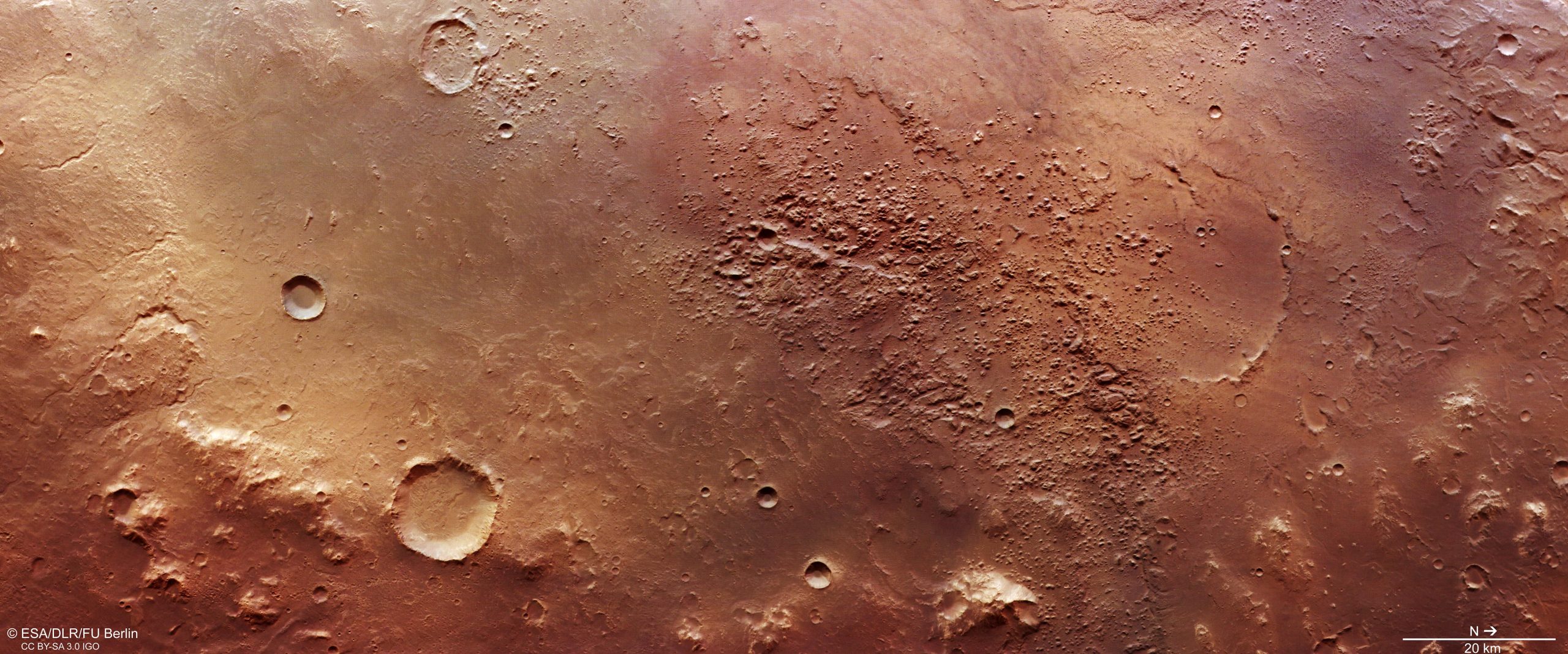
    Holden Basin on Mars
    Holden Basin on Mars. This image from ESA’s Mars Express shows a portion of the Uzboi-Ladon-Morava (ULM) outflow system, which may have once drained up to 9% of the Martian surface. This image comprises data gathered by Mars Express’ High Resolution Stereo Camera (HRSC) on April 24, 2022. It was created using data from the nadir channel, the field of view aligned perpendicular to the surface of Mars, and the color channels of the HRSC. It is a ‘true color’ image, reflecting what would be seen by the human eye if looking at this region of Mars. The image is centered at about 329°E/25°S. North is to the right. Credit: ESA/DLR/FU Berlin, CC BY-SA 3.0 IGO

    ESA’s Mars Express spacecraft takes us over the Holden Basin – part of a region that is a high-ranking target in the search for signs of past life on the Red Planet. This image was taken by the spacecraft’s High Resolution Stereo Camera (HRSC) on April 24, 2022.

    A Barren Landscape Shaped by Water

    The Holden Basin* is part of a series of channels and sinks called the Uzboi-Ladon-Morava (ULM) outflow system. This may have once drained up to 9% of the Martian surface. The ULM outflow system is a fascinating subject for Mars orbiters and rovers to investigate in further detail due to its complicated history.
    Holden Basin in Context
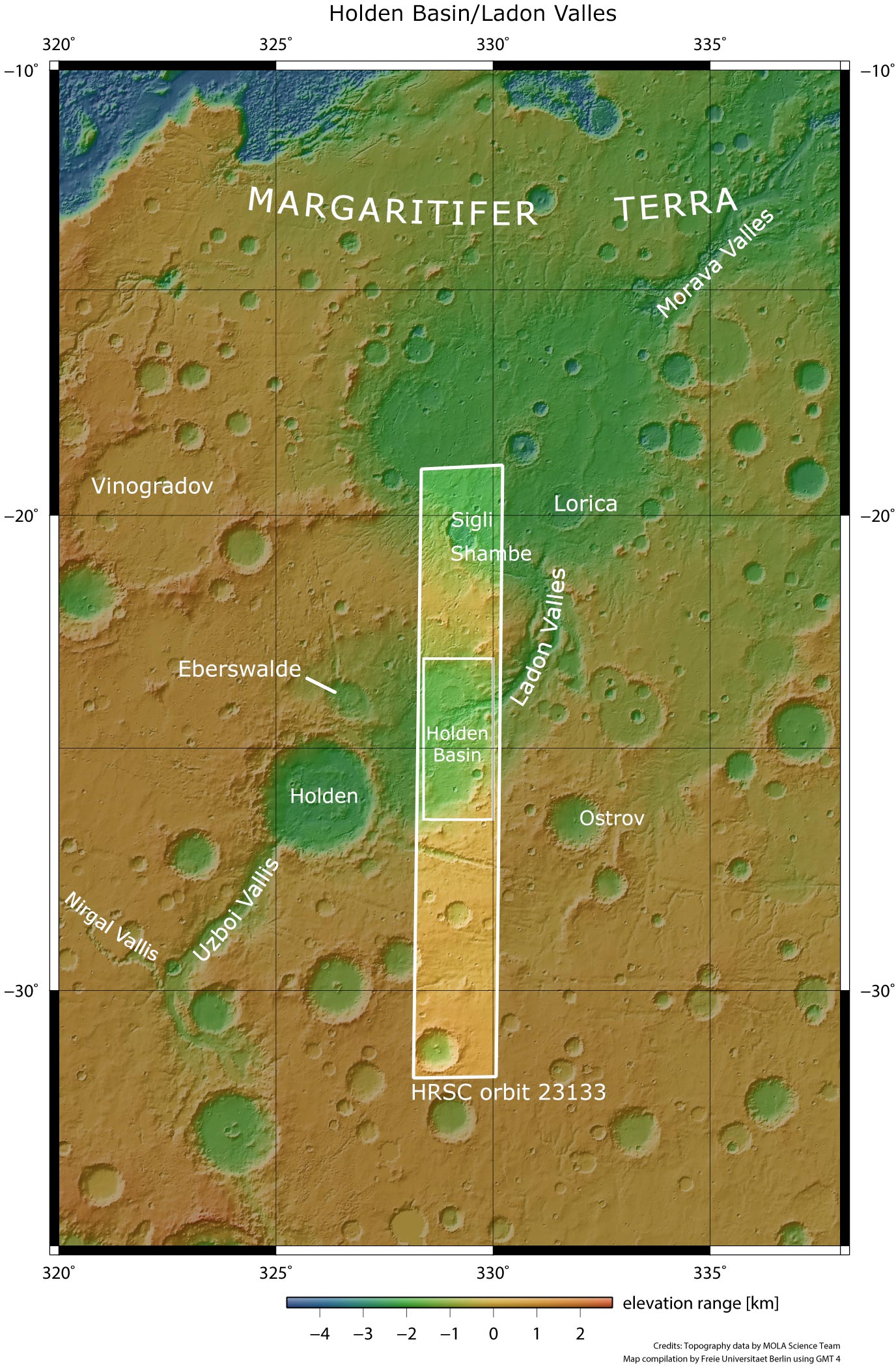
    Holden Basin in context. This image from ESA’s Mars Express shows the informally named Holden Basin, which formed part of Mars’ Uzboi-Ladon-Morava (ULM) outflow system. The area outlined by the bold white box indicates the area imaged by the Mars Express HRSC on April 24, 2022, during orbit 23133. Credit: ESA/DLR/FU Berlin, CC BY-SA 3.0 IGO

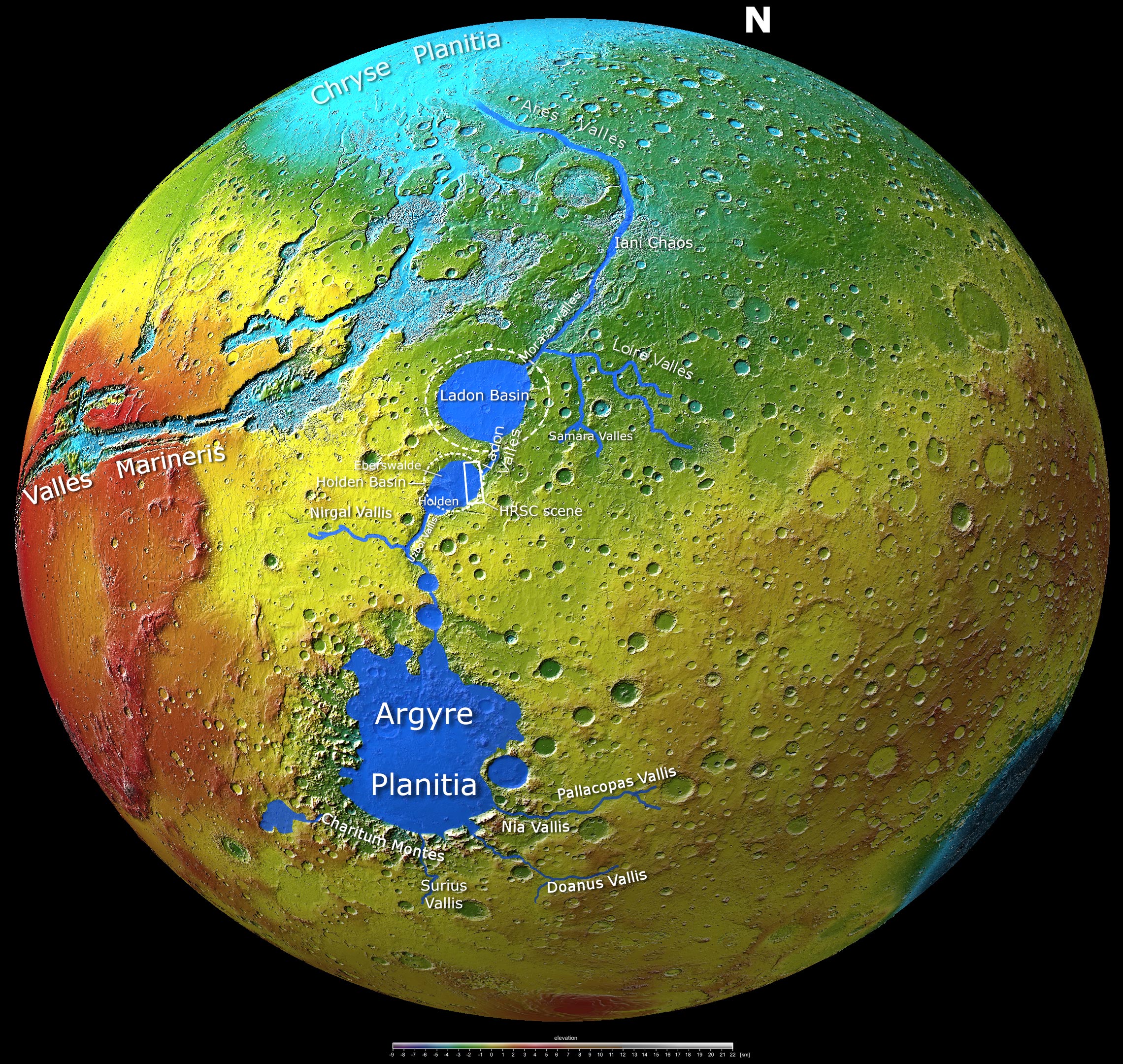
    In the maps above and directly below, we see the Holden Basin and the full ULM outflow system in context. The solid royal blue color in the map below shows how water once flowed across this region of Mars; it would have started in channels that drain into the Argyre Planitia, then flowed through Uzboi Vallis into the location now scarred by the Holden Crater. From there it would have collected in the Holden Basin before streaming through Ladon Valles to Ladon Basin and beyond.

    The map below also shows Mars’ ‘Grand Canyon’ Valles Marineris, which we delved into in our previous Mars Express image release. Iani Chaos, another chaotic area that we have explored in detail, is visible toward the top of the image.
    ULM Outflow System in Context
    Uzboi-Ladon-Morava (ULM) outflow system in context. This image was created using data from the Mars Orbiter Laser Altimeter (MOLA) instrument on NASA’s Mars Global Surveyor mission. It shows the complete Uzboi-Ladon-Morava (ULM) outflow system. The area outlined by the bold white box indicates part of the Holden Basin, which was imaged by the Mars Express HRSC on April 24, 2022, during orbit 23133. The dashed circles depict the informally named Holden and Ladon Basins. Credit: MOLA Science Team/FU Berlin, CC BY-SA 3.0 IGO

    A Closer Look at Holden Basin

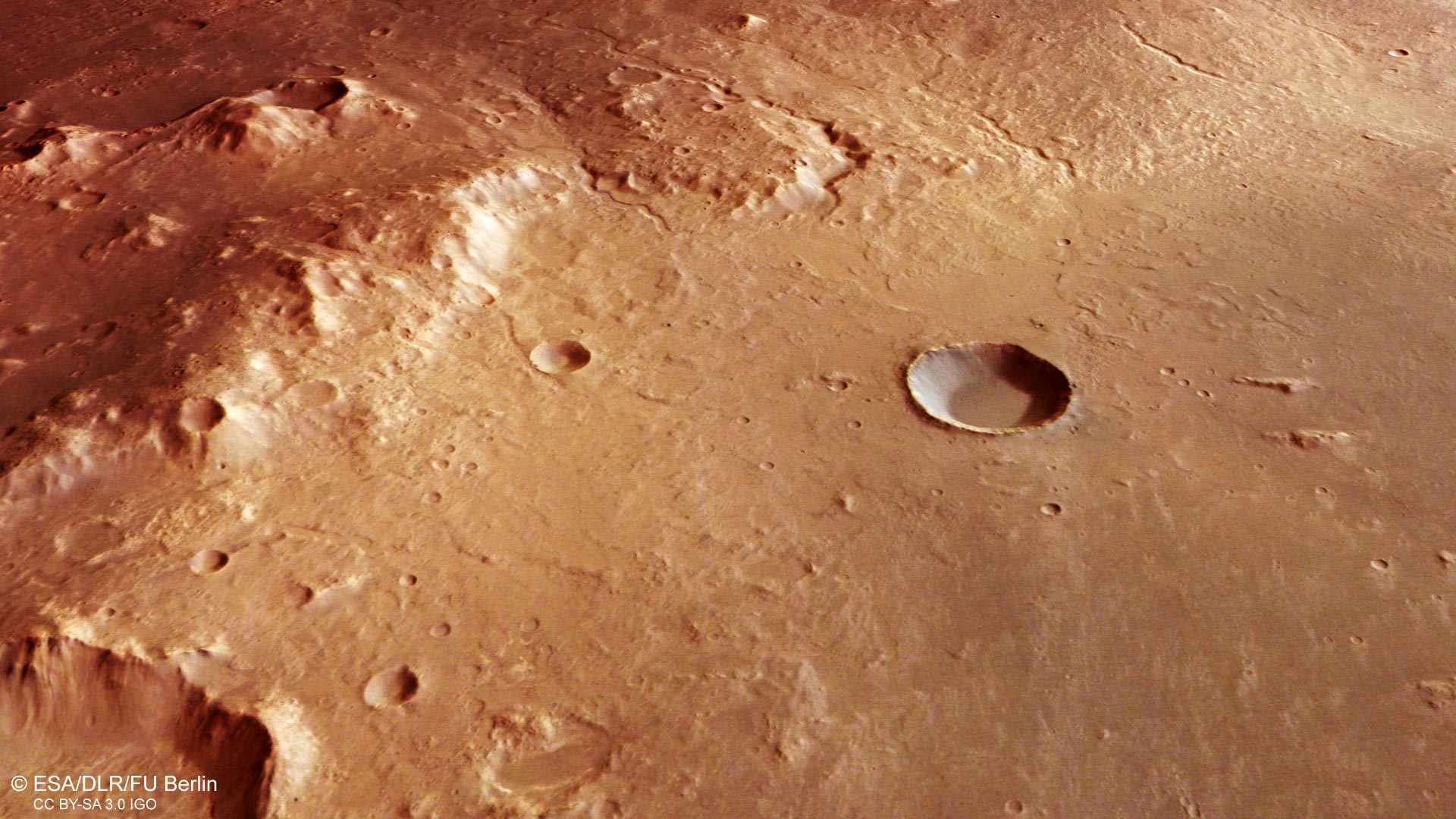
    The images below show close-ups of the Holden Basin from inside the once water-filled reservoir.

    The first image is from the south of the Holden Basin (the left side of the main image at the top of this page). It shows a distinct crater and the basin walls, which slope gently down to around 1500 meters (5,000 feet) below the level of the surrounding ground.
    Perspective View of Holden Basin
    Perspective view of Holden Basin. This oblique perspective view of part of Mars’ informally named Holden Basin was generated from the digital terrain model and the nadir and color channels of the HRSC on ESA’s Mars Express. Credit: ESA/DLR/FU Berlin, CC BY-SA 3.0 IGO

    The second image is from the northeast of the Holden Basin (the bottom right of the main image). It takes a closer look at the location where water would have flowed from Holden Basin to Ladon Valles. The bumps in the rough terrain were formed when water ice under the surface of Mars melted.
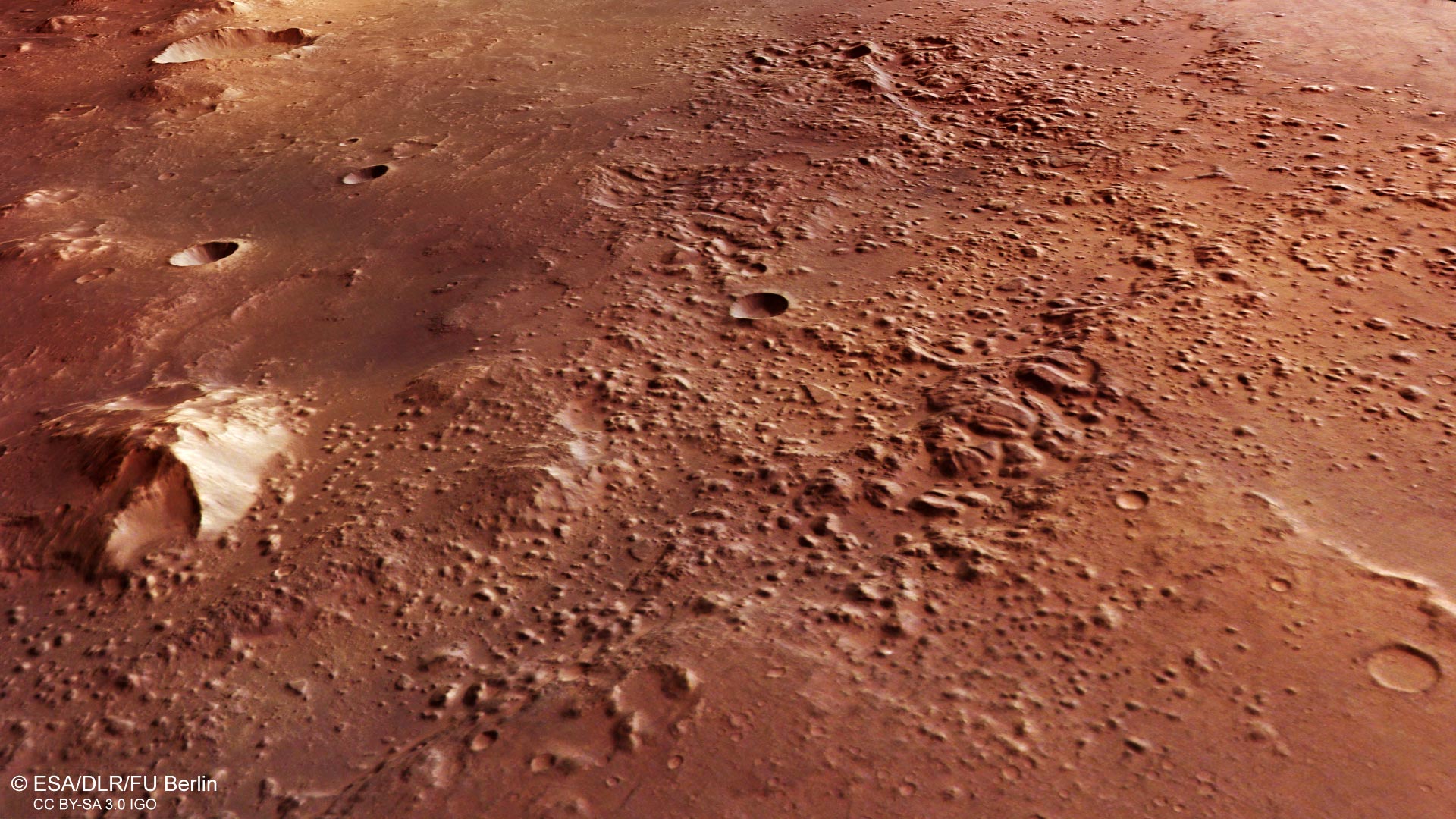
    Perspective View From Holden Basin
    Perspective view of Holden Basin. This oblique perspective view of part of Mars’ informally named Holden Basin was generated from the digital terrain model and the nadir and color channels of the HRSC on ESA’s Mars Express. Credit: ESA/DLR/FU Berlin, CC BY-SA 3.0 IGO

    High-Ranking Target in the Search for Life

    The entire region could be an interesting target in the search for ancient life on Mars. Our experience on Earth tells us that where there is water, there is life: could the same have been true billions of years ago on Mars?

    Ladon Valles and Holden Crater – both of which lie just outside the imaged area, and can be seen in the images showing the broader region – may be particularly interesting as they contain layered and phyllosilicate-bearing deposits. Phyllosilicates are a type of mineral also found on Earth, with one example being clay. They could serve as a reaction center for organic molecules, which make up all living things on Earth; past experiments suggest that phyllosilicates could have played a role in the origin of life.

    Topography of Holden Basin
    Topography of Holden Basin. This color-coded topographic image shows Holden Basin, which forms part of Mars’ Uzboi-Ladon-Morava (ULM) outflow system. It was created from data collected by ESA’s Mars Express on April 24, 2022. It is based on a digital terrain model of the region, from which the topography of the landscape can be derived. Lower parts of the surface are shown in blues and purples, while higher altitude regions show up in whites and reds, as indicated on the scale to the top right. North is to the right. The image is centered at about 329°E/25°S. Credit: ESA/DLR/FU Berlin, CC BY-SA 3.0 IGO

    The 140-km (85-mile) wide Holder Crater formed when Mars was hit by a space rock; the material that was ejected during the impact filled Holden Basin, which is itself a much older impact crater. As the crater shows no evidence that significant amounts of water flowed through it, it very likely formed after the ULM system had mostly dried out. Due to its interesting geology and potential for clues to past life, Holden Crater was on the shortlist of landing sites for NASA’s Mars Science Laboratory and Perseverance rover.

    Exploring Mars

    Mars Express has been orbiting the Red Planet since 2003, imaging Mars’ surface, mapping its minerals, identifying the composition and circulation of its tenuous atmosphere, probing beneath its crust, and exploring how various phenomena interact in the martian environment.
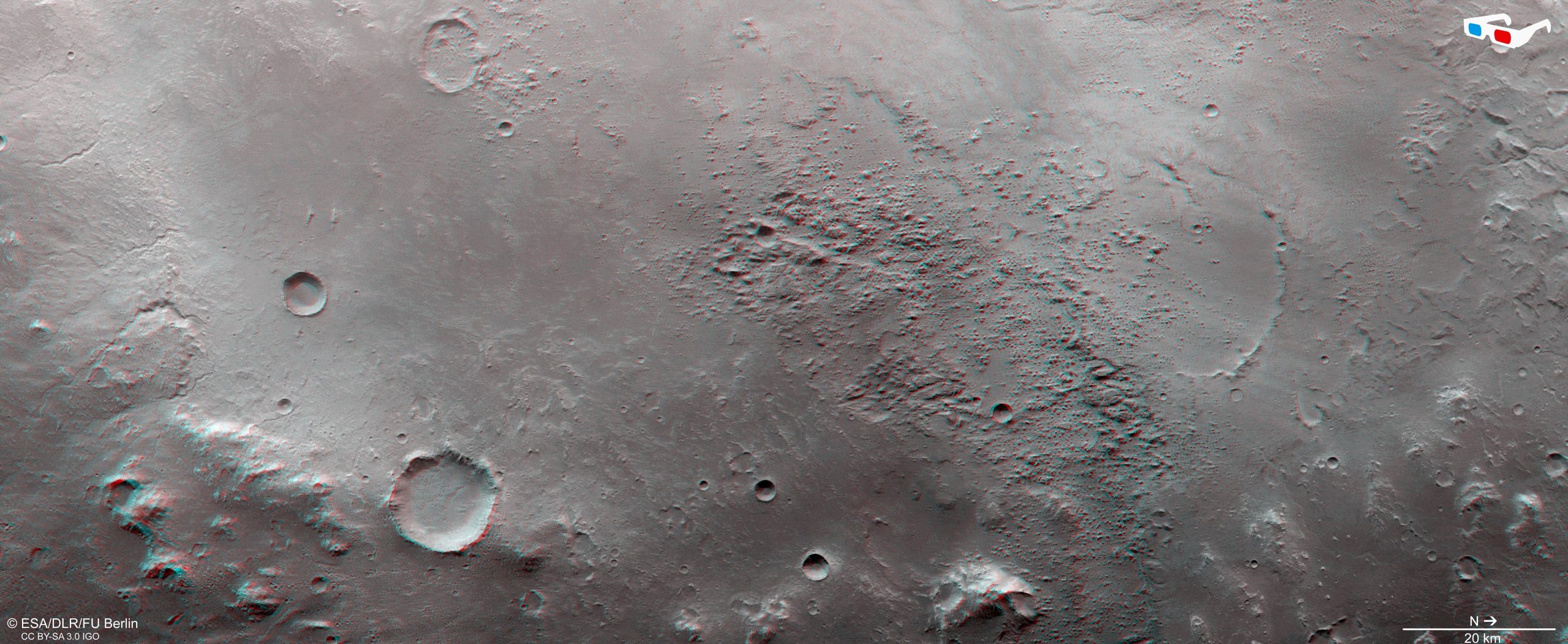
    Holden Basin in 3D
    Holden Basin in 3D. This stereoscopic image shows the informally named Holden Basin, which forms part of Mars’ Uzboi-Ladon-Morava (ULM) outflow system. It was generated from data captured by the High Resolution Stereo Camera (HRSC) on ESA’s Mars Express orbiter on April 24, 2022, during orbit 23133. The anaglyph, derived from data acquired by the nadir channel and one stereo channel of the HRSC, offers a three-dimensional view when viewed using red-green or red-blue glasses. Credit: ESA/DLR/FU Berlin, CC BY-SA 3.0 IGO

    The mission’s High Resolution Stereo Camera (HRSC), responsible for these new images, has revealed much about Mars’ diverse surface features, with recent images showing everything from wind-sculpted ridges and grooves and brain terrain to monstrous “claw mark” scratches, impact craters and channels that once carried liquid water, and volcanoes, tectonic faults, river channels, and ancient lava pools.

    * The names Holden Basin and Ladon Basin are not officially recognized by the International Astronomical Union.

    Never miss a breakthrough: Join the SciTechDaily newsletter.
    Follow us on Google and Google News.

    European Space Agency Mars Mars Express Planets Popular
    Share. Facebook Twitter Pinterest LinkedIn Email Reddit

    Related Articles

    A Snaking Scar Across Mars: The Mystery of Aganippe Fossa

    Mars Express Discovers Mysterious Martian “Spiders”

    Mars Express Reveals Hidden Ice Reserves at Mars’s Equator

    Mars As Never Seen Before: ESA’s Mars Express New Global Color Mosaic

    The Odyssey of Mars Express: Charting Two Decades of Red Planet Exploration

    Mars’ Mega Volcano: A Tour of Ascraeus Mons’ Rugged Terrain

    The “Grandest Canyon” in the Solar System: Mars Express Captures Stunning Images of Massive Martian Canyon

    Martian Brain Freeze: Mars Express Reveals Utopia Planitia

    Intriguing Martian Scars: An Ancient Crater Triplet on Mars

    Leave A Reply Cancel Reply

    • Facebook
    • Twitter
    • Pinterest
    • YouTube

    Don't Miss a Discovery

    Subscribe for the Latest in Science & Tech!

    Trending News

    Scientists Warn That This Common Pet Fish Can Wreck Entire Ecosystems

    Scientists Make Breakthrough in Turning Plastic Trash Into Clean Fuel Using Sunlight

    This Popular Supplement May Interfere With Cancer Treatment, Scientists Warn

    Scientists Finally Solved One of Water’s Biggest Mysteries

    Could This New Weight-Loss Pill Disrupt the Entire Market? Here’s What You Should Know About Orforglipron

    Earth’s Crust Is Tearing Open in Africa, and It Could Form a New Ocean

    Breakthrough Bowel Cancer Trial Leaves Patients Cancer-Free for Nearly 3 Years

    Natural Compound Shows Powerful Potential Against Rheumatoid Arthritis

    Follow SciTechDaily
    • Facebook
    • Twitter
    • YouTube
    • Pinterest
    • Newsletter
    • RSS
    SciTech News
    • Biology News
    • Chemistry News
    • Earth News
    • Health News
    • Physics News
    • Science News
    • Space News
    • Technology News
    Recent Posts
    • Ancient Roman Ship Coating Reveals Secrets Hidden for 2,200 Years
    • Enormous Prehistoric Insects Puzzle Scientists
    • College Student Identifies Bizarre New Carnivorous Dinosaur Three Times Older Than T. rex
    • The Most Effective Knee Arthritis Treatments Aren’t What You Expect
    • Scientists Develop Bioengineered Chewing Gum That Could Help Fight Oral Cancer
    Copyright © 1998 - 2026 SciTechDaily. All Rights Reserved.
    • Science News
    • About
    • Contact
    • Editorial Board
    • Privacy Policy
    • Terms of Use

    Type above and press Enter to search. Press Esc to cancel.