
Close Menu
    Facebook X (Twitter) Instagram
    SciTechDaily
    • Biology
    • Chemistry
    • Earth
    • Health
    • Physics
    • Science
    • Space
    • Technology
    Facebook X (Twitter) Pinterest YouTube RSS
    SciTechDaily
    Home»Space»Martian Brain Freeze: Mars Express Reveals Utopia Planitia
    Space

    Martian Brain Freeze: Mars Express Reveals Utopia Planitia

    By European Space Agency (ESA)March 30, 20221 Comment6 Mins Read
    Facebook Twitter Pinterest Telegram LinkedIn WhatsApp Email Reddit
    Share
    Facebook Twitter LinkedIn Pinterest Telegram Email Reddit
    Utopia Planitia on Mars
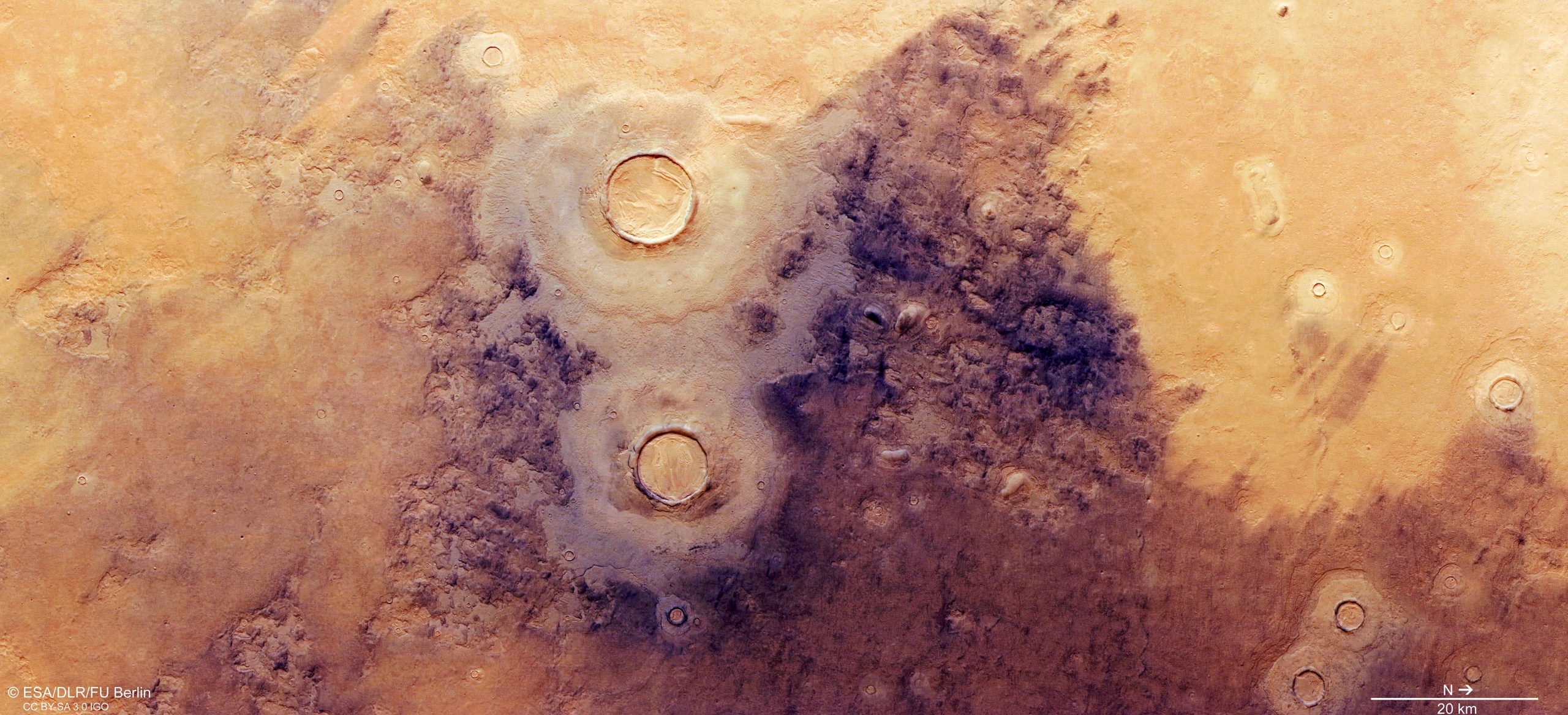
    This image from ESA’s Mars Express shows Utopia Planitia, a plain that fills one of three major basins in the northern hemisphere of Mars – Utopia – and has a diameter of 3,300 km. This image comprises data gathered by Mars Express’ High Resolution Stereo Camera (HRSC) on July 12, 2021. Credit: ESA/DLR/FU Berlin, CC BY-SA 3.0 IGO

    New views from ESA’s Mars Express reveal fascinating ice-related features in Mars’ Utopia region – home to the largest known impact basin not only on the Red Planet, but in the Solar System.

    Utopia is one of three major basins in Mars’ northern hemisphere (along with Acidalia and Arcadia) and has a diameter of roughly 3,300 km (2,100 miles): just under twice the north-south size of Earth’s Sahara Desert.

    This image shows a slice of Utopia Planitia, the plain that fills this colossal and ancient basin.
    Utopia Planitia Mars Map
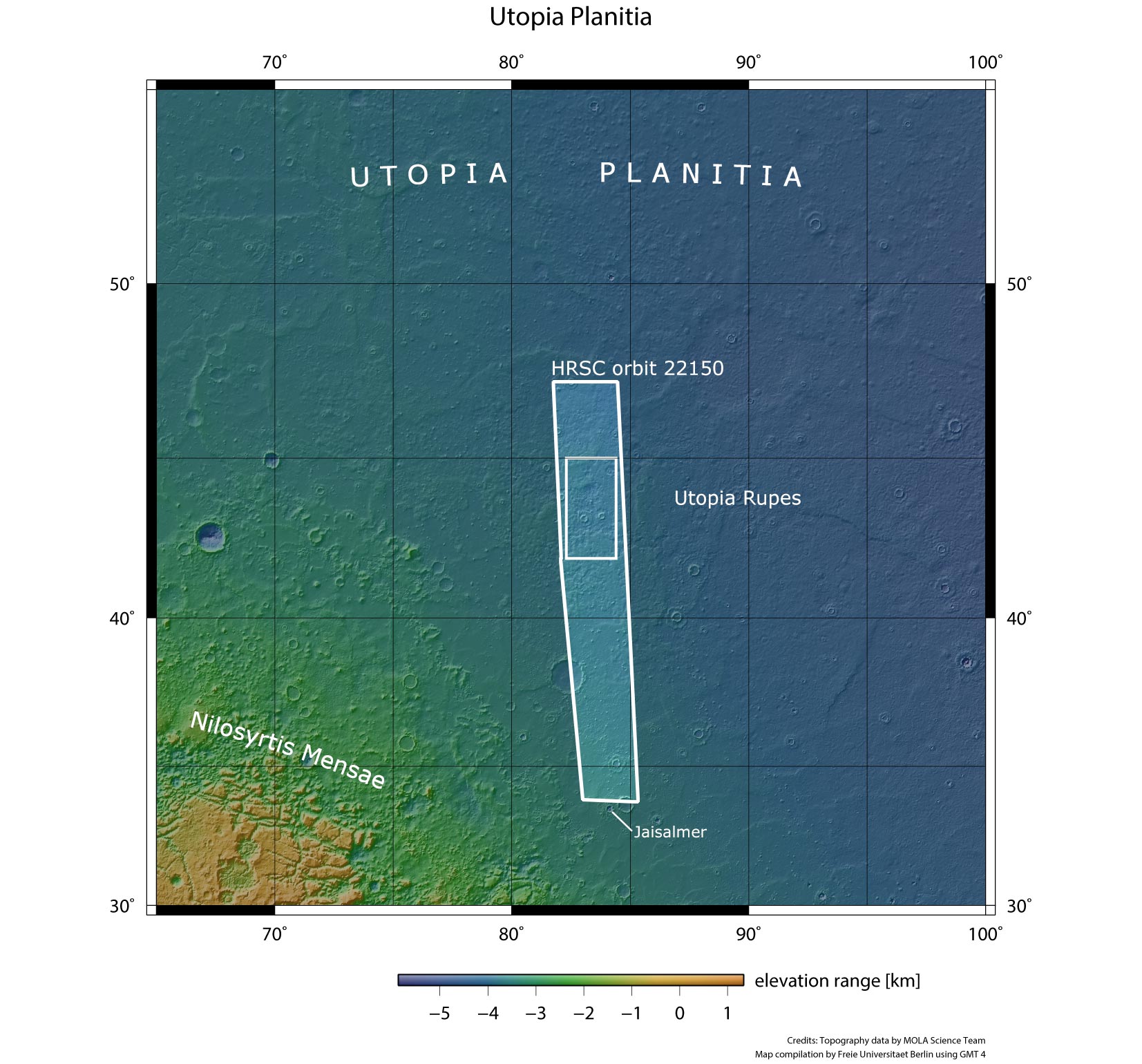
    This image from ESA’s Mars Express shows Utopia Planitia, a plain that fills one of three major basins in the northern hemisphere of Mars – Utopia – and has a diameter of 3,300 km, in wider context. The area outlined by the bold white box indicates the area imaged by the Mars Express High Resolution Stereo Camera on July 12, 2021, during orbit 22150. Credit: NASA/MGS/MOLA Science Team

    This plain is thought to have formed as the Utopia basin was filled by a mix of sediments, lavas, and volatile substances (those that vaporize easily, such as nitrogen, carbon dioxide, hydrogen, and water), all transported across the Martian surface by water, wind or other processes.

    Layers of Ice

    Utopia Planitia is an intriguing and ice-rich region; ice has been spotted lying both at and just below the surface, and at greater depths (detected via observations of fresh craters and pits, and by probing Mars’ deeper layers using radar).

    Visible to the left and right of this scene are large, smooth patches of surface known as ‘mantled deposits’. These are thick layers of ice- and dust-rich material that have smoothed the surface and were likely deposited as snow back when Mars’ rotational axis was much more tilted than it is today (as was last the case some 10 million years ago).
    Topography of Utopia Planitia
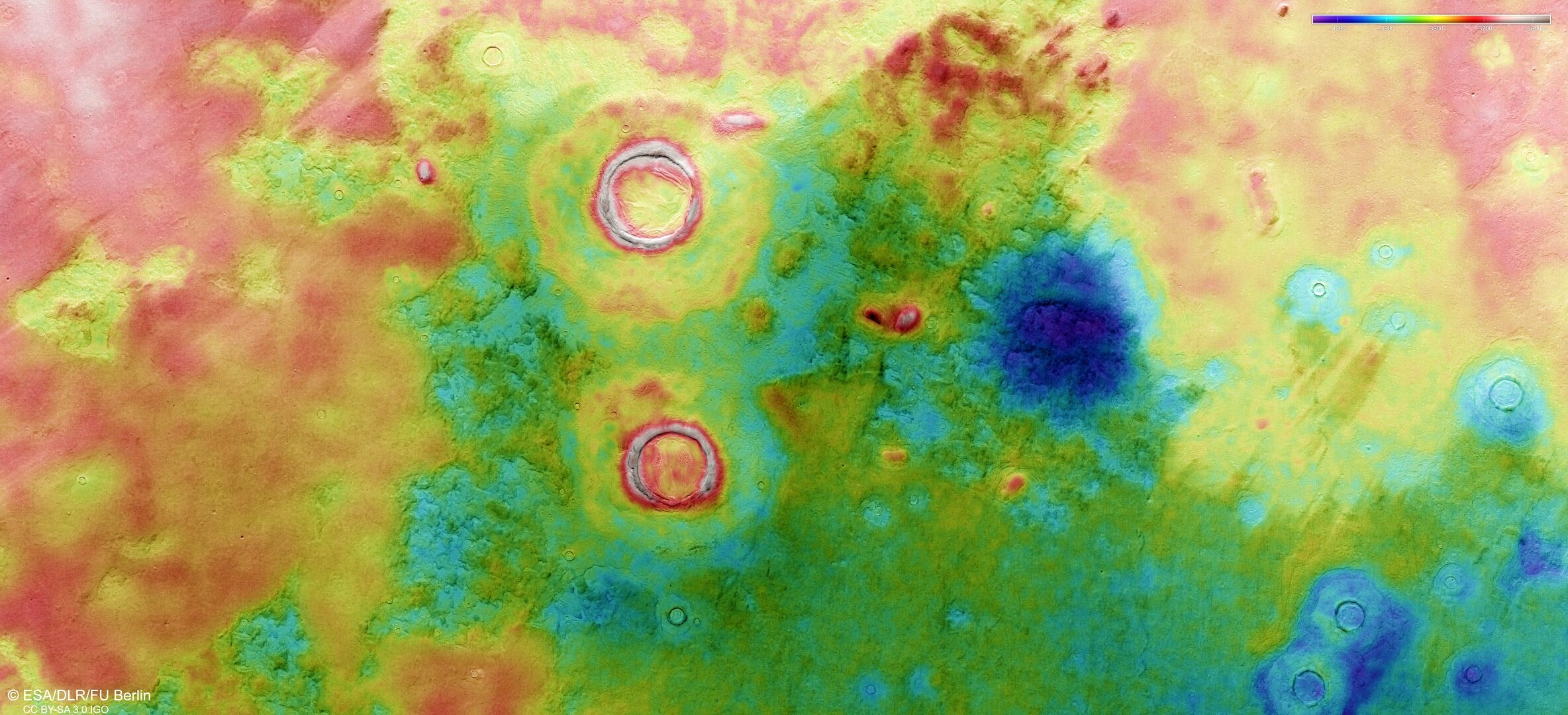
    This color-coded topographic image of Utopia Planitia was created from data collected by ESA’s Mars Express on July 12, 2021. It is based on a digital terrain model of the region, from which the topography of the landscape can be derived. Lower parts of the surface are shown in blues and purples, while higher altitude regions show up in whites and reds, as indicated on the scale to the top right. North is to the right. Credit: ESA/DLR/FU Berlin, CC BY-SA 3.0 IGO

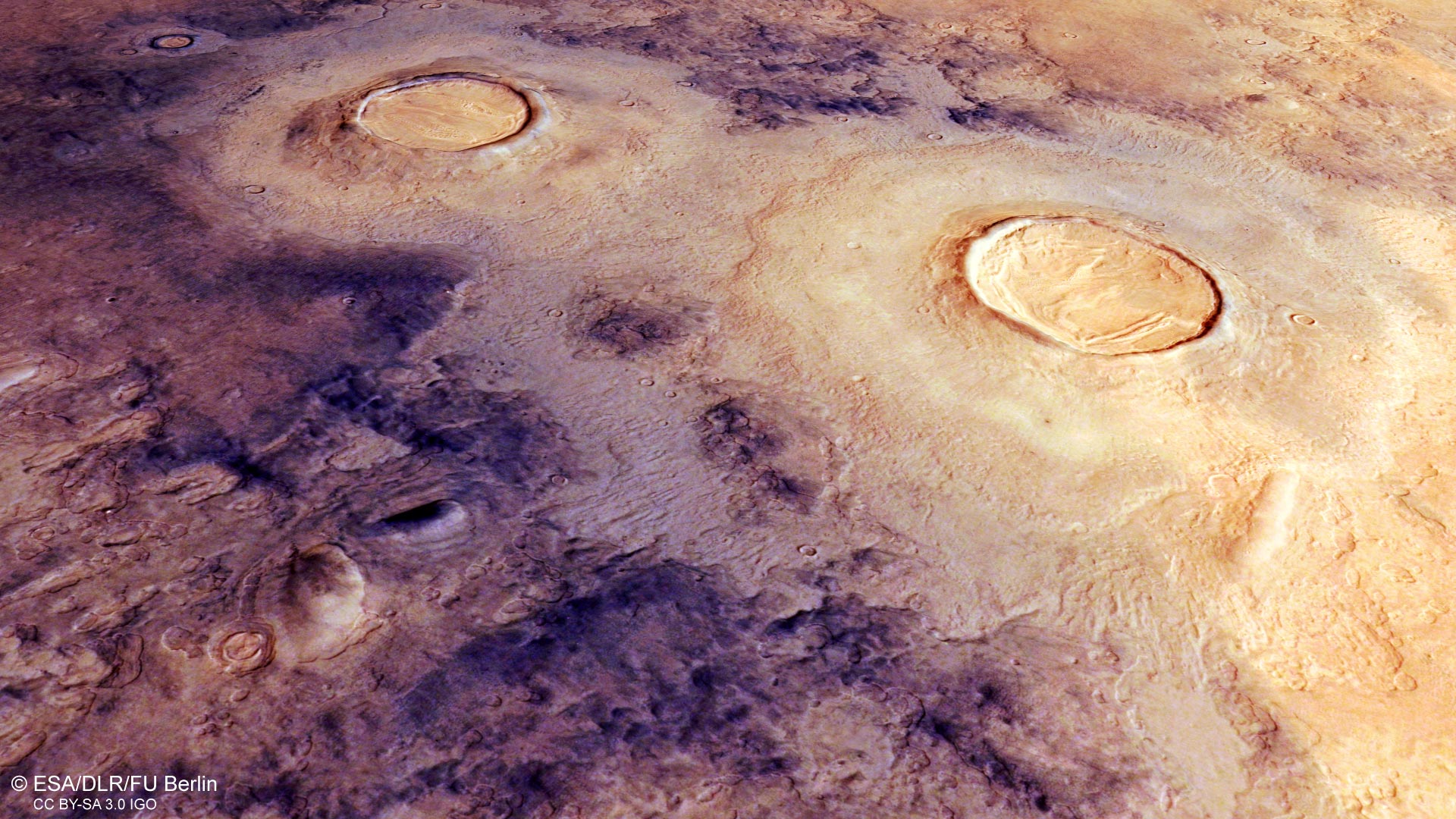
    Moving back towards the image center, the two largest impact craters visible here are surrounded by double-layered mounds of material. A similarly layered appearance is also visible in the deposits that have built up within the craters themselves, and in the craters’ thick rims.

    Brain Terrain

    These craters are more interesting still. The second-largest crater in this image (just below-left of center) showcases a texture known as ‘brain terrain’, where material has become deformed and warped in a concentric pattern that resembles the complex patterns and ridges found on the surface of the human brain.

    Brain terrain is associated with the icy material found near the boundary between Mars’ northern plains and its southern highlands, a ‘dichotomy’ located to the south/south-west (upper left) of this scene.’
    Utopia Planitia on Mars Perspective View
    This oblique perspective view of Utopia Planitia on Mars was generated from the digital terrain model and the nadir and color channels of the High Resolution Stereo Camera on ESA’s Mars Express. Credit: ESA/DLR/FU Berlin, CC BY-SA 3.0 IGO

    Just to the right of the brain-textured crater is an especially dark-colored region, created as the ice-rich ground contracted and cracked at low temperatures. This formed polygonal patterns and fractures that subsequently captured dark dust blown across Mars by wind, leading to the dark appearance seen here.
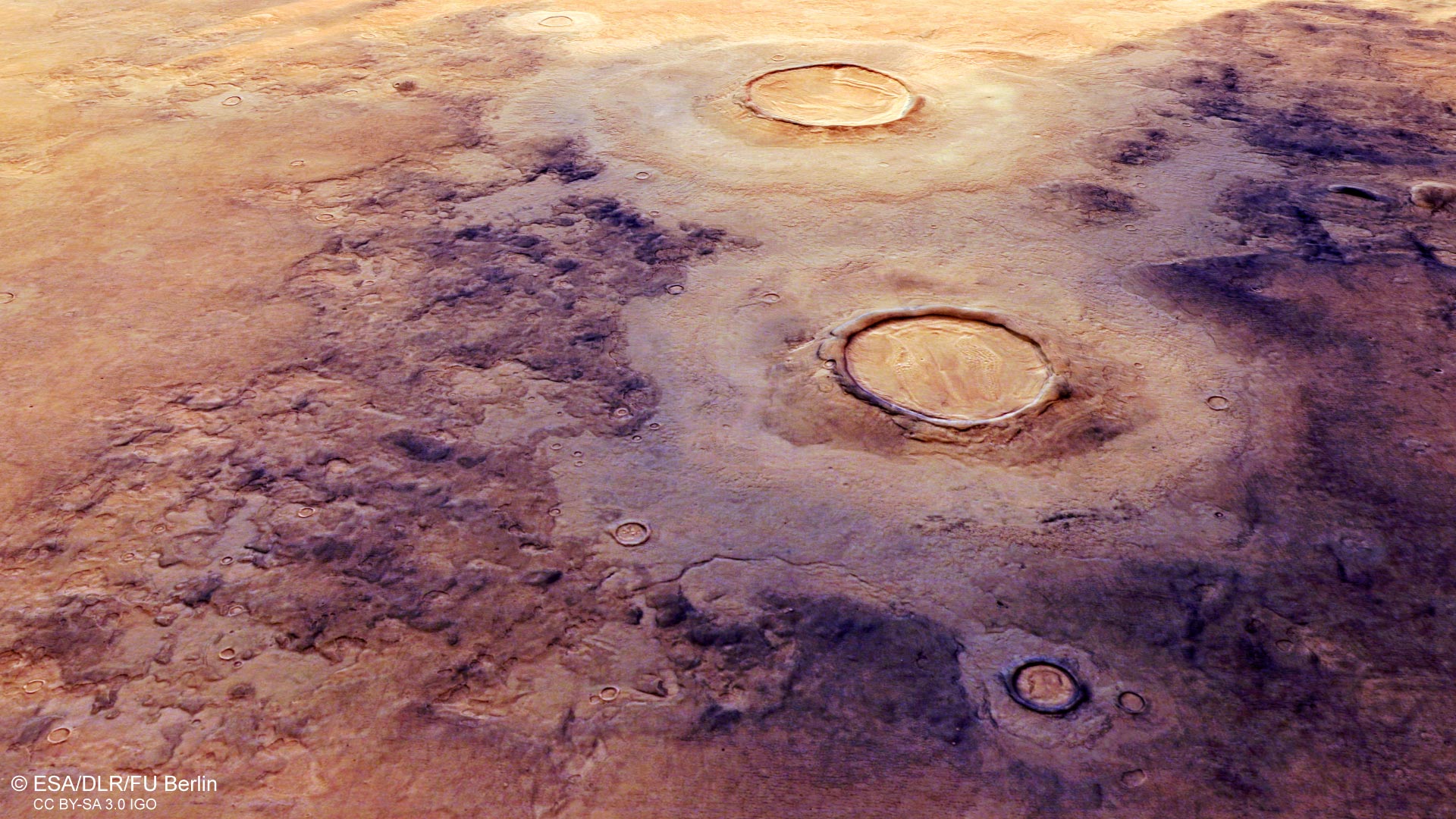
    Additionally, scalloped depressions are omnipresent throughout this image. These have circular to elliptical shapes, depths of several tens of meters, and sizes varying from tens to thousands of meters across.

    These features are the result of ground ice either melting or turning to gas, which then causes the surface to weaken and collapse. Upon closer look, layered mantled deposits can also be seen in and around these scalloped depressions.

    Just to the right of the brain-textured crater is an especially dark-colored region, created as the ice-rich ground contracted and cracked at low temperatures. This formed polygonal patterns and fractures that subsequently captured dark dust blown across Mars by wind, leading to the dark appearance seen here.

    Utopia Planitia Mars Perspective View
    This oblique perspective view of Utopia Planitia on Mars was generated from the digital terrain model and the nadir and color channels of the High Resolution Stereo Camera on ESA’s Mars Express. Credit: ESA/DLR/FU Berlin, CC BY-SA 3.0 IGO

    Additionally, scalloped depressions are omnipresent throughout this image. These have circular to elliptical shapes, depths of several tens of meters, and sizes varying from tens to thousands of meters across.

    These features are the result of ground ice either melting or turning to gas, which then causes the surface to weaken and collapse. Upon closer look, layered mantled deposits can also be seen in and around these scalloped depressions.

    A Diverse Surface

    Mars Express has been orbiting the Red Planet since 2003, imaging Mars’ surface, mapping its minerals, identifying the composition and circulation of its tenuous atmosphere, probing beneath its crust, and exploring how various phenomena interact in the Martian environment.
    Utopia Planitia in 3D
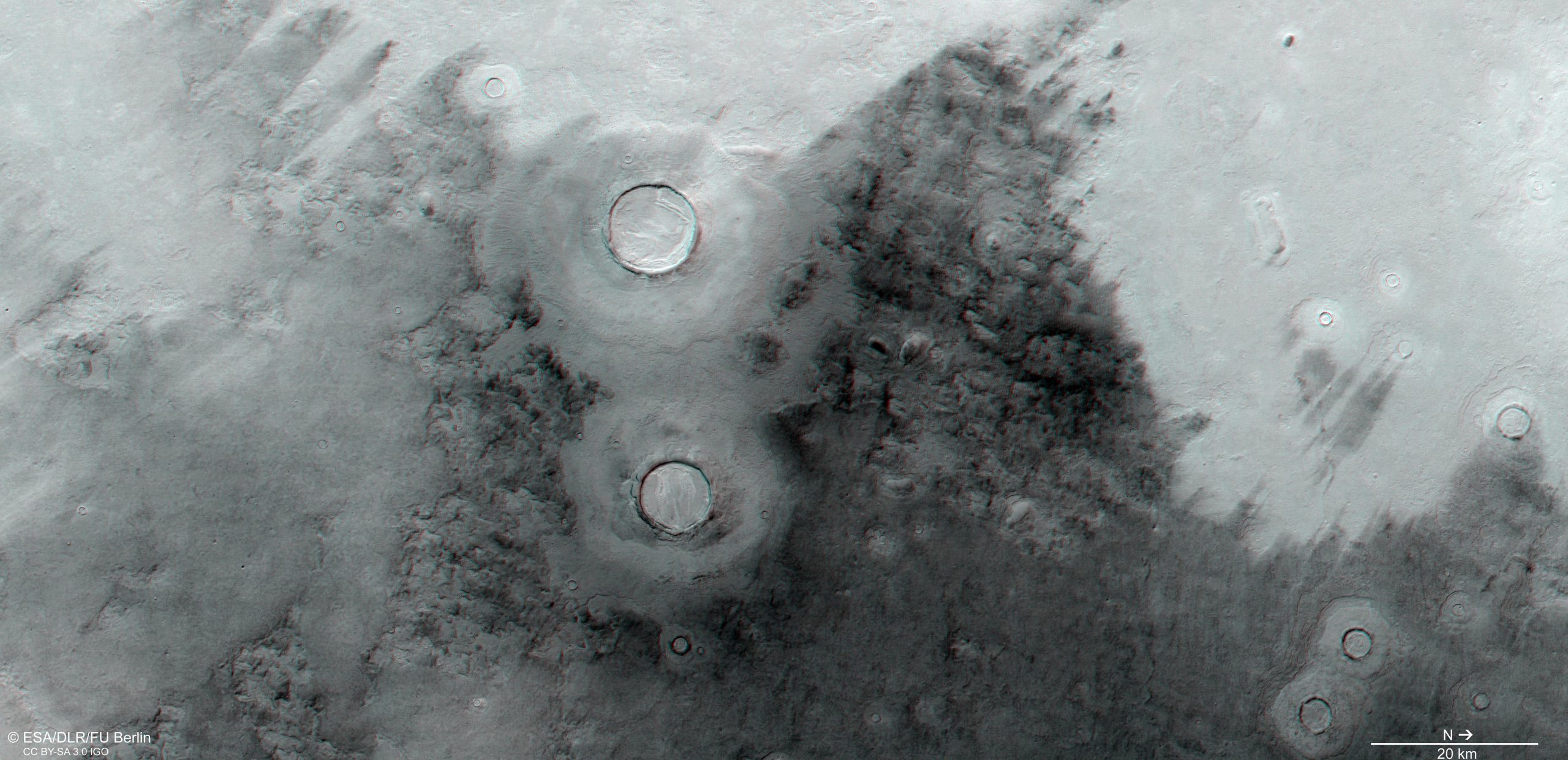
    This stereoscopic image shows Utopia Planitia on Mars, and was generated from data captured by the High Resolution Stereo Camera (HRSC) on ESA’s Mars Express orbiter on July 12, 2021 during orbit 22150. The anaglyph, derived from data acquired by the nadir channel and one stereo channel of the HRSC, offers a three-dimensional view when viewed using red-green or red-blue glasses. Credit: ESA/DLR/FU Berlin, CC BY-SA 3.0 IGO

    The mission’s High Resolution Stereo Camera (HRSC), responsible for these latest images, has revealed much about Mars’ diverse surface features, with recent image releases showing everything from wind-sculpted ridges and grooves to geologically rich regions filled with volcanoes, impact craters, tectonic faults, river channels and ancient lava pools. The camera has also captured other views of Utopia Planitia, such as a snapshot of Adamas Labyrinthus.

    Never miss a breakthrough: Join the SciTechDaily newsletter.
    Follow us on Google and Google News.

    European Space Agency Mars Mars Express Planets Popular
    Share. Facebook Twitter Pinterest LinkedIn Email Reddit

    Related Articles

    A Snaking Scar Across Mars: The Mystery of Aganippe Fossa

    Mars Express Discovers Mysterious Martian “Spiders”

    Mars Express Reveals Hidden Ice Reserves at Mars’s Equator

    Mars As Never Seen Before: ESA’s Mars Express New Global Color Mosaic

    The Odyssey of Mars Express: Charting Two Decades of Red Planet Exploration

    Mars’ Mega Volcano: A Tour of Ascraeus Mons’ Rugged Terrain

    Chaotic Crust Contains Clues to Mars’ Watery Past in Search for Signs of Past Life on the Red Planet

    The “Grandest Canyon” in the Solar System: Mars Express Captures Stunning Images of Massive Martian Canyon

    Intriguing Martian Scars: An Ancient Crater Triplet on Mars

    1 Comment

    1. Sekar on April 2, 2022 12:10 pm

      Very Interesting.

      1. Illiya Priogene . Irreverible Thermodynamics.
      2. Fractal Patterns. Mathematical terms. Link with possible forces (Internal and External) driving formation of planetary formaion and modifications over time.
      3. Matter-Energy Equivalance. Matterominance and “aggregation and agglomeration over time” creates planetary bodies and their sattelites. When energy becomes dominant the elements revert to primary state of Hydrogen and Hydrogen Isotopes (Deuterium Tritium) and becomes a star with plasma which shares light and heat with the planetary body , once equilibrium is attined.
      4. Compare with Planet Earth data and other Planetary bodies to discern a patten (if any) , aligned with known forces existing in the solar system.
      5. Data could be useful in the future, if and when we try planetary habitability attempt,s and conditions to be engineered on a planetary body (including sattelites of known planets) to sustain life and attempt to increase our footprint in the solar system and elsewhere.

      Views expressed are personal and not binding on anyone.

      Reply
    Leave A Reply Cancel Reply

    • Facebook
    • Twitter
    • Pinterest
    • YouTube

    Don't Miss a Discovery

    Subscribe for the Latest in Science & Tech!

    Trending News

    Millions of People Have Osteopenia Without Realizing It – Here’s What You Need To Know

    Researchers Discover Boosting a Single Protein Helps the Brain Fight Alzheimer’s

    World-First Study Reveals Human Hearts Can Regenerate After a Heart Attack

    Why Your Dreams Feel So Real Sometimes and So Strange Other Times

    This Simple Home Device May Boost Brain Power in Adults Over 40

    Enormous Prehistoric Insects Puzzle Scientists

    Scientists Develop Bioengineered Chewing Gum That Could Help Fight Oral Cancer

    After 37 Years, the World’s Longest-Running Soil Warming Experiment Uncovers a Startling Climate Secret

    Follow SciTechDaily
    • Facebook
    • Twitter
    • YouTube
    • Pinterest
    • Newsletter
    • RSS
    SciTech News
    • Biology News
    • Chemistry News
    • Earth News
    • Health News
    • Physics News
    • Science News
    • Space News
    • Technology News
    Recent Posts
    • Shockingly Powerful Giant Octopuses Ruled the Seas 100 Million Years Ago
    • After 100 Years, Scientists Uncover Hidden Rule Governing Cosmic Rays
    • The Milky Way Has a Hidden Edge and Scientists Finally Mapped It
    • Scientists Stunned by New Organic Molecules Found on Mars
    • Scientists Discover Evolution’s 120-Million-Year-Old “Cheat Sheet”
    Copyright © 1998 - 2026 SciTechDaily. All Rights Reserved.
    • Science News
    • About
    • Contact
    • Editorial Board
    • Privacy Policy
    • Terms of Use

    Type above and press Enter to search. Press Esc to cancel.