
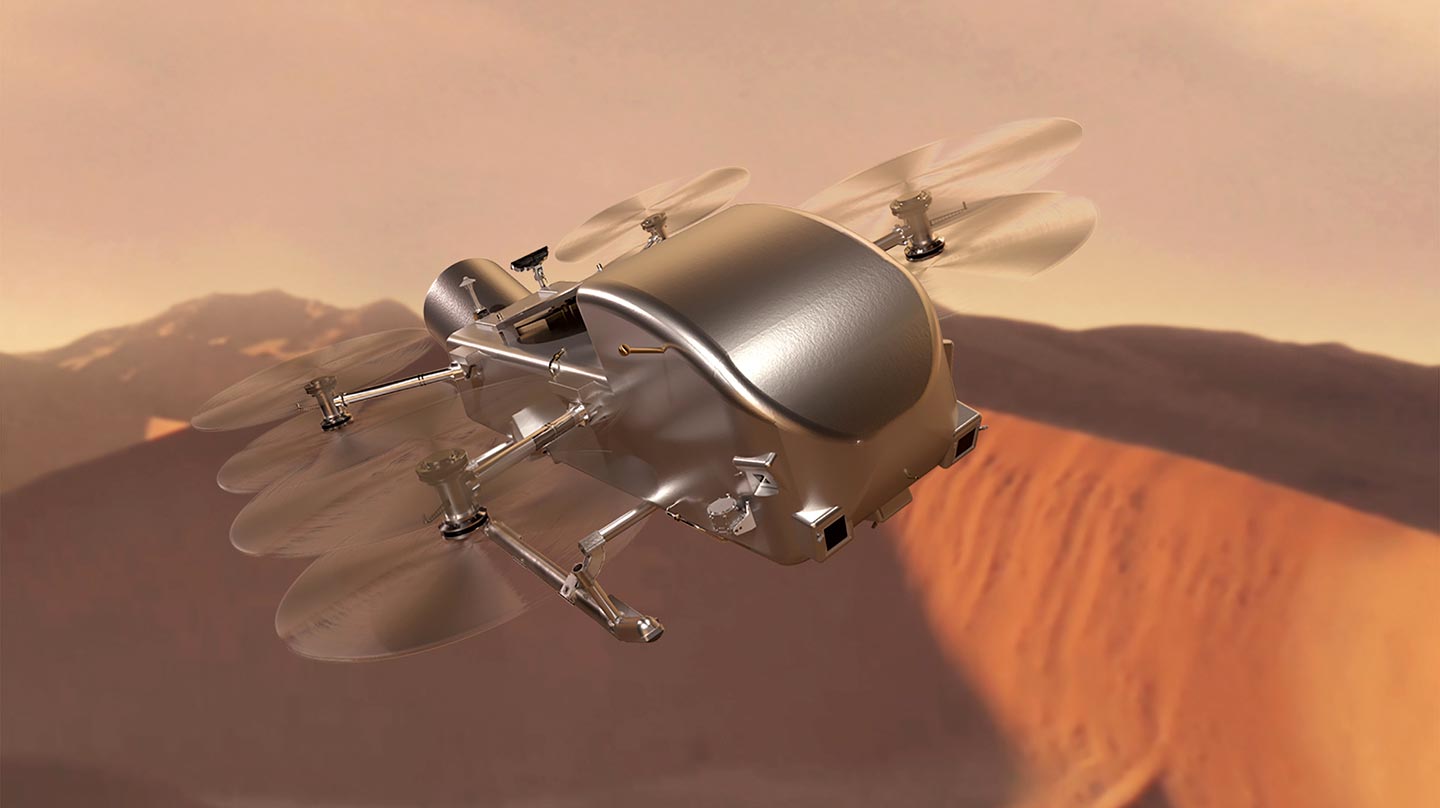
NASA’s Dragonfly mission, set to explore Saturn’s moon Titan, has progressed to final design and construction stages with a confirmed launch in 2028 and a budget of $3.35 billion.
NASA has confirmed its Dragonfly rotorcraft mission to Saturn’s organic-rich moon Titan. The decision allows the mission to progress to completion of final design, followed by the construction and testing of the entire spacecraft and science instruments.
“Dragonfly is a spectacular science mission with broad community interest, and we are excited to take the next steps on this mission,” said Nicky Fox, associate administrator, Science Mission Directorate at NASA Headquarters in Washington. “Exploring Titan will push the boundaries of what we can do with rotorcraft outside of Earth.”
Mission Development Updates
In early 2023, the mission successfully passed all the success criteria of its Preliminary Design Review. At that time, however, the mission was asked to develop an updated budget and schedule to fit into the current funding environment. This updated plan was presented and conditionally approved in November 2023, pending the outcome of the fiscal year 2025 budget process. In the meantime, the mission was authorized to proceed with work on final mission design and fabrication to ensure that the mission stayed on schedule.
With the release of the president’s fiscal year 2025 budget request, Dragonfly is confirmed with a total lifecycle cost of $3.35 billion and a launch date of July 2028. This reflects a cost increase of about two times the proposed cost and a delay of more than two years from when the mission was originally selected in 2019. Following that selection, NASA had to direct the project to replan multiple times due to funding constraints in fiscal years 2020 through 2022. The project incurred additional costs due to the COVID-19 pandemic, supply chain increases, and the results of an in-depth design iteration. To compensate for the delayed arrival at Titan, NASA also provided additional funding for a heavy-lift launch vehicle to shorten the mission’s cruise phase.
Mission Details and Collaborations
The rotorcraft, targeted to arrive at Titan in 2034, will fly to dozens of promising locations on the moon, looking for prebiotic chemical processes common on both Titan and the early Earth before life developed. Dragonfly marks the first time NASA will fly a vehicle for science on another planetary body. The rotorcraft has eight rotors and flies like a large drone.
Dragonfly is being designed and built under the direction of the Johns Hopkins Applied Physics Laboratory (APL) in Laurel, Maryland, which manages the mission for NASA. Elizabeth Turtle of APL is the principal investigator. The team includes key partners at NASA’s Goddard Space Flight Center in Greenbelt, Maryland; Lockheed Martin Space in Littleton, Colorado; NASA’s Ames Research Center in Silicon Valley, California; NASA’s Langley Research Center in Hampton, Virginia; Penn State University in State College, Pennsylvania; Malin Space Science Systems in San Diego, California; Honeybee Robotics in Pasadena, California; NASA’s Jet Propulsion Laboratory in Southern California; CNES (Centre National d’Etudes Spatiales) in Paris; the German Aerospace Center (DLR) in Cologne, Germany; and JAXA (Japan Aerospace Exploration Agency) in Tokyo. Dragonfly is the fourth mission in NASA’s New Frontiers Program, managed by NASA’s Marshall Space Flight Center in Huntsville, Alabama, for the agency’s Science Mission Directorate in Washington.
Never miss a breakthrough: Join the SciTechDaily newsletter.
Follow us on Google and Google News.