
Close Menu
    Facebook X (Twitter) Instagram
    SciTechDaily
    • Biology
    • Chemistry
    • Earth
    • Health
    • Physics
    • Science
    • Space
    • Technology
    Facebook X (Twitter) Pinterest YouTube RSS
    SciTechDaily
    Home»Science»2D Ferroelectric Liquid Crystal: The Next Big Thing in Display Technology
    Science

    2D Ferroelectric Liquid Crystal: The Next Big Thing in Display Technology

    By Science China PressApril 28, 2024No Comments3 Mins Read
    Facebook Twitter Pinterest Telegram LinkedIn WhatsApp Email Reddit
    Share
    Facebook Twitter LinkedIn Pinterest Telegram Email Reddit
    2D Vermiculite LC
    A polarized optical image of 2D vermiculite LC showing interference colors. Credit: ©Science China Press

    Researchers discovered ferroelectricity in 2D vermiculite, boosting electric field responsivity in liquid crystals and paving the way for innovative large-scale displays.

    Electro-optical liquid crystal (LC) device with wide applications is a cornerstone of the information society, which can continuously and dynamically modulate the light intensity, polarization, and phase retardation. An ancient theoretical insight proposes that a LC material with both an extremely large geometrical anisotropy and an inherent electric dipole is highly expected to improve the electric field responsivity of LCs.

    However, neither commercial organic LC molecules nor R&D LC nanomaterials meet both aforementioned perquisites, while such LCs have not been reported so far. As for now, they are open questions for LC community about whether such an LC exists and the upper limit of its electric field responsivity.

    Discovery of Ferroelectricity in Vermiculite

    In response to these questions, for the first time, the research team led by Professor Bilu Liu from Tsinghua Shenzhen International Graduate School, Tsinghua University reveal the ferroelectricity in a century-old clay mineral, vermiculite, in its monolayer limit. The two-dimensional (2D) vermiculite possesses an extremely large geometrical anisotropy and the ferroelectricity endows an inherent electric dipole.

    By dispersing 2D vermiculite in deionized water, the research team prepares a LC dispersion with 2D ferroelectric moieties. Its electric field responsivity, i.e., the Kerr coefficient, raises the record value of Kerr coefficient by an order of magnitude.

    Considering that the 2D vermiculite LC represents a new class of inorganic lyotropic LC with 2D ferroelectric materials, the physical insights provided in this work, such as the relationship between the responsivity and geometrical anisotropy of LC materials, have universality to other potential similar LCs.
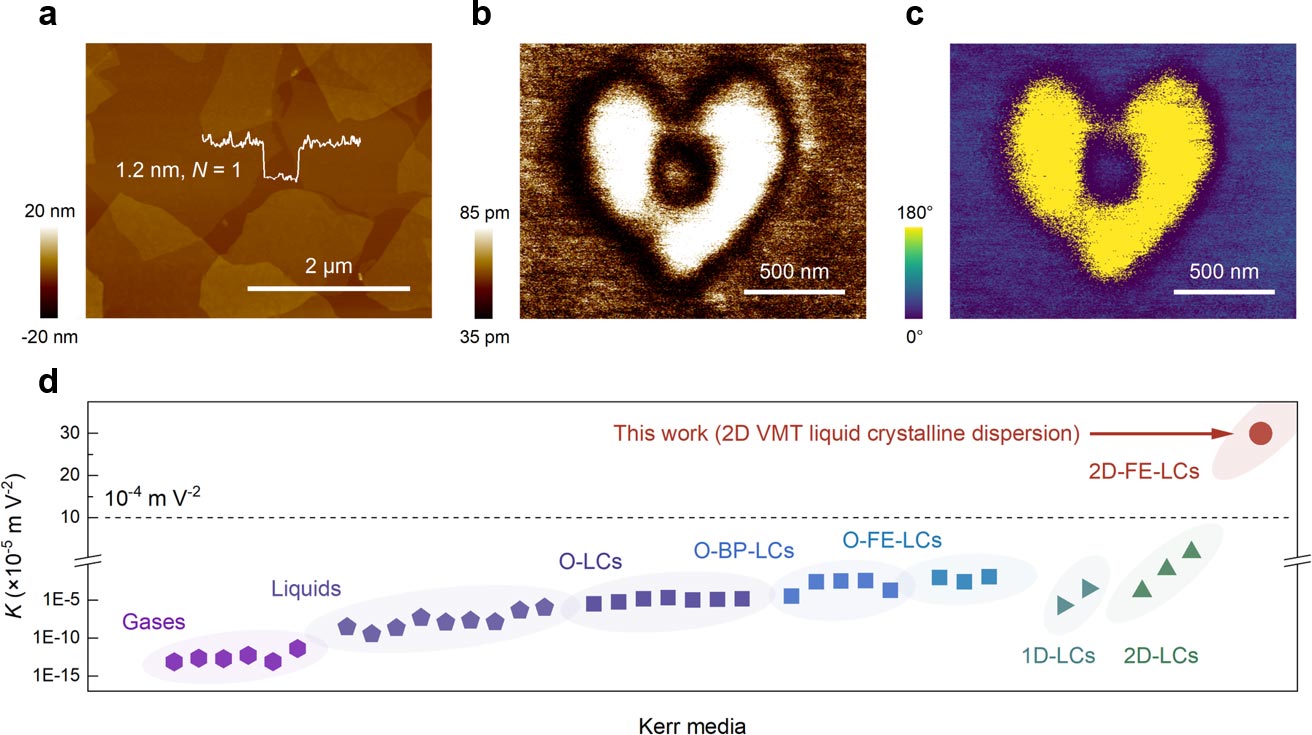
    Ferroelectricity of 2D Vermiculite and the Electric Field Responsivity
    a) AFM image of 2D vermiculite. b) PFM amplitude map of 2D vermiculite. c) PFM phase map of 2D vermiculite. d. Comparison of electric field responsivity of 2D vermiculite LC and other media. Credit: ©Science China Press

    Technological Advancements and Future Applications

    The breakthrough of the electric field responsivity enables an ultra-low operational electric field and the fabrication of electro-optical LC devices with an inch-level electrode separation, which is not practical previously. A large-scale and energy-efficient prototypical displayable billboard with inch-scale pixels has been fabricated for outdoor interactive scenes, where the letters and digits can be shown on it controlled by smartphone software or human gestures.

    “Scientifically, we give a new strategy to design advanced inorganic LCs or LC-like systems with sensitive electric field responsivity. The key is to prepare 2D ferroelectric materials dispersion from layered bulk.” Prof. Bilu Liu said, “From another perspective, the inspiring evidence on 2D ferroelectricity in layered natural minerals brings new opportunities for scalable production and practical application of van der Waals ferroelectric materials.”

    Reference: “An inorganic liquid crystalline dispersion with 2D ferroelectric moieties” by Ziyang Huang, Zehao Zhang, Rongjie Zhang, Baofu Ding, Liu Yang, Keyou Wu, Youan Xu, Gaokuo Zhong, Chuanlai Ren, Jiarong Liu, Yugan Hao, Menghao Wu, Teng Ma and Bilu Liu, 21 March 2024, National Science Review.
    DOI: 10.1093/nsr/nwae108

    The research receive funding from National Natural Science Foundation of China, Department of Education of Guangdong Province, Shenzhen Municipal Science and Technology Innovation Council, Tsinghua Shenzhen International Graduate School

    Never miss a breakthrough: Join the SciTechDaily newsletter.
    Follow us on Google and Google News.

    2D Materials Crystals Ferroelectric Materials Materials Science
    Share. Facebook Twitter Pinterest LinkedIn Email Reddit

    Related Articles

    Unlocking the Future With Lithium Niobate’s Ferroelectric Magic

    Roman Relics to Tech Treasures: Glass Fragments Unlock Future Secrets

    Zentropy – A New Theory That Could Transform Material Science

    Beyond Graphene: A New “Metallic” 2D Material – Molybdenene

    Holographic Beetles and Liquid Crystals: The Science of Ultra-Secure QR Codes

    New Method Developed to Isolate Atomic Sheets and Create New Materials

    Tunable Crystal Symmetry in Graphene Enables Nanoelectromechanical Sensors

    CVD Graphene With Large Grains Is As Strong as Exfoliated Graphene

    Graphene is Transparent to Water

    Leave A Reply Cancel Reply

    • Facebook
    • Twitter
    • Pinterest
    • YouTube

    Don't Miss a Discovery

    Subscribe for the Latest in Science & Tech!

    Trending News

    Popular Sugar-Free Sweetener Linked to Liver Disease, Study Warns

    What Is Hantavirus? The Deadly Disease Raising Alarm Worldwide

    Scientists Just Discovered How the Universe Builds Monster Black Holes

    Scientists Unveil New Treatment Strategy That Could Outsmart Cancer

    A Simple Vitamin May Hold the Key to Treating Rare Genetic Diseases

    Scientists Think the Real Fountain of Youth May Be Hiding in Your Gut

    Ravens Don’t Follow Wolves, They Predict Them

    This Common Knee Surgery May Be Doing More Harm Than Good

    Follow SciTechDaily
    • Facebook
    • Twitter
    • YouTube
    • Pinterest
    • Newsletter
    • RSS
    SciTech News
    • Biology News
    • Chemistry News
    • Earth News
    • Health News
    • Physics News
    • Science News
    • Space News
    • Technology News
    Recent Posts
    • Scientists Use AI To Supercharge Ultrafast Laser Simulations by More Than 250x
    • Scientists Just Found a Surprising Way To Destroy “Forever Chemicals”
    • Popular Supplement Ingredient Linked to Shorter Lifespan in Men
    • Scientists May Have Found a Way To Repair Nerve Damage in Multiple Sclerosis
    • GLP-1 Weight Loss Linked To Dramatically Lower Risk of Sleep Apnea, Kidney Disease and More
    Copyright © 1998 - 2026 SciTechDaily. All Rights Reserved.
    • Science News
    • About
    • Contact
    • Editorial Board
    • Privacy Policy
    • Terms of Use

    Type above and press Enter to search. Press Esc to cancel.