
Close Menu
    Facebook X (Twitter) Instagram
    SciTechDaily
    • Biology
    • Chemistry
    • Earth
    • Health
    • Physics
    • Science
    • Space
    • Technology
    Facebook X (Twitter) Pinterest YouTube RSS
    SciTechDaily
    Home»Space»Tantalizing Tectonics: Monstrous “Claw Mark” Scratches on the Surface of Mars
    Space

    Tantalizing Tectonics: Monstrous “Claw Mark” Scratches on the Surface of Mars

    By European Space Agency (ESA)May 9, 2022No Comments6 Mins Read
    Facebook Twitter Pinterest Telegram LinkedIn WhatsApp Email Reddit
    Share
    Facebook Twitter LinkedIn Pinterest Telegram Email Reddit
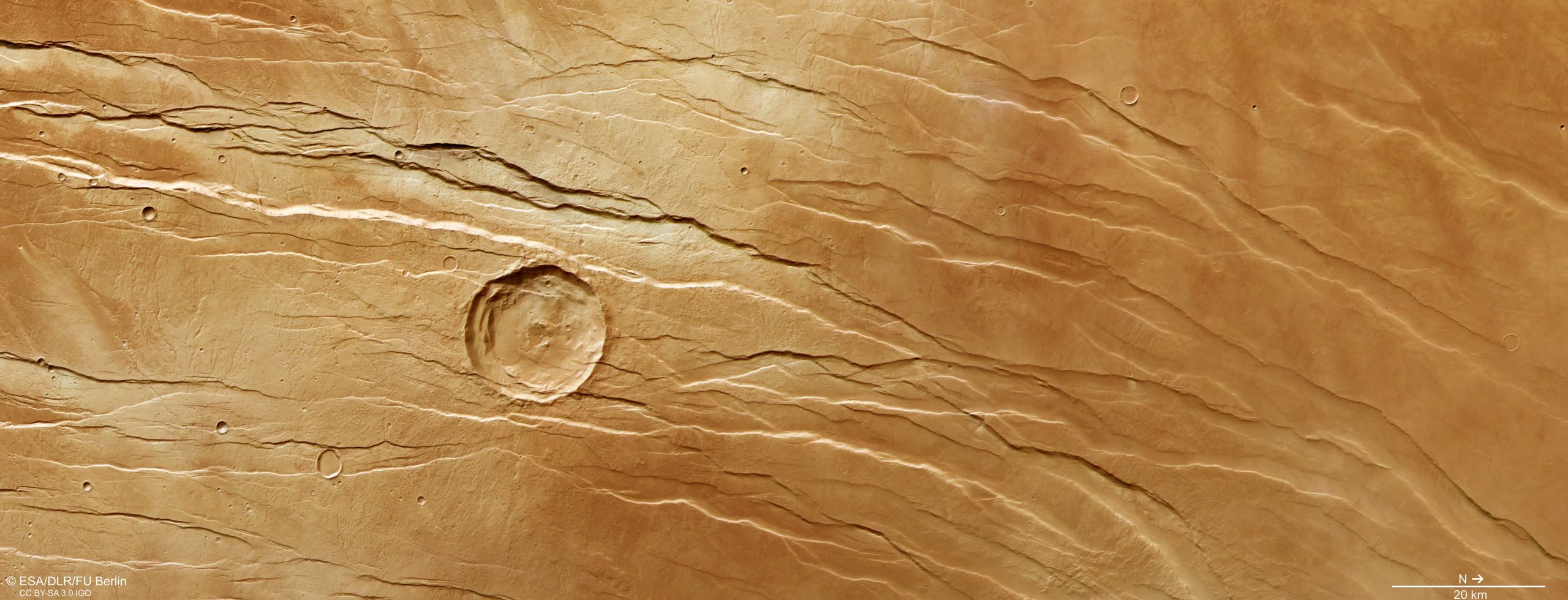
    Tantalus Fossae on Mars
    This image from ESA’s Mars Express shows part of a large fault system on Mars known as Tantalus Fossae. This image comprises data gathered by Mars Express’ High Resolution Stereo Camera (HRSC) on July 19, 2021. It was created using data from the nadir channel, the field of view aligned perpendicular to the surface of Mars, and the color channels of the HRSC. It is a ‘true color’ image, reflecting what would be seen by the human eye if looking at this region of Mars. The ground resolution is approximately 18 m/pixel and the images are centered at about 43°N/257°E. North is to the right. Credit: ESA/DLR/FU Berlin, CC BY-SA 3.0 IGO

    This network of long grooves and scratches forms part of a giant fault system on Mars known as Tantalus Fossae, and is shown here as seen by the European Space Agency’s Mars Express.

    At first glance, these features appear to be the result of someone raking their fingernails, or claws, across the surface of the Red Planet, gouging out long trenches in the process.

    While not quite so dramatic in its formation, Tantalus Fossae (‘fossae’ meaning a hollow or depression) is a noticeable feature on Mars. This system of troughs flanks a sprawling, low-relief martian volcano named Alba Mons, running along the volcano’s eastern side.
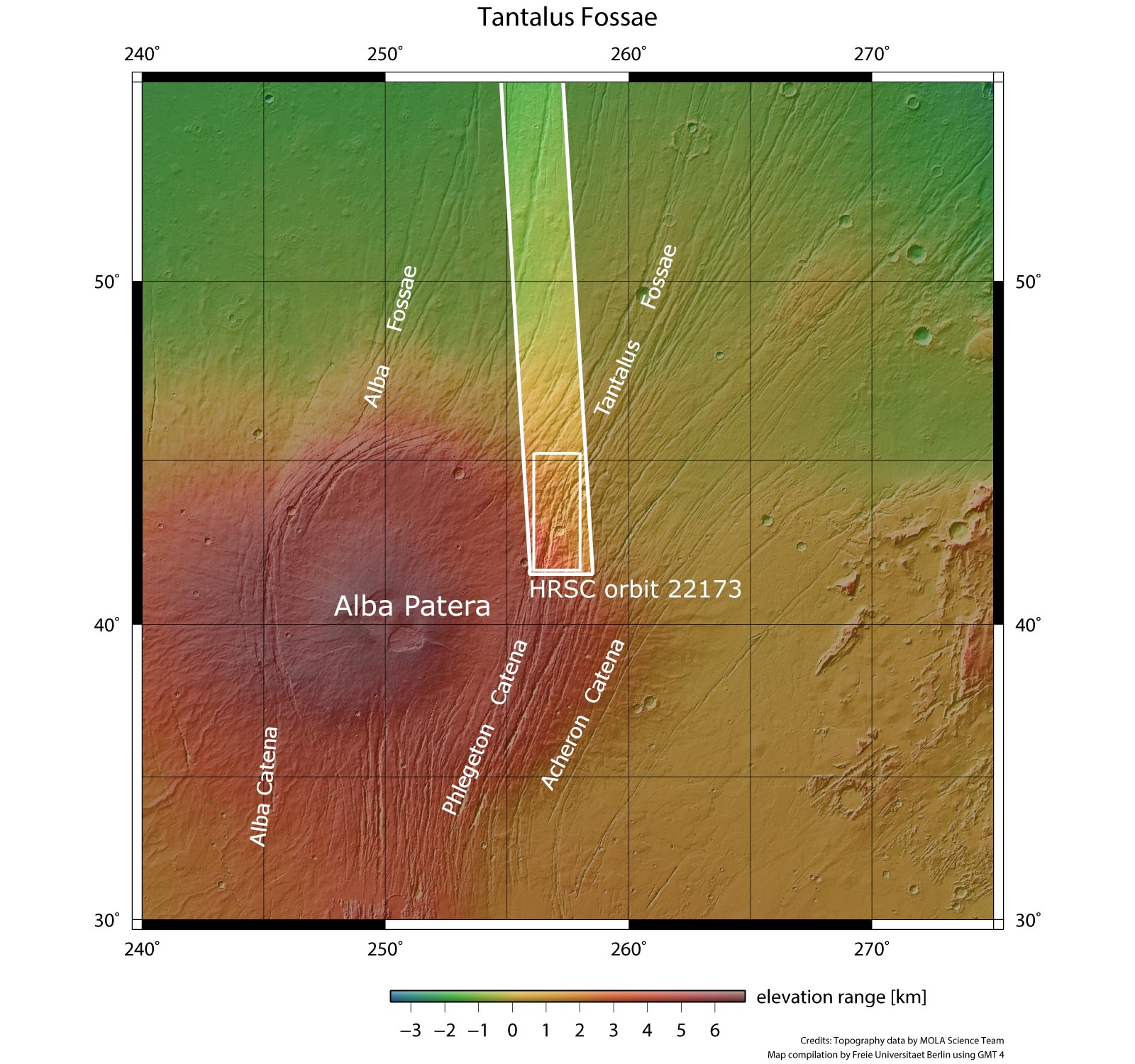
    Tantalus Fossae in Context
    This image from ESA’s Mars Express shows part of Tantalus Fossae, a large system of faults found on Mars, in wider context.
    The area outlined by the bold white box indicates the area imaged by the Mars Express High Resolution Stereo Camera on July 19, 2021, during orbit 22173. Credit: NASA/MGS/MOLA Science Team

    The fossae were created as the summit of Alba Mons rose in elevation, causing the surrounding surface to become warped, extended, and broken. The Tantalus Fossae faults are a great example of a surface feature known as grabens; each trench formed as two parallel faults opened up, causing the rock between to drop down into the resulting void.
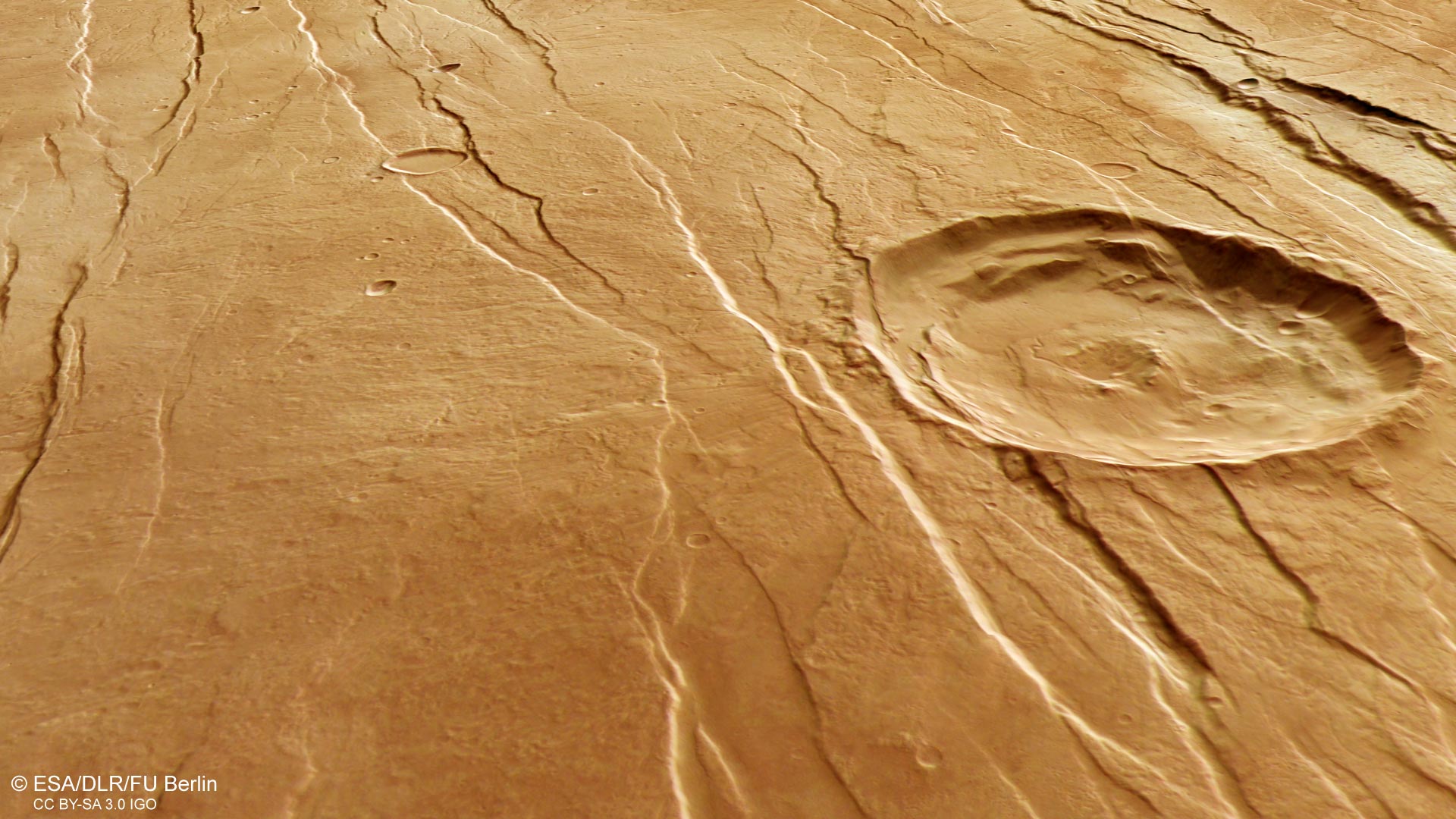
    Tantalus Fossae Perspective View
    This oblique perspective view of Tantalus Fossae on Mars was generated from the digital terrain model and the nadir and color channels of the High Resolution Stereo Camera on ESA’s Mars Express. Credit: ESA/DLR/FU Berlin, CC BY-SA 3.0 IGO

    The same features can be found on the western side of Alba Mons, forming an incomplete ring around the volcano. Overall, this volcano’s associated grabens stretch out for up to 1000 km (620 miles) in length, up to 10 km (6.2 miles) in width, and are up to 350 m (1,150 feet) deep.

    A Complex History

    Throughout this Mars Express image, numerous grabens can be seen running roughly northeast (bottom-right) to southwest (top-left).

    These structures are thought to have formed not at the same time but one after the other, providing scientists the opportunity to reconstruct a past timeline and picture of what created this dramatic landscape.

    The large impact crater at the center of the image, for example, is crosscut by grabens, indicating that it was already present before the volcano was uplifted to create the Tantalus Fossae faults. The second-largest impact crater (far smaller and to the bottom-left of the central crater) appears to superpose the faults, and is therefore likely to be younger.
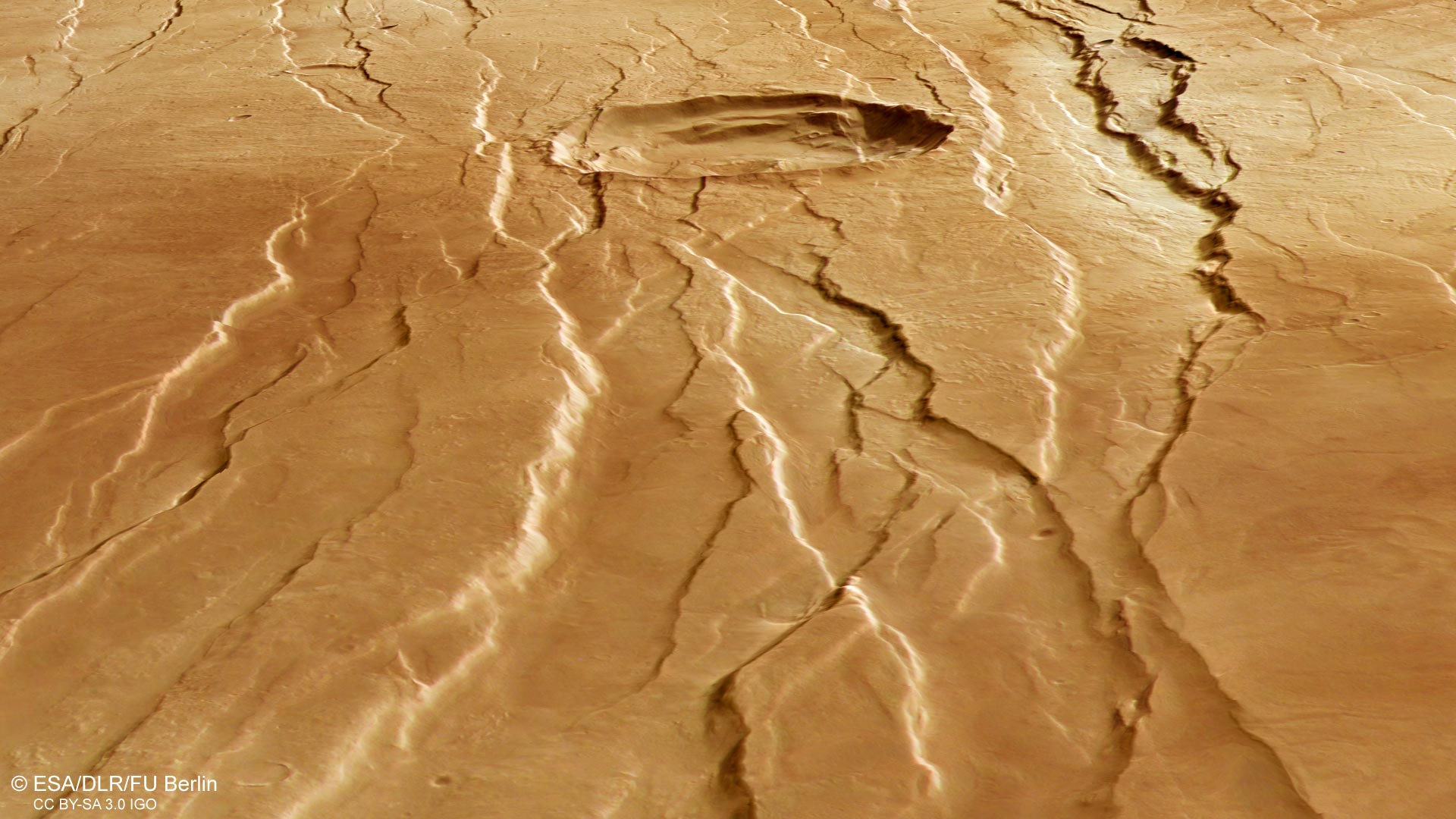
    Perspective View of Tantalus Fossae
    This oblique perspective view of Tantalus Fossae on Mars was generated from the digital terrain model and the nadir and color channels of the High Resolution Stereo Camera on ESA’s Mars Express. Credit: ESA/DLR/FU Berlin, CC BY-SA 3.0 IGO

    Upon closer look, many small, branching valleys can be seen across this region. These valleys appear to cut directly through the grabens, and so are assumed to be older.

    As shown most clearly in the associated topographic view, the northern (right) part contains far lower terrain than the southern (left) part – in places, as much as three kilometers lower in altitude. We would expect any small, branching valleys to run along the slopes of Alba Mons and merge where the ground is lowest, but this is not seen here, implying that the valleys must originate from more ancient times – before Alba Mons rose to sculpt this terrain into what we see today.
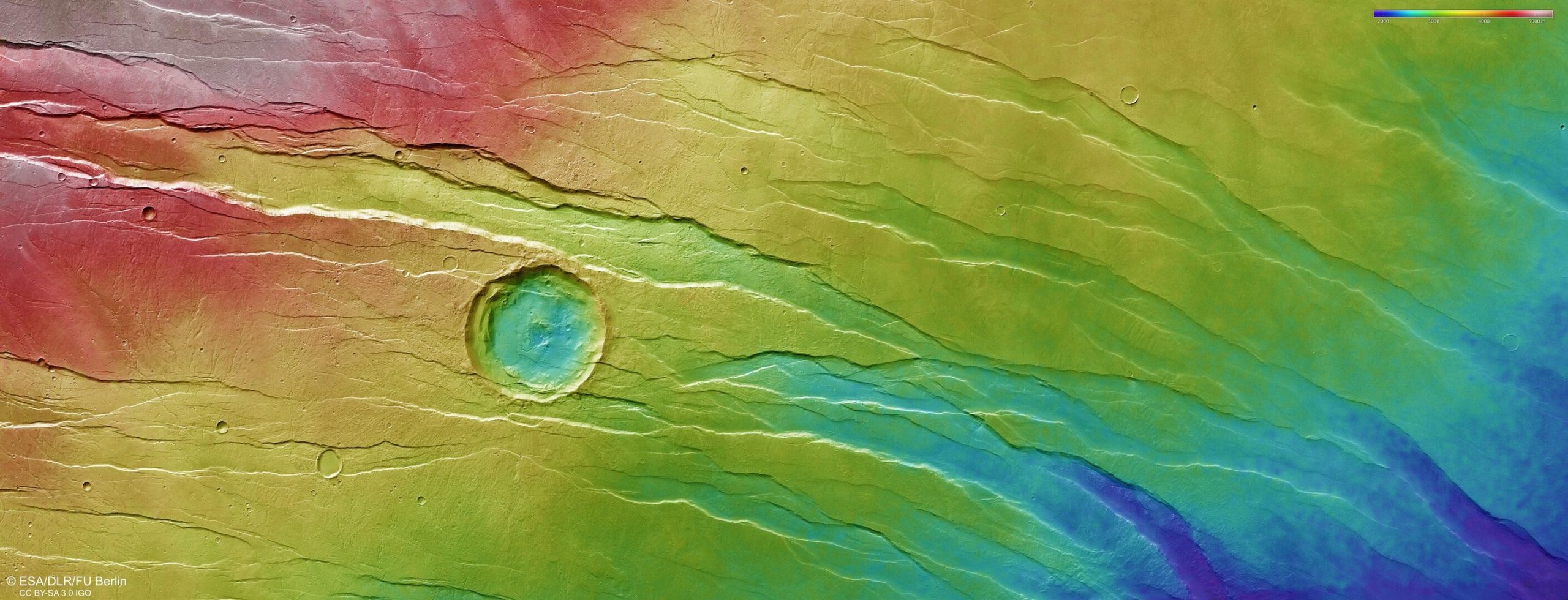
    Topography of Tantalus Fossae
    This color-coded topographic image of Tantalus Fossae was created from data collected by ESA’s Mars Express on July 19, 2021, during orbit 22173. It is based on a digital terrain model of the region, from which the topography of the landscape can be derived. Lower parts of the surface are shown in blues and purples, while higher altitude regions show up in whites and reds, as indicated on the scale to the top right. North is to the right. The ground resolution is approximately 18 m/pixel and the images are centered at about 43°N/257°E. Credit: ESA/DLR/FU Berlin, CC BY-SA 3.0 IGO

    This area is named after Tantalus, a son of Zeus and Plouto (Pluto) who, according to Greek legend, betrayed the gods and was forced by Hades to stand in water beneath a fruit tree. When he tried to drink the water retreated, and when he tried to eat the branches moved beyond his reach – a punishment known as the torments of Tantalus.

    Exploring Mars

    Mars Express has been orbiting the Red Planet since 2003, imaging Mars’ surface, mapping its minerals, identifying the composition and circulation of its tenuous atmosphere, probing beneath its crust, and exploring how various phenomena interact in the martian environment.
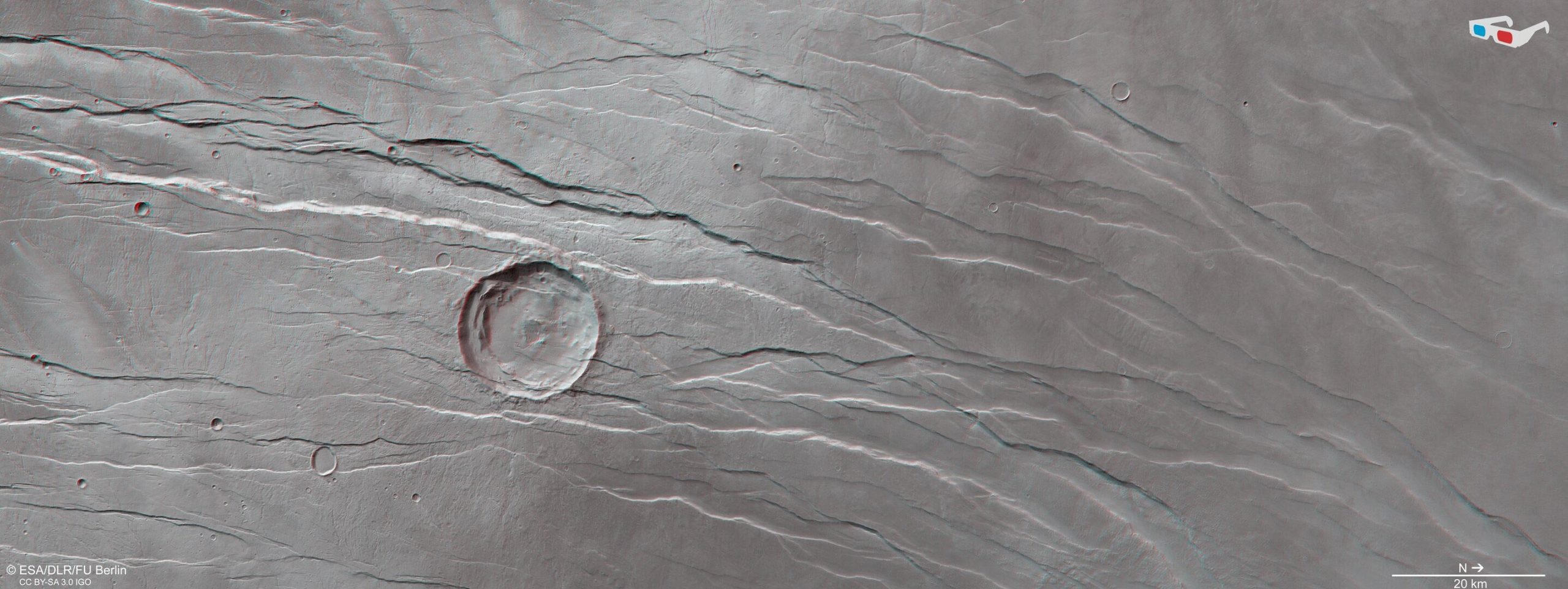
    Tantalus Fossae in 3D
    This stereoscopic image shows Tantalus Fossae on Mars, and was generated from data captured by the High Resolution Stereo Camera (HRSC) on ESA’s Mars Express orbiter on July 19, 2021, during orbit 22173. The anaglyph, derived from data acquired by the nadir channel and one stereo channel of the HRSC, offers a three-dimensional view when viewed using red-green or red-blue glasses. Credit: ESA/DLR/FU Berlin, CC BY-SA 3.0 IGO

    The mission’s High Resolution Stereo Camera (HRSC), responsible for these new images, has revealed much about Mars’ diverse surface features, with recent images showing everything from brain terrain and wind-sculpted ridges and grooves to volcanoes, impact craters, tectonic faults, river channels, and ancient lava pools.

    Never miss a breakthrough: Join the SciTechDaily newsletter.
    Follow us on Google and Google News.

    European Space Agency Mars Mars Express Popular Tectonic Plates
    Share. Facebook Twitter Pinterest LinkedIn Email Reddit

    Related Articles

    A Snaking Scar Across Mars: The Mystery of Aganippe Fossa

    Mars Express Discovers Mysterious Martian “Spiders”

    Mars Express Reveals Hidden Ice Reserves at Mars’s Equator

    Intriguing Martian Scars: An Ancient Crater Triplet on Mars

    Mars Express Spacecraft Has Discovered Liquid Water Ponds Buried Under the Martian Surface

    Mysteriously Long, Thin Cloud Returns on Mars – Not Linked to Volcanic Activity

    View a Stunning Flight Over Korolev Crater on Mars via Mars Express

    Moreux Crater: The Dark Dunes of Mars in Stunning Imagery From Mars Express Orbiter

    Nilosyrtis Mensae, Mars: Dramatically Different Regions of the Red Planet Come Together as One

    Leave A Reply Cancel Reply

    • Facebook
    • Twitter
    • Pinterest
    • YouTube

    Don't Miss a Discovery

    Subscribe for the Latest in Science & Tech!

    Trending News

    Scientists Say This Simple Supplement May Actually Reverse Heart Disease

    Warming Oceans Could Trigger a Dangerous Methane Surge

    This Simple Movement Could Be Secretly Cleaning Your Brain

    Male Birth Control Breakthrough: Scientists Find Way To Turn Sperm Production Off and Back On

    A Common Vitamin Could Hold the Key to Treating Fatty Liver Disease

    New Research Shows Vitamin B12 May Hold the Key to Healthy Aging

    These Simple Daily Habits Can Quickly Improve Blood Pressure and Heart Risk Factors

    A Common Nutrient May Play a Surprising Role in Anxiety

    Follow SciTechDaily
    • Facebook
    • Twitter
    • YouTube
    • Pinterest
    • Newsletter
    • RSS
    SciTech News
    • Biology News
    • Chemistry News
    • Earth News
    • Health News
    • Physics News
    • Science News
    • Space News
    • Technology News
    Recent Posts
    • Scientists Just Exposed a 300 Million-Year-Old Fossil Mistake
    • Ravens Don’t Follow Wolves, They Predict Them
    • This Common Knee Surgery May Be Doing More Harm Than Good
    • Scientists Discover a New Way To Control Metals at the Atomic Scale
    • Scientists Create “Quantum Sound” Device That Works Near Absolute Zero
    Copyright © 1998 - 2026 SciTechDaily. All Rights Reserved.
    • Science News
    • About
    • Contact
    • Editorial Board
    • Privacy Policy
    • Terms of Use

    Type above and press Enter to search. Press Esc to cancel.