

Close Menu
    Facebook X (Twitter) Instagram
    SciTechDaily
    • Biology
    • Chemistry
    • Earth
    • Health
    • Physics
    • Science
    • Space
    • Technology
    Facebook X (Twitter) Pinterest YouTube RSS
    SciTechDaily
    Home»Technology»One Million Times Faster Than Current Technology: New Optical Computing Approach Offers Ultrafast Processing
    Technology

    One Million Times Faster Than Current Technology: New Optical Computing Approach Offers Ultrafast Processing

    By Aalto UniversityDecember 12, 20223 Comments2 Mins Read
    Facebook Twitter Pinterest Telegram LinkedIn WhatsApp Email Reddit
    Share
    Facebook Twitter LinkedIn Pinterest Telegram Email Reddit
    Optical Computer Concept
    Ultrafast computer processing speeds are possible with optical chirality logic gates that operate about a million times faster than existing technologies.

    Processing devices based on polarized light run one million times faster than current technology.

    Logic gates are the basic building blocks of computer processors. Conventional logic gates are electronic, working by shuffling around electrons. However, researchers have been developing light-based optical logic gates to meet the data processing and transfer demands of next-generation computing. Aalto University scientists developed new optical chirality logic gates that operate about a million times faster than existing technologies, offering ultrafast processing speeds.
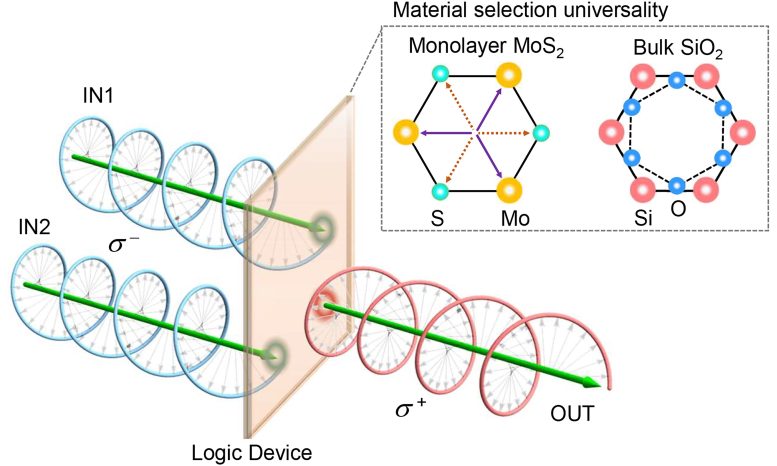
    Optical Chirality Logic Gate Schematic
    The optical chirality logic gate is made of a material that emits lights with different circular polarization depending on the chirality of the input beams. Credit: Yi Zhang / Aalto University

    This new approach, which is described in a paper published in the journal Science Advances, uses circularly polarized light as the input signal. The logic gates are made from crystalline materials that are sensitive to the handedness of a circularly polarized light beam – that is, the light emitted by the crystal depends on the handedness of the input beams. This serves as the basic building block for one type of logic gate (XNOR), and the remaining types of logic gates are built by adding filters or other optical components.

    Additionally, the team demonstrated that a single device could contain all of their chirality logic gates operating simultaneously in parallel. This is a significant advance over existing logic gates, which can only carry out a single logic operation at a time. Simultaneous parallel logic gates could be used to build complex, multifunctional logic circuits. Finally, the team demonstrated that the chirality logic gate could be controlled and configured electronically, a necessary step for hybrid electrical/optical computing.

    Reference: “Chirality logic gates” by Yi Zhang, Yadong Wang, Yunyun Dai, Xueyin Bai, Xuerong Hu, Luojun Du, Hai Hu, Xiaoxia Yang, Diao Li, Qing Dai, Tawfique Hasan and Zhipei Sun, 9 December 2022, Science Advances.
    DOI: 10.1126/sciadv.abq8246

    Never miss a breakthrough: Join the SciTechDaily newsletter.
    Follow us on Google and Google News.

    Aalto University Optics Popular
    Share. Facebook Twitter Pinterest LinkedIn Email Reddit

    Related Articles

    New Camera Combines Lasers and Terahertz Waves to Reveal ‘Unseen’ Detail and ‘See Inside’ Objects

    “Perfect” Solar Energy Absorber Created by Laser Etching Metal With Nanoscale Structures

    New Quantum Detector Measures the Tiniest Energies in Superconducting Circuits

    New Flexible Transparent Solar Cells Could Be Used in Buildings, Vehicles and Portable Electronics

    Pavlov’s Soft Robot: Liquid Crystal Polymer Learns to Move and Grab Objects

    Blanket of Entangled Light Pulses for Larger and More Powerful Quantum Computers

    Prototype Large-Scale Quantum Processor Made Entirely of Light

    New Tunable Optical Chips Can Be Used As Building-Blocks for Next Generation Quantum Computers

    Engineers Develop a Telescopic Contact Lens

    3 Comments

    1. jms on December 12, 2022 4:13 pm

      Moore seems safe.

      Reply
    2. Dr Kincaid on December 14, 2022 7:29 am

      “About a million” is what I expect from general interest publications. I opened this article to see actual units of performance.

      Reply
    3. Kim Wilson on December 14, 2022 5:15 pm

      Less than 100 fsec. Think massively parallel.

      Reply
    Leave A Reply Cancel Reply

    • Facebook
    • Twitter
    • Pinterest
    • YouTube

    Don't Miss a Discovery

    Subscribe for the Latest in Science & Tech!

    Trending News

    Scientists Recreate a Nuclear Fireball and Uncover Fallout’s Hidden Chemistry

    These Tiny Gut Particles Could Be Accelerating Aging Throughout the Body

    Doctors Changed One Thing and Weight Gain Stopped

    Magnetic Fields May Solve a Longstanding Binary Star Mystery

    The Probiotic Breakthrough for Natural Anxiety Relief and Better Mental Health

    Animal vs. Plant Protein: Scientists Found a Surprising Nutritional Difference

    According to Scientists, This Simple Dietary Change Is Linked to Lower Depression Scores

    Researchers Discover a Hidden Vitamin D Problem That Persists Year-Round

    Follow SciTechDaily
    • Facebook
    • Twitter
    • YouTube
    • Pinterest
    • Newsletter
    • RSS
    SciTech News
    • Biology News
    • Chemistry News
    • Earth News
    • Health News
    • Physics News
    • Science News
    • Space News
    • Technology News
    Recent Posts
    • NASA Spots Giant Ocean Swell Signaling a Potential El Niño Comeback
    • The “Impossible” Earthquake Beneath Utah Was Real After All
    • Scientists Uncover Why Walking Gets Slower and More Exhausting As We Age
    • 24 Hours Without Sleep Changes Your Saliva in Measurable Ways
    • A Major Update Just Hit Cholesterol Guidelines – Here’s What Every Adult Needs To Know
    Copyright © 1998 - 2026 SciTechDaily. All Rights Reserved.
    • Science News
    • About
    • Contact
    • Editorial Board
    • Privacy Policy
    • Terms of Use

    Type above and press Enter to search. Press Esc to cancel.