
Advancing Electric Propulsion for Deep Space Exploration
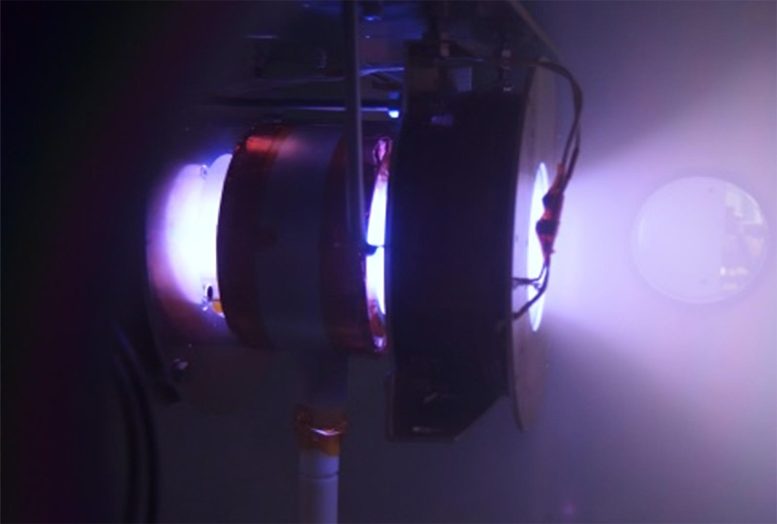
A researcher at Tohoku University has made significant improvements to a high-power electrodeless plasma thruster, bringing us closer to deeper space exploration.
These advancements in electric propulsion technology have the potential to revolutionize the space industry in the same way that innovations in terrestrial transportation, such as cars, trains, and aircraft, have transformed their respective industries.
Electric propulsion is a technique utilizing electromagnetic fields to accelerate a propellant and generate thrust that propels a spacecraft. Space agencies have pioneered electric propulsion technology as the future of space exploration.
Already, several space missions have successfully been completed using electric propulsion devices, such as gridded ion thrusters and Hall thrusters. Solar power is converted into thrust energy when the propellant becomes ionized, i.e., a plasma, and gets accelerated by electromagnetic fields. Yet, the electrodes necessary for these devices limit their lifetime, since they get exposed to and damaged by the plasma, especially at a high-power level.
he Promise of MN rf Plasma Thrusters
To circumvent this, scientists have turned to electrodeless plasma thrusters. One such technology harnesses radio frequency (rf) to generate plasma. An antenna emits radio waves into a cylindrical chamber to create plasma, where a magnetic nozzle channels and accelerates the plasma to generate thrust. MN rf plasma thrusters, or helicon thrusters as they are sometimes known, offer simplicity, operational flexibility, and a potentially high thrust-to-power ratio.
But the development of MN rf plasma thrusters has been stymied by the conversion efficiency of the rf power to thrust energy. Early experiments generated single-digit conversion rates, but more recent studies have reached a modest outcome of 20%.
Achieving a Record 30% Efficiency with Argon
In a recent study, Professor Kazunori Takahashi, from Tohoku University’s Department of Electrical Engineering, has achieved a 30% conversion efficiency.
Whilst mature electric propulsion devices often use xenon gas, which is expensive and difficult to supply in sufficient quantities, the current 30% efficiency was obtained with argon propellant. This indicates that an MN rf plasma thruster would reduce the cost and the resource load from the Earth.
“Applying a cusp-type magnetic field inhibited the energy loss that generally occurs to the plasma source wall,” Takahashi said. “The breakthrough opens the door to advances in high-power space transportation technology.”
Reference: “Thirty percent conversion efficiency from radiofrequency power to thrust energy in a magnetic nozzle plasma thruster” by Kazunori Takahashi, 10 November 2022, Scientific Reports.
DOI: 10.1038/s41598-022-22789-7
Never miss a breakthrough: Join the SciTechDaily newsletter.
Follow us on Google and Google News.
6 Comments
“Captain, they are now igniting PLASMA thrusters”
“Plasma? That’s not even faster than light. Don’t they know that?”
A 10% increase in the matter to propulsion drive, well done. Make it so, Professor Takahashi. Engage.
Since photons carry-away momentum, how about deep space propulsion w/o needing any fuel?
Imagine space-probes w/ large panels of bright/efficient (white/UV) LEDs, for example!!
Instead of plasma propulsion,why scientists don’t use cold LaserJet propulsion??which does not need any gas such as argon or xenon??
We need to couple this device to a 100MW reactor. This would open interplanetary space to human travels.
Instead of plasma propulsion,why scientists don’t use cold LaserJet propulsion??which does not need any gas such as argon or xenon??
This sounds like VASIMR (Variable Specific Impulse Magento-Plasma Rocket) which Ad-Astra corporation has a contract with NASA for. I believe they performed a multi-day ground test at 100KW of RF power in the last year or two.