
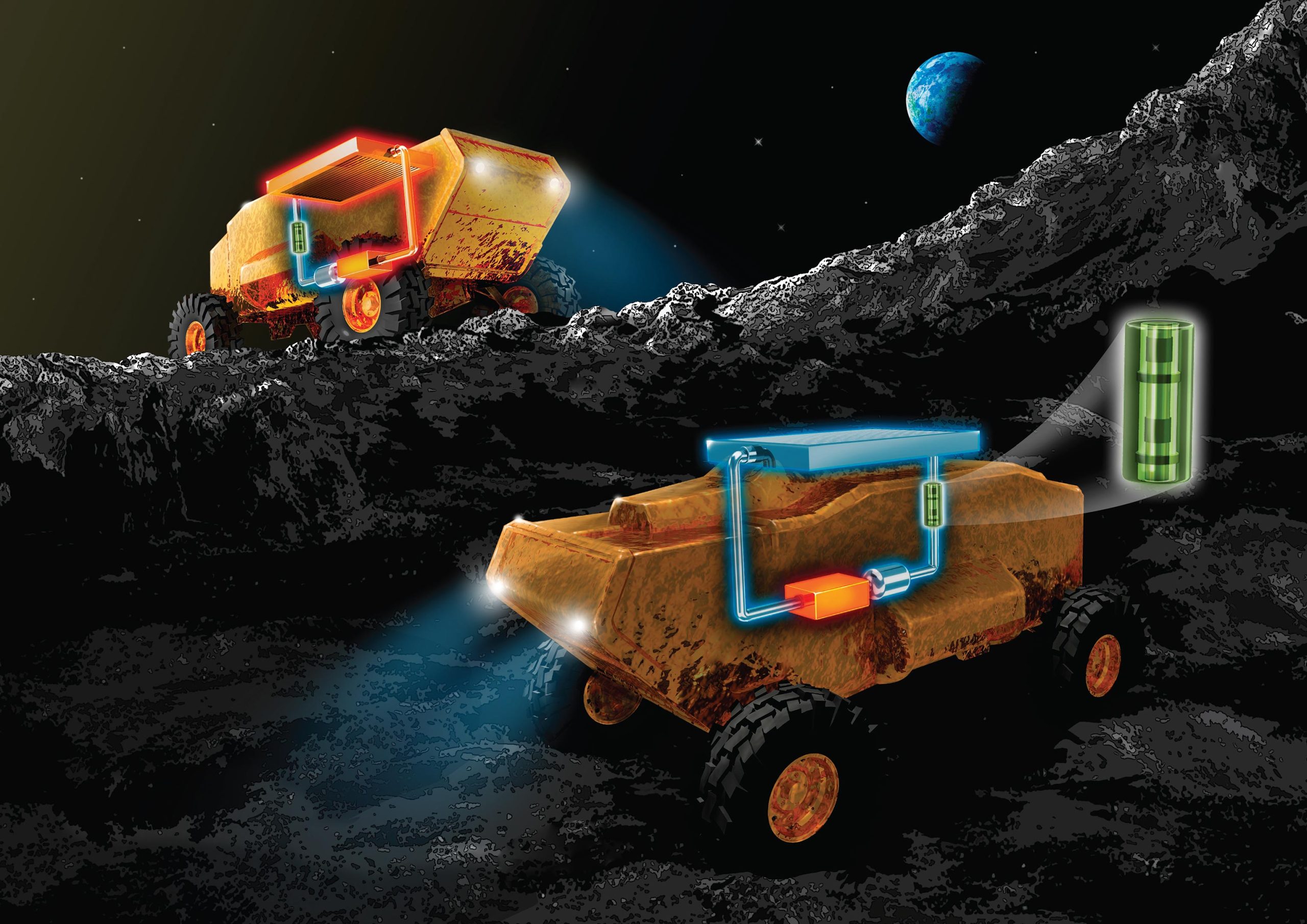
A team from Nagoya University invented a heat-switch device for lunar rovers to withstand the Moon’s extreme temperatures. The technology optimizes thermal control, alternating between cooling and insulating, facilitating longer missions with less energy.
Astronauts navigating the moon’s terrain in a vehicle contend with not only the perils of zero gravity and potential crater falls, but also drastic temperature swings. The moon’s climate ranges from searing highs of 127°C (260°F) to bone-chilling lows of -173°C (-280°F).
team from Nagoya University in Japan developed a heat-switch device designed to enhance the durability of lunar rovers. Their collaborative research with the Japan Aerospace Exploration Agency (JAXA) was featured in the journal Applied Thermal Engineering.
Future lunar missions will need reliable machines that can function under these harsh conditions. Recognizing the need for robust machinery for future exploration of the Moon, a team from Nagoya University in Japan invented a heat-switch device that promises to extend the operational lifespan of lunar-roving vehicles. Their study, conducted in collaboration with the Japan Aerospace Exploration Agency, was published in the journal Applied Thermal Engineering.
Heat-Switch Technology: A Solution for Lunar Conditions
“Heat-switch technology that can switch between daytime heat dissipation and nighttime insulation is essential for long-term lunar exploration,” said lead researcher Masahito Nishikawara. “During the day, the lunar rover is active, and the electronic equipment generates heat. Since there is no air in space, the heat generated by the electronics must be actively cooled and dissipated. On the other hand, during extremely cold nights, electronics must be insulated from the outside environment so that they don’t get too cold.”
Current devices tend to rely on heaters or passive valves attached to loop heat pipes for nighttime insulation. However, heaters are costly, and passive valves can increase the velocity of fluid flow, leading to a drop in pressure that can affect the efficiency of heat transfer. The technology developed by Nishikawara’s team offers a middle ground. With a lower pressure drop than passive valves and lower power consumption than heaters, it retains heat at night without compromising daytime cooling performance.
Operational Mechanics and Energy Efficiency
The thermal control device developed by the team combines a loop heat pipe (LHP) with an electrohydrodynamic (EHD) pump. During the day, the EHD pump is inactive, allowing the LHP to operate as usual. In lunar rovers, the LHP uses a refrigerant that cycles between vapor and liquid states. When the device heats up, the liquid refrigerant in the evaporator vaporizes, releasing heat through the rover’s radiator. The vapor then condenses back into liquid, which returns to the evaporator to absorb heat again. This cycle is driven by capillary forces in the evaporator, making it energy efficient.
At night, the EHD pump applies pressure opposite to the LHP flow, stopping the movement of the refrigerant. Electronics are completely insulated from the cold night environment with minimal electricity use. The team’s research included selection of the EHD pump’s electrode shape, device design, performance evaluation, and a demonstration test to stop LHP operation with the EHD pump. The results showed that the power consumption at night was almost zero.
Impact and Future Applications of the Technology
“This groundbreaking approach not only ensures the rover’s survival in extreme temperatures but also minimizes energy expenditure, a critical consideration in the resource-constrained lunar environment,” Nishikawara said. “It lays the foundation for potential integration into future lunar missions, contributing to the realization of sustained lunar exploration efforts.”
The implications of this technology extend beyond lunar rovers to broader applications in spacecraft thermal management. Integrating EHD technology into thermal fluid control systems could improve heat transfer efficiency and mitigate operational challenges. In the future, this could play an important role in space exploration.
The development of this heat-switch device marks an important milestone in developing technology for long-term lunar missions and other space exploration endeavors. All of which means that, in the future, lunar rovers and other spacecraft should be better equipped to operate in the extreme environments of space.
Reference: “Demonstration of heat switch function of loop heat pipe controlled by electrohydrodynamic conduction pump” by Masahito Nishikawara, Takeshi Miyakita, Genki Seshimo, Hiroshi Yokoyama and Hideki Yanada, 15 May 2024, Applied Thermal Engineering.
DOI: 10.1016/j.applthermaleng.2024.123428
Never miss a breakthrough: Join the SciTechDaily newsletter.
Follow us on Google and Google News.