
Close Menu
    Facebook X (Twitter) Instagram
    SciTechDaily
    • Biology
    • Chemistry
    • Earth
    • Health
    • Physics
    • Science
    • Space
    • Technology
    Facebook X (Twitter) Pinterest YouTube RSS
    SciTechDaily
    Home»Chemistry»Researchers Have Developed an Entire Color Palette of Inexpensive Fluorescent Dyes
    Chemistry

    Researchers Have Developed an Entire Color Palette of Inexpensive Fluorescent Dyes

    By ETH ZurichFebruary 7, 2023No Comments2 Mins Read
    Facebook Twitter Pinterest Telegram LinkedIn WhatsApp Email Reddit
    Share
    Facebook Twitter LinkedIn Pinterest Telegram Email Reddit
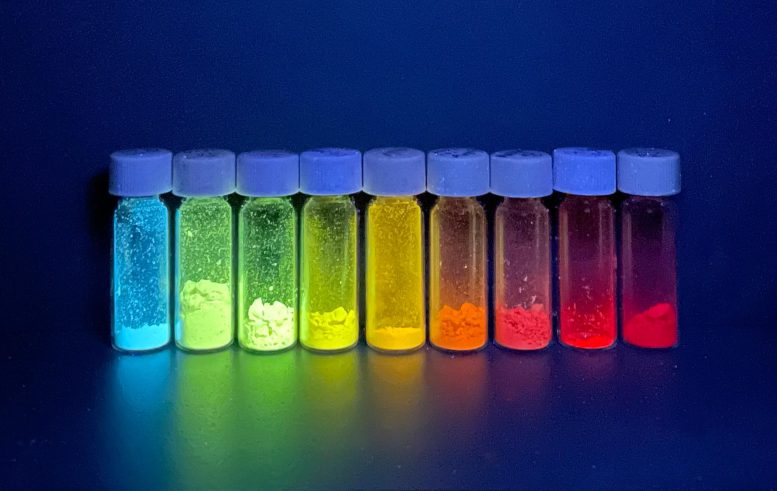
    Inexpensive Fluorescent Dyes
    Polymer fluorescent inks can now also be produced in red. Credit: ETH Zurich

    AI-Designed Fluorescent Dyes Unlock New Possibilities in Security and Tech Applications

    ETH Zurich researchers have created new fluorescent dyes that are simple and inexpensive to make. The dyes are made up of modular polymers with varying numbers of subunits that determine their color. The subunits are either easily obtainable commercially or can be produced in a single reaction step by chemists.

    Yinyin Bao, a senior scientist in the groups of ETH professors Jean-Christophe Leroux and Chih-Jen Shih, led a team of scientists in successfully using a new approach to generate a diverse spectrum of colors, including red, which was previously challenging to produce. Working with scientists from RMIT University in Melbourne, they utilized artificial intelligence algorithms to determine the required number of molecule subunits for each desired color.

    Potential applications for the fluorescent inks include UV-​activated security inks for banknotes, certificates, passports, or for encrypting information. The method can also be used to produce inks that change color after prolonged UV illumination. In their new work, which the scientists published in the scientific journal Chem, they demonstrated this using the example of two initially red fluorescent inks, one of which turns blue after several minutes of UV illumination, while the other remains red. This property can also be used for security features.

    Other applications for the new fluorescent molecules are in solar power plants, or they could one day be combined with semiconducting molecules to produce low-cost organic light-emitting diodes (OLEDs) for displays.

    Reference: “Machine learning-assisted exploration of a versatile polymer platform with charge transfer-dependent full-color emission” by Suiying Ye 1, Nastaran Meftahi, Igor Lyskov, Tian Tian, Richard Whitfield, Sudhir Kumar, Andrew J. Christofferson, David A. Winkler, Chih-Jen Shih, Salvy Russo, Jean-Christophe Leroux and Yinyin Bao, 2 January 2023, Chem.
    DOI: 10.1016/j.chempr.2022.12.003

    Never miss a breakthrough: Join the SciTechDaily newsletter.
    Follow us on Google and Google News.

    Artificial Intelligence ETH Zurich Fluorescence Materials Science Polymers
    Share. Facebook Twitter Pinterest LinkedIn Email Reddit

    Related Articles

    Polymer Fluorescence: Chain Length Determines Molecular Color

    Scientists Turn Plastic Waste Into Valuable Chemicals With Sunlight

    Forget ‘Super’ Glue, Scientists Develop New ‘Hyper’ Glue

    Material Synthesized That Can Increase/Decrease Volume by 100x Controlled by Electrical Signal

    US Army Synthetic Biology Research Advances Toward New Class of High-Performance Materials

    Unique Particles – With Stickiness of Gecko Feet – Formed by Harnessing Chaos

    Super Durable, Flexible, Water-Repelling Material Inspired by Porcupinefish

    Storing Secret Messages in Light-Sensitive Polymers

    MIT Researchers Develop New Strategy for Stronger Polymers

    Leave A Reply Cancel Reply

    • Facebook
    • Twitter
    • Pinterest
    • YouTube

    Don't Miss a Discovery

    Subscribe for the Latest in Science & Tech!

    Trending News

    Popular Vitamin B3 Supplements May Help Cancer Cells Survive, Scientists Warn

    Scientists Discover Strange Property of Rice and Turn It Into a Smart Material

    NASA Artemis II Skips Burn As Astronaut Captures Stunning View of Earth

    NASA’s Artemis II: Humans Just Left Earth Orbit for the First Time Since 1972

    What Causes Chronic Pain? Scientists Identify Key Culprit in the Brain

    Semaglutide Shows Surprising Mental Health Benefits in Massive 100,000-Person Study

    This Liquid Snapped Instead of Flowing and Scientists Were Shocked

    Breakthrough Alzheimer’s Drug Rewires the Brain Instead of Just Clearing Plaques

    Follow SciTechDaily
    • Facebook
    • Twitter
    • YouTube
    • Pinterest
    • Newsletter
    • RSS
    SciTech News
    • Biology News
    • Chemistry News
    • Earth News
    • Health News
    • Physics News
    • Science News
    • Space News
    • Technology News
    Recent Posts
    • Scientists Uncover the Secret “Glue” That Helps Soil Hold Water
    • Climate Change Is Altering a Key Greenhouse Gas in a Way Scientists Didn’t Expect
    • Why Antarctic Sea Ice Suddenly Collapsed After Decades of Growth
    • Astronomers Discover the Most Pristine Star Ever Found
    • New Study Suggests Gravitational Waves May Have Created Dark Matter
    Copyright © 1998 - 2026 SciTechDaily. All Rights Reserved.
    • Science News
    • About
    • Contact
    • Editorial Board
    • Privacy Policy
    • Terms of Use

    Type above and press Enter to search. Press Esc to cancel.