
Close Menu
    Facebook X (Twitter) Instagram
    SciTechDaily
    • Biology
    • Chemistry
    • Earth
    • Health
    • Physics
    • Science
    • Space
    • Technology
    Facebook X (Twitter) Pinterest YouTube RSS
    SciTechDaily
    Home»Space»Astronomers Discover a Gamma-Ray Burst without a Radio Afterglow
    Space

    Astronomers Discover a Gamma-Ray Burst without a Radio Afterglow

    By Curtin UniversityDecember 23, 2013No Comments3 Mins Read
    Facebook Twitter Pinterest Telegram LinkedIn WhatsApp Email Reddit
    Share
    Facebook Twitter LinkedIn Pinterest Telegram Email Reddit
    Researchers Discover a New Population of Exploding Stars
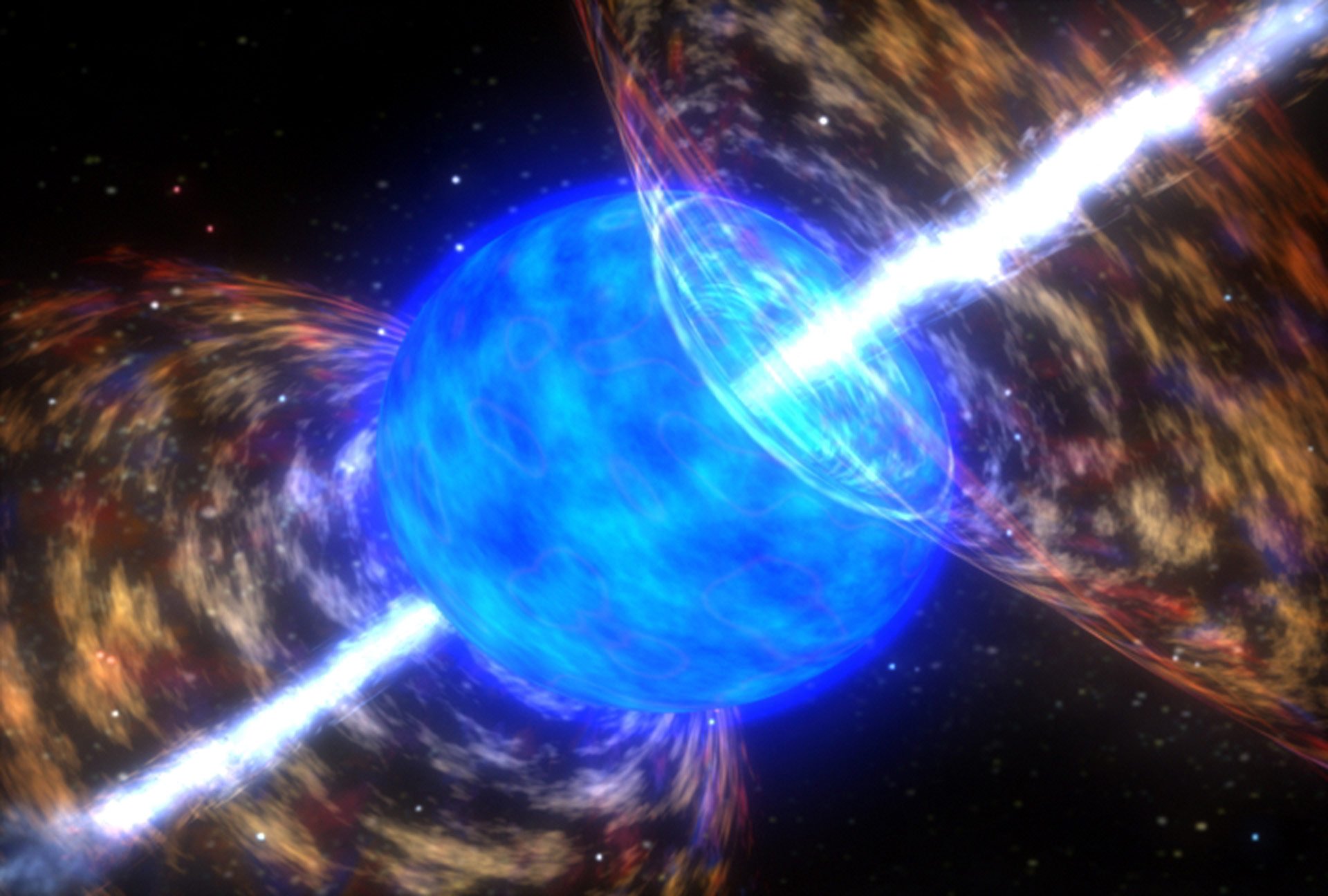
    Astronomers found a new group of exploding stars that cease emitting radio waves before collapsing into a Black Hole. Credit: NASA

    In a new study, astronomers detail the discovery of a gamma-ray burst without a radio afterglow.

    Astronomers led by a Curtin University researcher have discovered a new population of exploding stars that “switch off” their radio transmissions before collapsing into a Black Hole.

    These exploding stars use all of their energy to emit one last strong beam of highly energetic radiation – known as a gamma-ray burst – before they die.

    Up until now, it was thought all gamma-ray bursts were followed by a radio afterglow – a premise that a team of Australian astronomers of the Center for All-sky Astrophysics (CAASTRO) at Curtin University and the University of Sydney originally set out to prove correct.

    “But we were wrong. After studying an ultra-sensitive image of gamma-ray bursts with no afterglow, we can now say the theory was incorrect and our telescopes have not failed us,” lead researcher and Curtin research fellow Dr Paul Hancock said.

    The technique used to create the ultra-sensitive image was recently published in The Astrophysical Journal.

    It allowed for the stacking of 200 separate observations on top of each other to re-create the image of a gamma-ray burst in much better quality – yet, no trace of a radio afterglow was found.

    “In our research paper we argue that there must be two distinct types of gamma-ray burst, likely linked to differences in the magnetic field of the exploding star,” Dr Hancock said.

    “Gamma-ray bursts are thought to mark the birth of a Black Hole or Neutron Star – both of which have super-dense cores. But Neutron Stars have such strong magnetic fields (a million times stronger than those of Black Holes) that producing gamma-rays are more difficult.

    “We think that those stars that collapse to form a Neutron Star have energy left over to produce the radio afterglow whereas those that become Black Holes put all their energy into one final powerful gamma-ray flash.”

    New work is underway to test the team’s theory and to see if there are other subtle ways in which the two types of bursts differ.

    “We now have to take a whole new look at gamma-ray bursts – so far this work has shown that being wrong is sometimes more interesting than being right,” Dr Hancock said.

    Telescope facilities such as the Australia Telescope Compact Array in northern New South Wales and the Karl Jansky Very Large Array in the US both have observing programs to search for gamma-ray burst afterglows and have been recently upgraded to increase their sensitivity.

    The ARC Center of Excellence for All-sky Astrophysics (CAASTRO) is a collaboration between The University of Sydney, The Australian National University, The University of Melbourne, Swinburne University of Technology, the University of Queensland, The University of Western Australia and Curtin University, the latter two participating together as the International Center for Radio Astronomy Research (ICRAR). CAASTRO is funded under the Australian Research Council (ARC) Center of Excellence program, with additional funding from the seven participating universities and from the NSW State Government’s Science Leveraging Fund.

    Reference: “Two populations of gamma-ray burst radio afterglows” by P. J. Hancock, B. M. Gaensler and T. Murphy, 4 October 2013, The Astrophysical Journal.
    DOI: 10.1088/0004-637X/776/2/106
    arXiv:1308.4766

    Never miss a breakthrough: Join the SciTechDaily newsletter.
    Follow us on Google and Google News.

    Astronomy Astrophysics Black Hole Curtin University Gamma Ray
    Share. Facebook Twitter Pinterest LinkedIn Email Reddit

    Related Articles

    Black Hole Jets Pack Power of 10,000 Suns, Stunning New Study Reveals

    Astronomers Witness Unprecedented Cosmic Explosion Linked to a “Missing” Black Hole

    A Bizarre Seven-Hour Gamma-Ray Explosion From Deep Space Has Left Astronomers Puzzled

    Strange, Record-Breaking Gamma-Ray Explosion Lasted 7 Hours and Defies Explanation

    Scientists Propose New Explanation for “Impossible” Gamma-Ray Burst

    New Astrophysics Model Unveils the Secrets of Long Gamma-Ray Bursts

    A New Way To Annihilate a Star: Stellar Demolition Derby Near Black Hole in Ancient Galaxy

    Unprecedented Discovery: Astronomers Observe Most Distant Black Hole Devouring a Star

    Researchers Study Mysterious Gamma Ray Source with No Known Counterpart

    Leave A Reply Cancel Reply

    • Facebook
    • Twitter
    • Pinterest
    • YouTube

    Don't Miss a Discovery

    Subscribe for the Latest in Science & Tech!

    Trending News

    “I Couldn’t Do It Anymore” – Antarctic Guides Quit Their Dream Jobs After Witnessing Tourism’s Damage

    Scientists Say Eating Less Protein May Help You Live Longer

    Scientists Solve a Long-Standing Mystery About Bird and Dinosaur Eggs

    Belly Fat and Low Vitamin D May More Than Double the Risk of Early Death

    Lost in Space: Rare Cosmic Flare Exposes a Wandering Black Hole Far From Its Galaxy’s Center

    Dark Matter May Be Leaving a Signal in Earth’s Atmosphere

    Scientists Discover a 300-Million-Year-Old Geological Time Capsule Inside Fossilized Wood

    Oral Weight Loss Pill Helps Patients Lose up to 12% of Body Weight

    Follow SciTechDaily
    • Facebook
    • Twitter
    • YouTube
    • Pinterest
    • Newsletter
    • RSS
    SciTech News
    • Biology News
    • Chemistry News
    • Earth News
    • Health News
    • Physics News
    • Science News
    • Space News
    • Technology News
    Recent Posts
    • Industrial Chicken Farming Is Supercharging the Spread of a Dangerous Foodborne Bacterium
    • Honeybee Queens May Pass Toxic Chemicals to the Next Generation
    • This Common Amino Acid May Help the Body Fight Cancer and Viruses
    • Schizophrenia’s Brain Damage May Start in One Key Region
    • A Simple Treatment Could Save Extremely Premature Babies From Blindness
    Copyright © 1998 - 2026 SciTechDaily. All Rights Reserved.
    • Science News
    • About
    • Contact
    • Editorial Board
    • Privacy Policy
    • Terms of Use

    Type above and press Enter to search. Press Esc to cancel.