
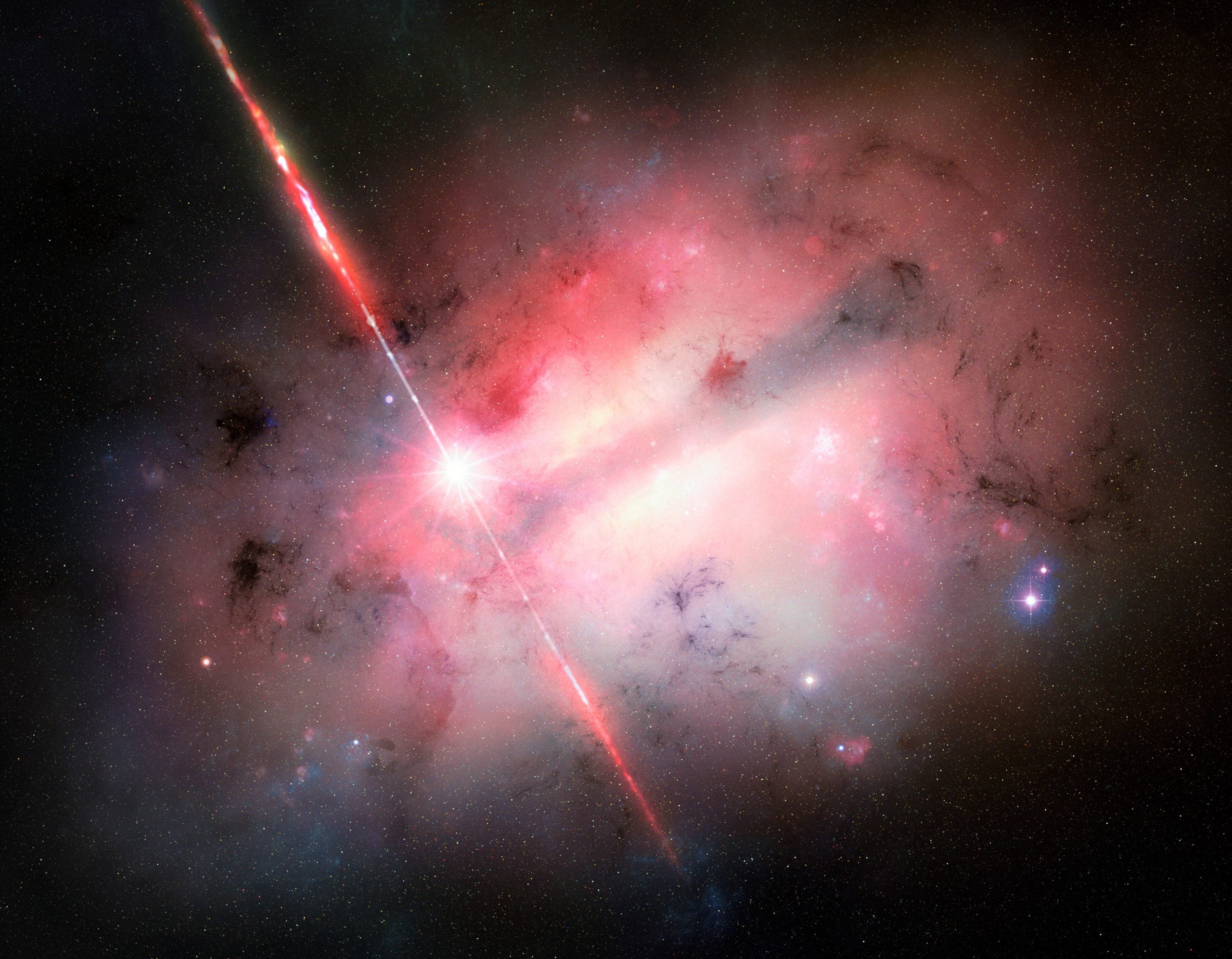
A record-breaking cosmic explosion has forced astronomers to rethink what they know about gamma-ray bursts.
Researchers at the University of North Carolina at Chapel Hill have contributed to new insights into the most long-lived cosmic explosion ever recorded. The event was a gamma-ray burst that remained active for nearly seven hours. Known as GRB 250702B, it pushes beyond long-standing theories about the processes that create these powerful outbursts.
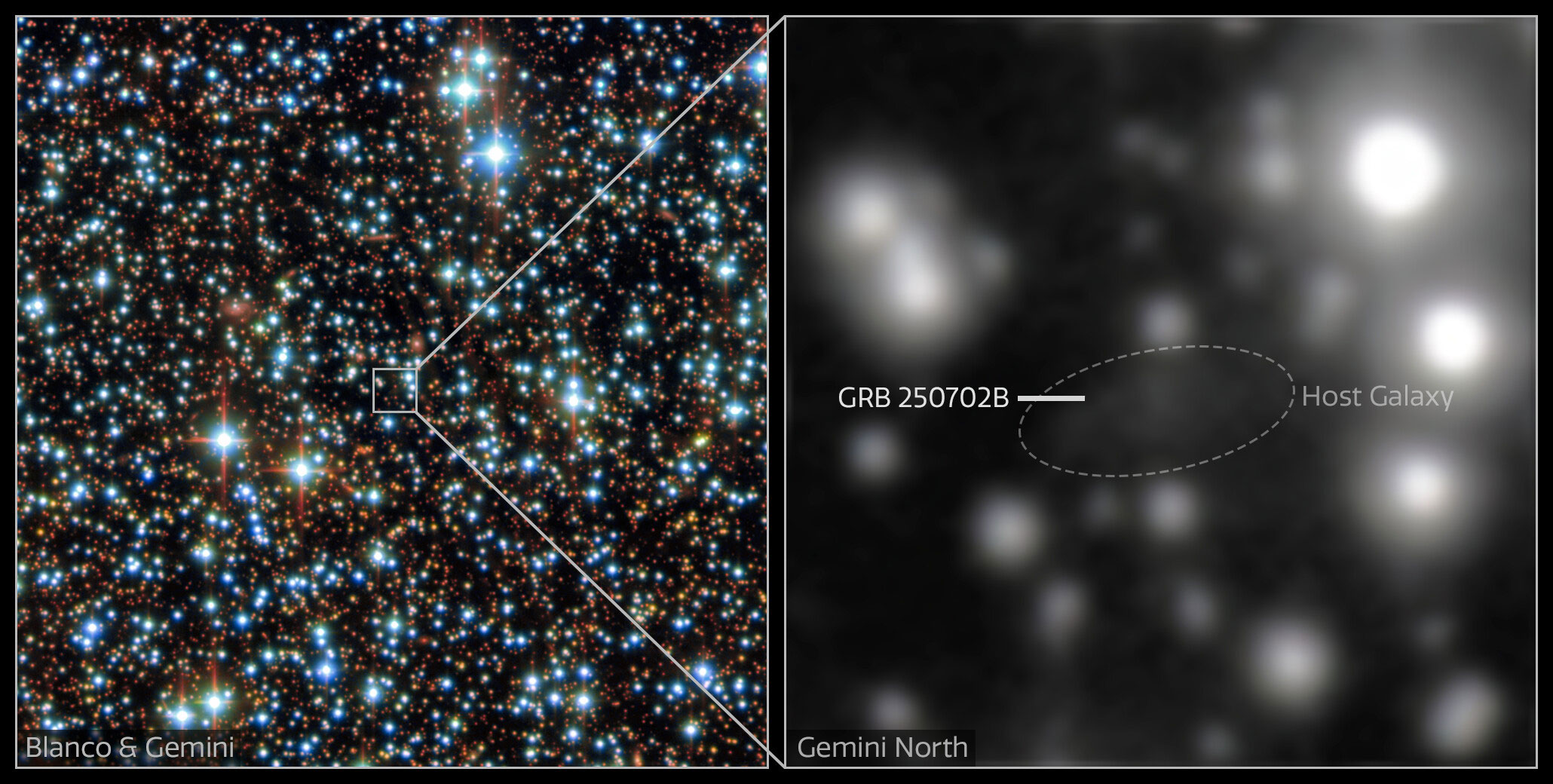
Gamma-ray bursts are brief but extreme surges of high-energy radiation triggered by violent events in space and typically last only seconds or minutes. GRB 250702B defied that pattern, setting a new duration record. Following its discovery by space-based instruments, astronomers turned to some of the world’s largest ground-based telescopes to observe the fading afterglow. These observations traced the burst to a large, dust-filled galaxy.
The observations were part of a coordinated international campaign led in part by the UNC team, which relied on major ground-based telescopes in the United States. Their findings were combined with data from the European Southern Observatory’s Very Large Telescope, NASA’s Hubble Space Telescope and X-ray observations. Together, the evidence points to several possible explanations for the explosion, ranging from the collapse of a massive star to the merger of unusual stellar remnants, or even a star being shredded by a black hole. For now, the available data are not sufficient to determine which of these possibilities is responsible.
“This was the longest gamma-ray burst that humans have observed—long enough that it does not fit into any of our existing models for what causes gamma-ray bursts,” said Jonathan Carney, lead author of the study and PhD student in physics and astronomy at UNC-Chapel Hill.
A Rare Opportunity to Study Extreme Physics
Gamma-ray bursts are among the largest explosions in the universe, and astronomers have to rush to capture data before their light fades. Because this event was more prolonged and unusual, it offered scientists a rare opportunity to study the environment with both information from the explosion itself and later imaging of the host galaxy. The researchers found the explosion came from a distant, massive galaxy full of dust that blocked visible light—allowing only infrared and high-energy emissions to be detected.
“We’re not sure what caused this record-breaking event,” said Igor Andreoni, co-author and assistant professor of physics and astronomy at UNC-Chapel Hill. “We know it occurred billions of light-years away in a very complex galaxy. Our data revealed that an energetic phenomenon launched a narrow jet of material in our direction that traveled at least 99% the speed of light, piercing through thick layers of cosmic dust.”
Understanding these massive explosions helps scientists probe some of the universe’s most extreme environments where matter moves at nearly the speed of light, densities exceed atomic nuclei, and gravity is strong enough to warp spacetime itself. They also play a key role in scattering heavy elements, including those essential for life, across the cosmos.
“Our analysis shows this event could have several different causes—including the death of a massive star, the collision of a helium star, or even a star being ripped apart by a black hole,” Carney said. “But we can’t yet tell which explanation is correct. In the future, this event will serve as a unique benchmark—when astronomers discover similar explosions, they’ll ask whether they match GRB 250702B’s properties or represent something different entirely.”
Reference: “Optical/Infrared Observations of the Extraordinary GRB 250702B: A Highly Obscured Afterglow in a Massive Galaxy Consistent with Multiple Possible Progenitors” by Jonathan Carney, Igor Andreoni, Brendan O’Connor, James Freeburn, Hannah Skobe, Lewi Westcott, Malte Busmann, Antonella Palmese, Xander J. Hall, Ramandeep Gill, Paz Beniamini, Eric R. Coughlin, Charles D. Kilpatrick, Akash Anumarlapudi, Nicholas M. Law, Hank Corbett, Tomas Ahumada, Ping Chen, Christopher Conselice, Guillermo Damke, Kaustav K. Das, Avishay Gal-Yam, Daniel Gruen, Steve Heathcote, Lei Hu, Viraj Karambelkar, Mansi Kasliwal, Kathleen Labrie, Dheeraj Pasham, Arno Riffeser, Michael Schmidt, Kritti Sharma, Silona Wilke and Weicheng Zang, 26 November 2025, The Astrophysical Journal Letters.
DOI: 10.3847/2041-8213/ae1d67
Never miss a breakthrough: Join the SciTechDaily newsletter.
Follow us on Google and Google News.
4 Comments
Gamma rays product Gamma WAVES correct… They effect every planet they come in contact with which change behavior cycle of ocean waves,,, animals such as birds… Supposedly human behavior… Birds like sandhill cranes have gamma waves in their wings flight patterns… Watch birds in flight sandhill cranes are the simplest and most prevalent example of this gamma waves of motions… JUST my opinion
Where’s a good place for stargazing in the Triangle? Was any data sourced from local telescopes?
I’m sure the burst has the characteristics of a Gamma Ray but my question would ask what is it’s intensity of the energy that makes up the observation , and does that correlate in anyway compared to distance something like the lag time in radio transmissions . how many light years is this galaxie cluster from us and when gamma rays travel across the universe does distances stretch the ray to maximise it’s length of the energy signature and the time of the observation .
Death star exploding