
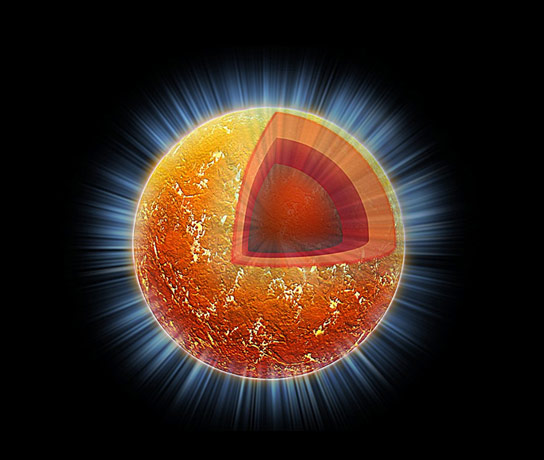
New research shows the similarities that neutron stars have with black holes.
For astrophysicists, neutron stars are extremely complex astronomical objects. Research conducted with the collaboration of SISSA and published in the journal Physical Review Letters demonstrates that in certain respects these stars can instead be described very simply and that they show similarities with black holes.
In how many ways can one describe an object? Take an apple: by just looking at it we can easily estimate its weight, shape, and color but we are unable to describe it at any other level, for example, to evaluate the chemical composition of its flesh. Something similar also applies to astronomical objects: until today one of the challenges facing scientists was to describe neutron stars at the nuclear physics level. The matter these stars are made up of is in fact extremely complex, and several complicated equations of state have been proposed. However, to date there is no agreement as to which is the correct (or the best) one. A theoretical study conducted by SISSA (the International School for Advanced Studies of Trieste,) in collaboration with Athens University, has demonstrated that neutron stars can also be described in relatively simple terms, by observing the structure of the space-time surrounding them.
“Neutron stars are complex objects owing to the matter that composes them. We can picture them as enormous atomic nuclei with a radius of about ten kilometers,” explains Georgios Pappas, first author of the study carried out at SISSA. “A neutron star is what remains of the collapse of a massive star: the matter inside it is extremely dense and mostly consisting of neutrons.”
“The nuclear physics required to understand the nature of the matter contained in these astronomical objects generally makes their description very complicated and difficult to formulate,” continues Pappas. “What we have demonstrated, by using numerical methods, is that there are properties that can provide a description of some aspects of neutron stars and the surrounding space time in a simple manner, similar to the description used for black holes.”
Black holes are truly unique objects: they have lost all matter and are only made up of space and time. Just like neutron stars they are the result of the collapse of a bigger star (in this case much bigger than the stars giving rise to neutron stars) and in the implosion all the matter has been swept away. “They are considered to be the most perfect objects in the Universe and the expression ‘hairless’ that was coined by John Archibald Wheeler to indicate their simplicity has become famous. According to our calculations, even neutron stars can be depicted in a very similar manner.”
Scientists use “multipole moments” as parameters to describe objects. The moments required to describe a black hole are two, mass and angular momentum (the speed at which it rotates around its axis.) For neutron stars three moments are needed: mass, angular momentum, and quadrupole moment, that is, a coefficient that describes the deformation of the object produced by its rotation.
“Our calculations revealed two unexpected findings. First, we discovered that these three parameters are sufficient since higher levels moments are not independent and can be derived from the first three,” explains Pappas. “The second surprising finding is that the description based on these parameters is independent of the equation of equation of state, or rather: we don’t even need to know which is the equation of state.”
In practice, we can have a description of a neutron star that is independent of the matter that forms it. “This has major implications,” concludes Pappas. “In fact, by using the data collected with astrophysical observations for example, the radiation emitted by a neutron star, or information about objects gravitating around the star or other information we can reconstruct the features of a neutron star.”
Reference: “Effectively universal behavior of rotating neutron stars in general relativity makes them even simpler than their Newtonian counterparts” by George Pappas and Theocharis A. Apostolatos, 26 March 2014, Physical Review Letters.
DOI: 10.1103/PhysRevLett.112.121101
arXiv:1311.5508
Never miss a breakthrough: Join the SciTechDaily newsletter.
Follow us on Google and Google News.
1 Comment
George Pappas, thank you for your examination of neutron stars.
I have not studied neutron stars, though these might have some similarities to black holes, I suspect there are few in common traits. One difference is the lack of angular momentum of the main body of the black holes. (I hasten to add I know this statement is not scientifically acceptable. Nor is any of the following.) In plain language –
The typical black hole could be visualized as a modified Boise-Einstein condensate, one quite dense.
1. Accreting matter, atoms, falling into the ergosphere of a black hole is shredded or separated into electrons and neutrons/protons.
2. The electrons take up positions within a stratum or ‘shell’ outside the main body. This entity behaves as a unit with quantum wave characteristics, that orbits the main body at high velocity.
3. The remainder atomic matter is absorbed into the black hole, another quantum state. At absolute zero K, particles cease all random motion, a prerequisite for forming condensates.
While in transit to the black hole thermal, kinetic, gravitational energies of accreting matter are shed by radiation and hot winds into the surrounding atmosphere and finally in the ergosphere, totally, before admission to the dense body is permitted. The most extreme example of this action is the quasar.
The angular momentum possessed by accreting matter is deposited in the strata of electrons/leptons surrounding the B-E condensate.
The electron like stratum encasing the B-E condensate may be considered to have spin, but the B-E condensate does not, though there may be vortices and swirls.
(More science heresy –) Individual black holes cannot totally merge with other black holes. Probably due to the electron barriers.
(More contrarian claims-) The nucleus of a mature galaxy is composed of multiple black holes of various masses, not just one massive black hole. Portions of a nucleus may under certain circumstances ‘calve’ or loosen portions of itself in a process described as Mitosis of Galactic Nuclei. These ‘daughter units’ when lodged within the galaxy proceed to form stars and are called stellar globular clusters. Those units that escape the galaxy eventually form what we call satellite galaxies. (The description of this process is too long to include here.)
If you have read to here, Dr. Pappas, you have great perseverance.
Thank you, again, k