
Close Menu
    Facebook X (Twitter) Instagram
    SciTechDaily
    • Biology
    • Chemistry
    • Earth
    • Health
    • Physics
    • Science
    • Space
    • Technology
    Facebook X (Twitter) Pinterest YouTube RSS
    SciTechDaily
    Home»Space»Cassini Views Four Moons of Saturn
    Space

    Cassini Views Four Moons of Saturn

    By NASAMarch 25, 2014No Comments2 Mins Read
    Facebook Twitter Pinterest Telegram LinkedIn WhatsApp Email Reddit
    Share
    Facebook Twitter LinkedIn Pinterest Telegram Email Reddit
    Cassini Views Four Moons of Saturn
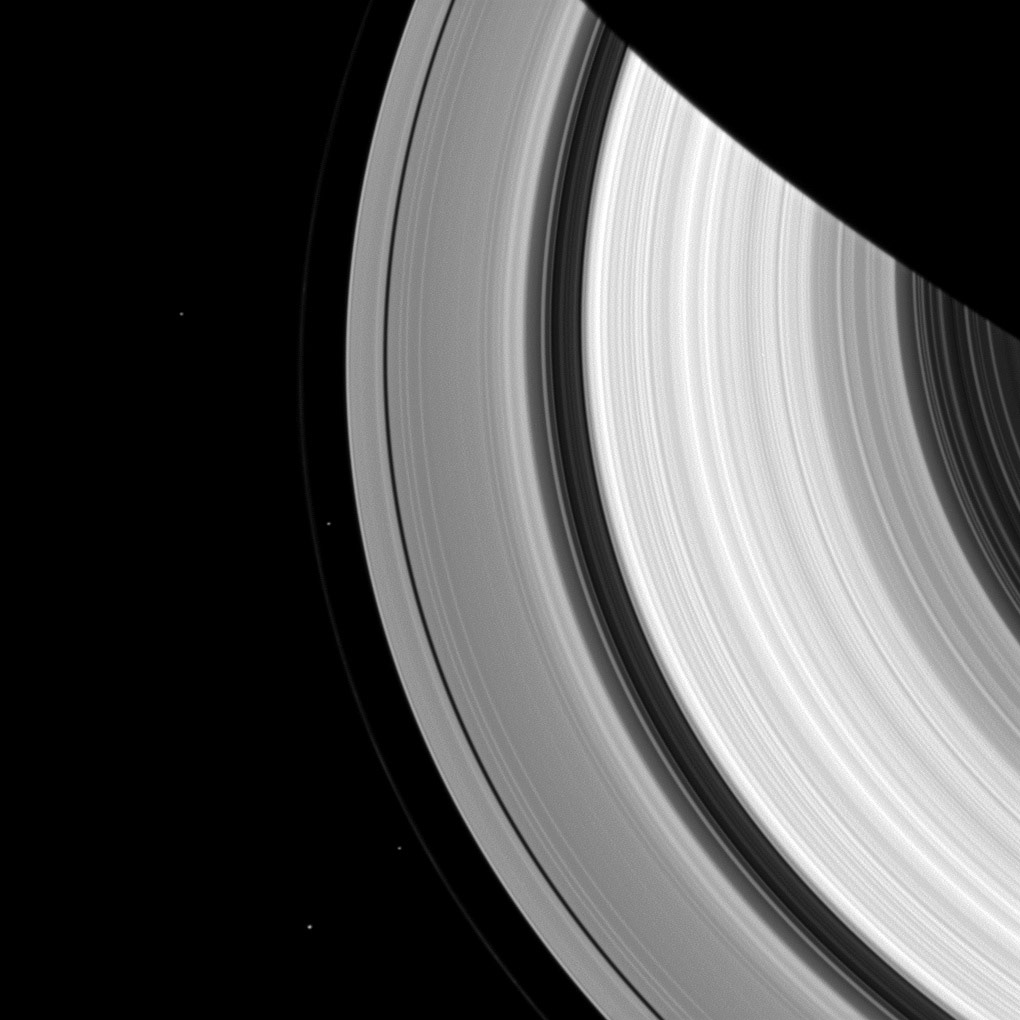
    Two pairs of moons, Prometheus and Pandora inside and outside the F ring, and Janus and Epimetheus farther out, make a rare joint appearance. Credit: NASA/JPL-Caltech/Space Science Institute

    Cassini views Saturn’s moons Prometheus, Pandora, Janus, and Epimetheus.

    Two pairs of moons make a rare joint appearance. The F ring’s shepherd moons, Prometheus and Pandora, appear just inside and outside of the F ring (the thin faint ring furthest from Saturn). Meanwhile, farther from Saturn the co-orbital moons Janus (near the bottom) and Epimetheus (about a third of the way down from the top) also are captured.

    Prometheus (53 miles, or 86 kilometers across) and Pandora (50 miles, or 81 kilometers across) sculpt the F ring through their gravitational influences. Janus (111 miles, or 179 kilometers across) and Epimetheus (70 miles, or 113 kilometers across) are famous for their orbital dance, swapping places about every four years. They are also responsible for gravitationally shaping the outer edge of the A ring into seven scallops.

    This view looks toward the sunlit side of the rings from about 47 degrees above the ringplane. The image was taken in visible light with the Cassini spacecraft wide-angle camera on October 11, 2013.

    The view was acquired at a distance of approximately 810,000 miles (1.3 million kilometers) from Saturn and at a Sun-Saturn-spacecraft, or phase, angle of 47 degrees. The image scale is 47 miles (76 kilometers) per pixel.

    The Cassini-Huygens mission is a cooperative project of NASA, the European Space Agency, and the Italian Space Agency. The Jet Propulsion Laboratory, a division of the California Institute of Technology in Pasadena, manages the mission for NASA’s Science Mission Directorate, Washington, D.C. The Cassini orbiter and its two onboard cameras were designed, developed, and assembled at JPL. The imaging operations center is based at the Space Science Institute in Boulder, Colorado.

    Never miss a breakthrough: Join the SciTechDaily newsletter.
    Follow us on Google and Google News.

    Astronomy JPL Moon NASA Saturn
    Share. Facebook Twitter Pinterest LinkedIn Email Reddit

    Related Articles

    NASA’s Cassini Spots Lightning in Saturn’s Northern Hemisphere

    Cassini Data Reveals Likely Subsurface Ocean on Titan

    Heat from Within the Planet Powers Saturn’s Jet Streams

    Study Finds a Mixture of Both Deep and Shallow Heating on Io

    Saturn’s Moon Phoebe Has Planet-Like Qualities

    A Closer Look at Titan’s Chemical Production

    Cassini Explores Titan’s Lake, Similarities to Etosha Salt Pan

    Cassini Views Saturn’s Moons Enceladus and Tethys

    NASA’s GRAIL Mission Returns Video From Far Side of the Moon

    Leave A Reply Cancel Reply

    • Facebook
    • Twitter
    • Pinterest
    • YouTube

    Don't Miss a Discovery

    Subscribe for the Latest in Science & Tech!

    Trending News

    One of the Universe’s Largest Stars May Be Getting Ready To Explode

    Scientists Discover Enzyme That Could Supercharge Ozempic-Like Weight Loss Drugs

    Popular Sweetener Linked to DNA Damage – “It’s Something You Should Not Be Eating”

    Ancient “Rock” Microbes May Reveal How Complex Life Began

    Researchers Capture Quantum Interference in One of Nature’s Rarest Atoms

    “A Plague Is Upon Us”: The Mass Death That Changed an Ancient City Forever

    Scientists Discover Game-Changing New Way To Treat High Cholesterol

    This Small Change to Your Exercise Routine Could Be the Secret to Living Longer

    Follow SciTechDaily
    • Facebook
    • Twitter
    • YouTube
    • Pinterest
    • Newsletter
    • RSS
    SciTech News
    • Biology News
    • Chemistry News
    • Earth News
    • Health News
    • Physics News
    • Science News
    • Space News
    • Technology News
    Recent Posts
    • Scientists Prove There Are Just Six Degrees of Separation in a Social Network
    • Bee Bacteria Could Fix a Major Flaw in Plant-Based Milk
    • Scientists Discover a Surprising Way To Make Bread Healthier and More Nutritious
    • Natural Compounds Boost Bone Implant Success While Killing Bacteria and Cancer Cells
    • After 60 Years, Scientists Uncover Unexpected Brain Effects of Popular Diabetes Drug Metformin
    Copyright © 1998 - 2026 SciTechDaily. All Rights Reserved.
    • Science News
    • About
    • Contact
    • Editorial Board
    • Privacy Policy
    • Terms of Use

    Type above and press Enter to search. Press Esc to cancel.