
New observations reveal how black hole jets behave under pressure, offering a crucial benchmark for understanding their role in cosmic evolution.
A new study led by Curtin University has used a global network of radio telescopes to capture images that reveal the enormous energy carried by jets from black holes. The results support long-standing ideas about how black holes influence the large-scale structure of the Universe.
Published in Nature Astronomy, the study focused on Cygnus X-1, a system that includes the first confirmed black hole and a massive supergiant star. Researchers found that the jets produced by this system generate energy comparable to 10,000 Suns.
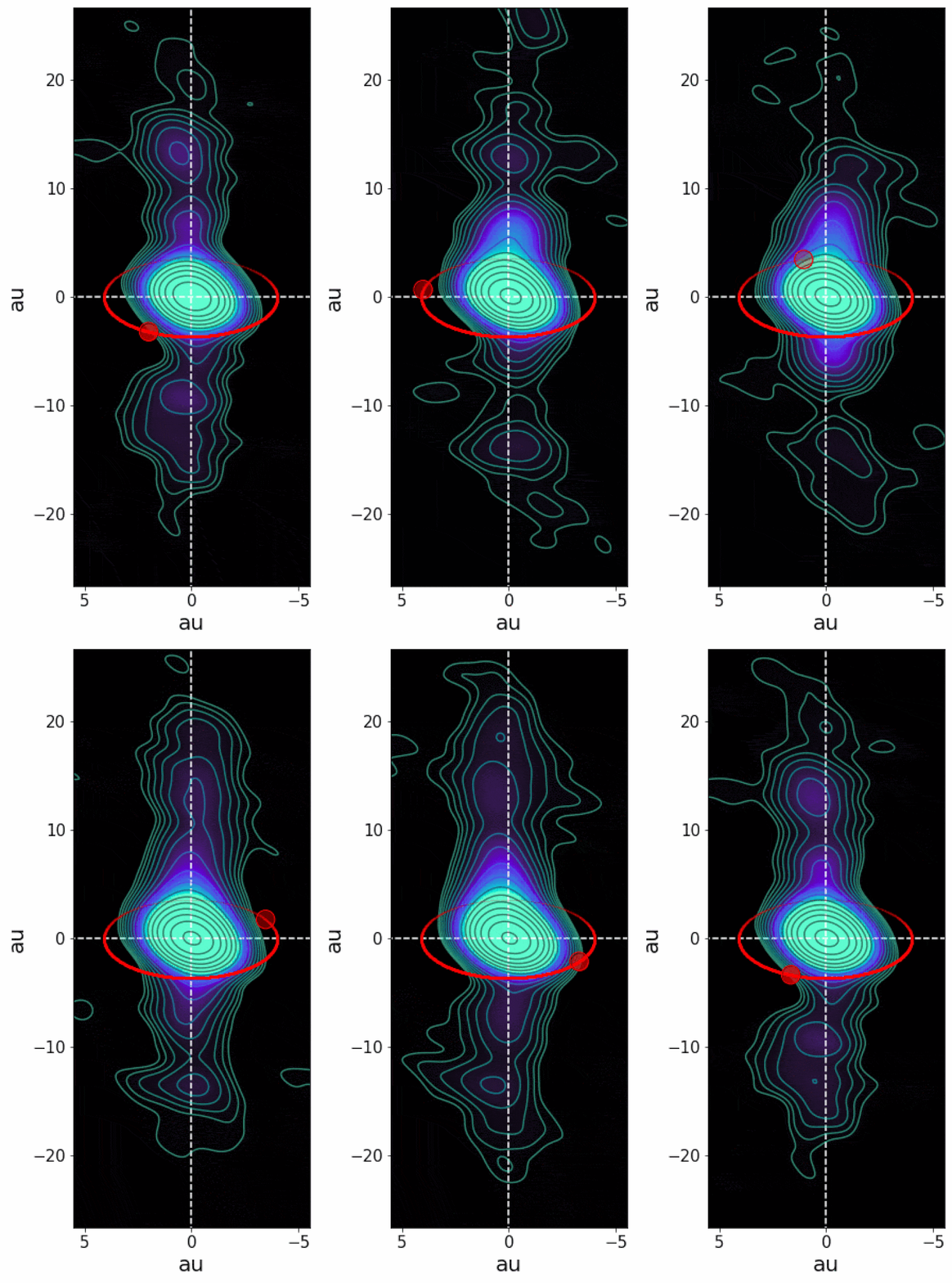
To make this measurement, scientists linked telescopes across vast distances, effectively creating an Earth-sized observing system. This allowed them to track how the jets were pushed and distorted by powerful stellar winds as the black hole orbited its companion star, similar to how strong gusts can disrupt the flow of water in a fountain.
By analyzing the strength of the star’s wind and the degree to which the jets were deflected, the team calculated the jets’ real-time power for the first time.
They also determined the jets’ speed, which reaches about half the speed of light, or 150,000 km per second (93,000 miles per second). This has been a difficult value to pin down for decades.
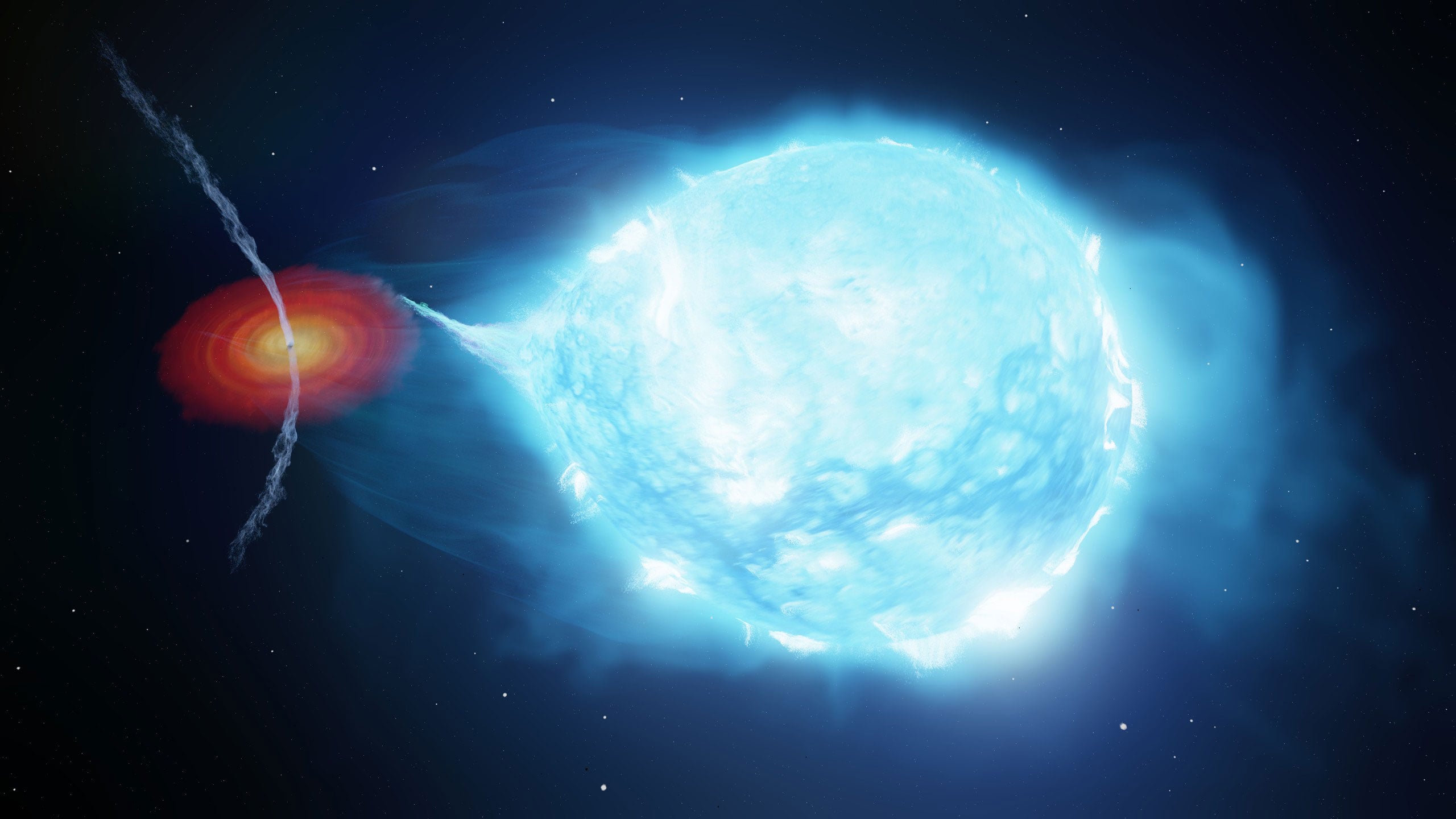
Artist’s impression of the Cygnus X-1 binary system, showing how the wind of the supergiant star bends the black hole’s jets away from the star as the objects move in their orbit around one another. Credit: International Centre for Radio Astronomy Research (ICRAR)
Observing the “Dancing Jets”
The project was led by the Curtin Institute of Radio Astronomy (CIRA) and the Curtin branch of the International Centre for Radio Astronomy Research (ICRAR), working with the University of Oxford.
Lead author Dr Steve Prabu, who was at CIRA during the study and is now based at the University of Oxford, said the team relied on a series of images showing what he called the “dancing jets.” He used this phrase to describe how the jets shift direction as they are repeatedly pushed by the supergiant star’s strong winds while both objects orbit each other.
Dr. Prabu explained that this measurement helps scientists estimate how much of the energy released near a black hole is transferred into its surroundings, where it can alter the environment.
“A key finding from this research is that about 10 percent of the energy released as matter falls in towards the black hole is carried away by the jets,” Dr. Prabu said.
“This is what scientists usually assume in large-scale simulated models of the Universe, but it has been hard to confirm by observation until now.”
Implications for Astrophysics and Galaxy Evolution
Co-author Professor James Miller-Jones, from CIRA and the Curtin branch of ICRAR, said earlier techniques could only estimate jet power averaged over thousands or millions of years. This made it difficult to directly compare jet energy with the X-ray energy released as matter falls into the black hole.
“And because our theories suggest that the physics around black holes is very similar, we can now use this measurement to anchor our understanding of jets, whether they are from black holes 10 or 10 million times the mass of the Sun,” Professor Miller-Jones said.
“With radio telescope projects such as the Square Kilometre Array Observatory currently under construction in Western Australia and South Africa, we expect to detect jets from black holes in millions of distant galaxies, and the anchor point provided by this new measurement will help calibrate their overall power output.
“Black hole jets provide an important source of feedback to the surrounding environment and are critical to understanding the evolution of galaxies.”
Reference: “A jet bent by a stellar wind in the black hole X-ray binary Cygnus X-1” by S. Prabu, J. C. A. Miller-Jones, A. Bahramian, V. Bosch-Ramon, S. Heinz, S. J. Tingay, C. M. Wood, A. J. Tetarenko, T. N. O’Doherty and V. Tudose, 16 April 2026, Nature Astronomy.
DOI: 10.1038/s41550-026-02828-3
Never miss a breakthrough: Join the SciTechDaily newsletter.
Follow us on Google and Google News.