
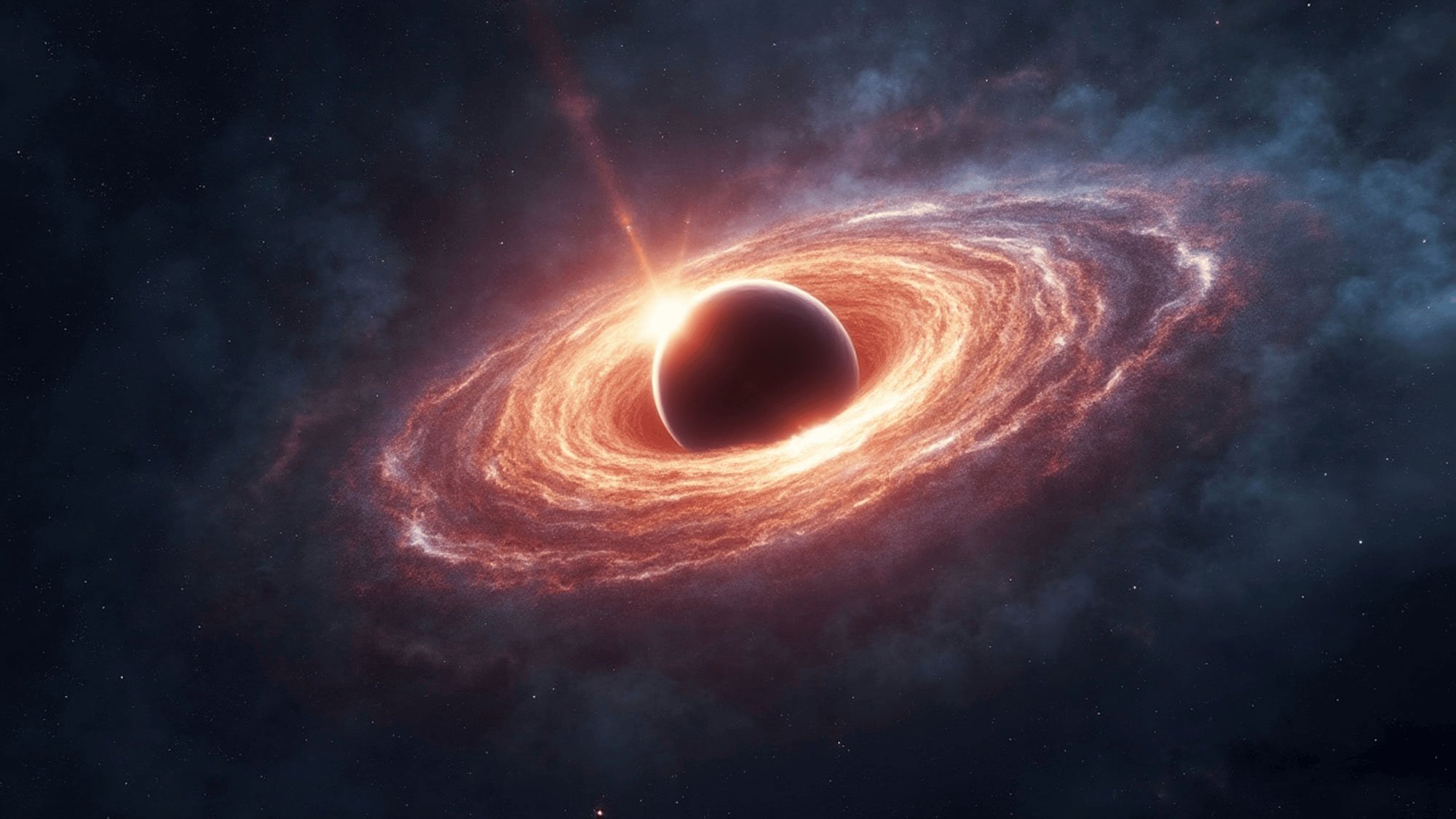
Astronomers confirmed an off-center black hole in a dwarf galaxy. It offers clues to how supermassive black holes may form.
Black holes are most often assumed to sit at the centers of galaxies, but a team led by Dr. Tao An of the Shanghai Astronomical Observatory, Chinese Academy of Sciences, has identified one that breaks this rule. The researchers discovered a wandering black hole in a dwarf galaxy roughly 230 million light-years from Earth (redshift z = 0.017).
Unlike the central black holes typically observed, this one lies nearly a kiloparsec away from the galaxy’s core and is actively producing radio jets. Classified as an off-nuclear, accreting black hole, it represents one of the closest and most clearly confirmed examples known to date.
The findings, published online in Science Bulletin on September 4, add weight to the idea that black hole growth is not confined to galactic centers. This offers new insight into how supermassive black holes may have formed and expanded so rapidly in the early universe.
Black Holes Are Not Always in Galactic Centers
In the standard view of galaxies, black holes are often described as their “hearts.” Yet mounting evidence shows that some do not stay anchored in the center. Instead, these so-called wandering black holes drift through a galaxy’s disk or outer regions, resembling travelers lost in cosmic space.
Why search for wandering black holes in dwarf galaxies? These systems are less massive and have simpler evolutionary paths, making them valuable “cosmic fossils” that hold clues to the early stages of black hole growth. Theoretical models suggest that after galaxy mergers, or through complex multi-body interactions, gravitational recoil can easily eject black holes from the weak gravitational fields of dwarf galaxies, sending them thousands of light-years from their centers. Simulations even indicate that a significant portion of black holes in dwarf galaxies could be displaced by nearly a kiloparsec (about 3,000 light-years). Until recently, however, direct and unambiguous observational proof of this phenomenon had remained out of reach.
New Discovery: A “Radio-loud Wandering Black Hole” in a Dwarf Galaxy
Dr. AN and colleagues directed their study toward a dwarf galaxy known as MaNGA 12772-12704, situated about 230 million light-years from Earth (z ≈ 0.017). Using integral field unit observations from the Mapping Nearby Galaxies at Apache Point Observatory (MaNGA) survey, they identified faint signatures of an active galactic nucleus (AGN). While the galaxy’s overall structure appeared normal, with no clear evidence of merging or a dual AGN, one striking detail emerged: its radio emission was displaced from the galaxy’s geometric center by nearly one kiloparsec (kpc).
Follow-up observations with the Very Long Baseline Array (VLBA) at 1.6 and 4.9 GHz revealed that the source lies 2.68 arcseconds away from the galactic center (corresponding to 0.94 kpc), with a radio core brightness temperature exceeding one billion kelvins. At 1.6 GHz, they detected a jet structure extending about 2.2 parsec (7.2 light-years) southeastward. These are typical AGN features.
Furthermore, by analyzing archival data spanning 1993–2023, the researchers discovered that the source exhibits irregular, long-term variability, becoming brighter and dimmer over decades. This behavior is consistent with sustained, in-situ accretion onto a black hole, and clearly distinct from the monotonically decreasing typical of supernova remnants, effectively ruling out such “impostors.” Based on the stellar mass of the host galaxy, the black hole’s mass is estimated to be about 300,000 times that of the Sun, placing it in the intermediate-mass black hole (IMBH) category.
Together, they confirmed that this is indeed an actively accreting, off-nuclear black hole with jets—currently the nearest and most robustly confirmed case of its kind. “This is like a cosmic lighthouse lit by a wandering black hole, although it has strayed from the galactic center, it still shines outward with powerful energy,” said Dr. Yuanqi Liu, a co-author of the study.
Rarity: Why Is This One So Important?
From a broader statistical perspective, this discovery is particularly striking. Out of more than 3,000 MaNGA dwarf galaxies, 628 showed possible AGN activity, and about 62% appeared offset from their optical centers. Only MaNGA 12772-12704 satisfied the “triple solid evidence” criteria: a compact high-brightness core, parsec-scale jets, and decades-long variability. This suggests that off-nuclear phenomena may not be uncommon. However, a “candidate” does not equal a confirmed detection.
“In dwarf galaxies especially, it is extremely difficult to obtain clear observational evidence for wandering AGN,” said Dr. Mar Mezcua, a co-author of the study from the Institute of Space Sciences of Spain.
Scientific Breakthrough: A New Path for Black Hole Growth
The prevailing view has long been that supermassive black holes primarily grow at galactic centers, rapidly feeding on central gas reservoirs. This study, however, demonstrates that an intermediate-mass black hole located outside the galactic nucleus can also sustain accretion and produce jets. These findings provide direct observational support for the idea that distributed feeding and multi-site growth as a potential pathway for the rapid formation of supermassive black holes in the early universe.
“This discovery prompts us to rethink black hole–galaxy co-evolution. Black holes are not only central ‘engines’, they may also quietly reshape their host galaxies from the outskirts,” said Dr. An.
Even when located in a galaxy’s “suburbs”, wandering black holes can inject energy into the surroundings through powerful outflows, influencing galactic dynamics and star formation.
Outlook: Unveiling the Cosmic Population of “Invisible” Black Holes
This study transforms wandering black holes from theoretical speculation into direct observational reality. With the advent of next-generation telescopes, such “lost black holes” may no longer be rare. In the near future, extremely large optical telescopes will measure galactic centers and structures with higher precision. Meanwhile, deep, high-resolution radio surveys using facilities such as the Five-hundred-meter Aperture Spherical Telescope (FAST) core array and Square Kilometre Array will detect even fainter radio signals, potentially resolving sub-parsec-scale micro-jets. These advances will lead to breakthroughs in confirming and statistically studying off-nuclear black holes.
Perhaps, one day, we will recognize that wandering black holes are not rare at all, but rather silent travelers at the edges of galaxies, quietly shaping their hosts’ cosmic evolution.
Reference: “A jetted wandering massive black hole candidate in a dwarf galaxy” by Yuanqi Liu, Tao An, Mar Mezcua, Yingkang Zhang, Ailing Wang, Jun Yang and Xiaopeng Cheng, 4 September 2025, Science Bulletin.
DOI: 10.1016/j.scib.2025.09.001
Never miss a breakthrough: Join the SciTechDaily newsletter.
Follow us on Google and Google News.
2 Comments
Just handwave it with “dark matter”, and you’re good.
Brilliant discoveries by NASA those black holes look like they hold planets in them with life.Those aliens make those thunderous rings around them.