
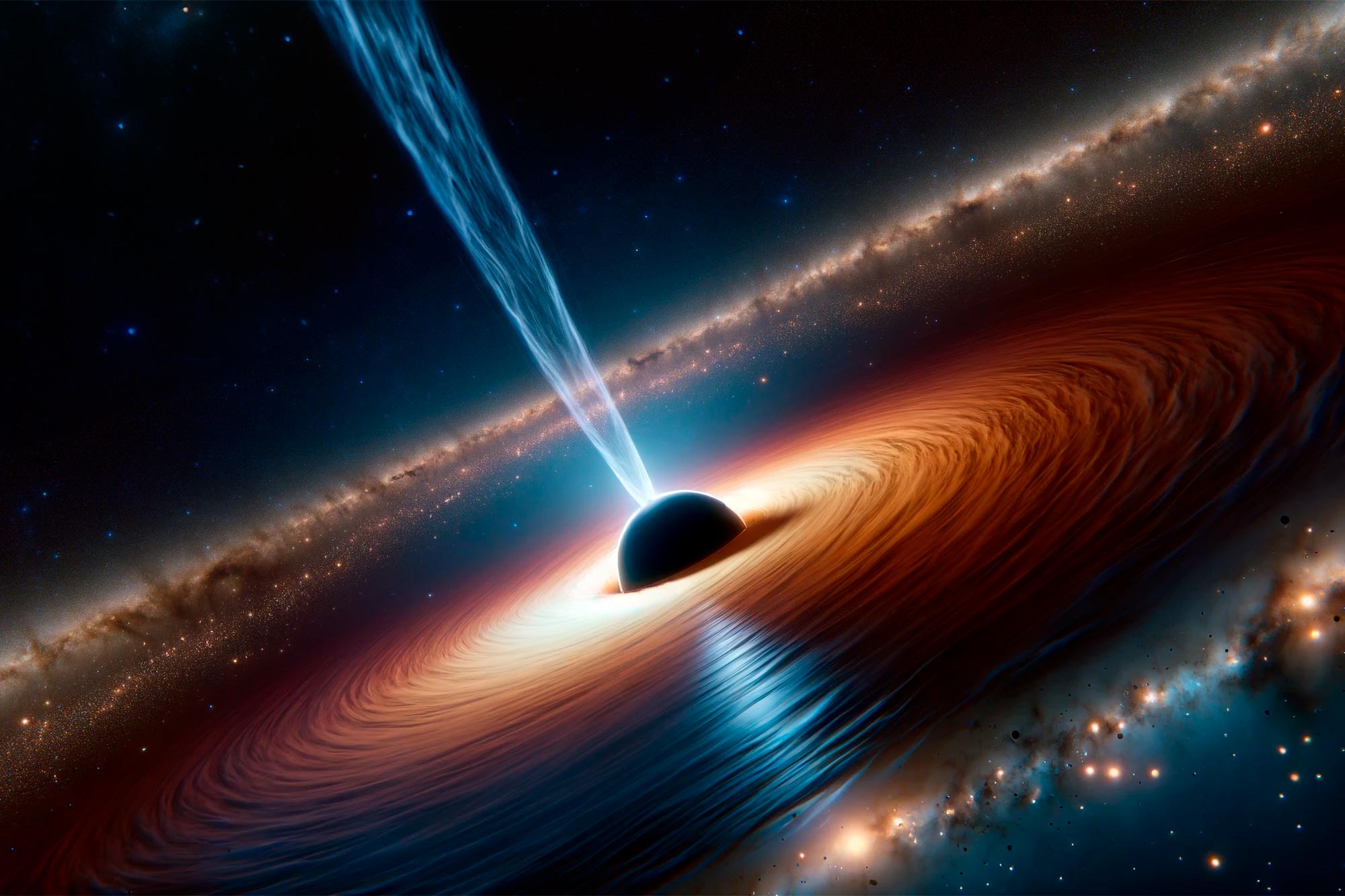
Black holes are fascinating cosmic entities characterized by gravitational pulls so intense that not even light can escape once it crosses into their event horizons. Yet, intriguingly, more than a hundred years ago, it was discovered that right outside the event horizon, black holes can produce potent streams of matter and energy, referred to as jets, which can travel nearly as fast as light. Telescopic observations have shown these jets extending directly outward in focused streams, resembling laser beams, with some jets reaching lengths that exceed entire galaxies.
Since the discovery of jets, many scholars, including Nobel Laureate Sir Roger Penrose, have studied the formation of these enigmatic phenomena. Currently, two main models attempt to explain jet formation: The “BZ-jet model,” named for the researchers Blandford and Znajek and now the most influential model, posits that a jet is formed by extracting spin energy from a black hole via magnetic field lines connected to the black hole’s event horizon. In contrast, the second model posits that a jet is formed by extracting rotational energy from a black hole’s accretion disk. The latter is a collection of ionized gas rotating around the black hole due to its strong gravitational force. The second model may be described as the “disk-jet model.”
Evaluating Jet Formation Models
Although the BZ-jet model had already been used by other researchers to simulate general relativistic collimated outflows—effectively, jets—it was unclear whether the BZ-jet model could explain the observed morphology of an actual jet, including its elongated structure, width, and limb-brightening, i.e., its increased brightness near the edge of the jet.
To investigate the validity of these two models, an international team led by Dr. Yuan Feng from the Shanghai Astronomical Observatory of the Chinese Academy of Sciences calculated the jets respectively predicted by these two models for the supermassive black hole at the center of Messier 87 (M87), a giant galaxy in the constellation Virgo. The team then compared its calculations with actual observations of the M87 jet, which had been recorded in the first-ever image of a black hole captured by the Event Horizon Telescope (EHT). The team’s research showed that the BZ-jet model accurately predicted the morphology of the observed M87 jet, while the disk-jet model struggled to explain the observations. The study was published in Science Advances.
Methodology and Findings
In terms of methods, the team first employed three-dimensional general relativistic magnetohydrodynamic (GRMHD) simulations to reproduce the structure of the M87 jet. To calculate the radiation from the simulated jets and compare the radiation with observations, the energy spectrum and spatial distribution of radiating electrons were crucial. The team hypothesized that electron acceleration occurred through “magnetic reconnection,” i.e., a process whereby magnetic energy is converted into kinetic energy, thermal energy, and particle acceleration. Based on this hypothesis, the team combined the results of particle acceleration studies using kinetic theory to solve a steady-state electron energy distribution equation. It then obtained the energy spectra and number densities of electrons in different regions of the simulated jets.
Combining this information with accretion simulations—including magnetic field strength, gas plasma temperature, and velocity—the team obtained results that could be compared with real observations. The results showed that the morphology of the jet predicted by the BZ-jet model matched the observed morphology of the M87 jet very well, including jet width, length, limb-brightening characteristics, and velocity. In contrast, the predictions of the disk-jet model were inconsistent with observations.
In addition, the team analyzed the magnetic reconnection process and found it was due to magnetic eruptions generated by magnetic fields in the accretion disk of the M87 black hole. These eruptions caused strong disturbances to the magnetic field, which could propagate over long distances, leading to magnetic reconnection in the jets.
This work bridges the gap between dynamic models of jet formation and various observed properties of jets, providing the first evidence that the BZ-jet model addresses the energy issues of jets and also explains other observations.
Reference: “Modeling the inner part of the jet in M87: Confronting jet morphology with theory” by Hai Yang, Feng Yuan, Hui Li, Yosuke Mizuno, Fan Guo, Rusen Lu, Luis C. Ho, Xi Lin, Andrzej A. Zdziarski and Jieshuang Wang, 22 March 2024, Science Advances.
DOI: 10.1126/sciadv.adn3544
Never miss a breakthrough: Join the SciTechDaily newsletter.
Follow us on Google and Google News.
3 Comments
The is formed due to the magnetic effect of rotation of disk around the supermassive black hole.
The jet evolves due to magnetic effect of rotation of the disk surrounding supermassive black hole.
Thus,this is found that rotation disk – jet model gives ground work to understand the geometry of the next model utilized Einstein’s GR to show the only path.So,the authors performance are good on dynamics of jet and to obtain right comparable geometry.