
Insights Into How Short-Term Stimulation Can Alter Sustained Brain Activities and Their Underlying Processes
Brain research is one of the most crucial fields in modern life sciences, and “emotion” is one of its major topics. Traditionally, the study of emotions in animals has been a complex area, predominantly examining fear responses in mice and rats.
However, since the 2010s, it has been increasingly reported in scientific papers that even crayfish and flies may have brain functions resembling emotions by focusing on several characteristics of their behavior, such as persistence and valence.
For instance, when an animal experiences a dangerous situation like being attacked by a predator (a negative valence) even for a short period, the animal’s behavior may be to stay in a safe place, ignoring normally attractive smells of food even if hungry, for a certain length of time (persistence), which can be regulated by a primitive form of emotion.
However, the details of these fundamental “emotion mechanisms” remain largely undisclosed.
Research on Emotions in Roundworms
An international research team from Nagoya City University (Japan) and Mills College at Northeastern University (USA) has revealed the possibility that the roundworm Caenorhabditis elegans possesses basic “emotions.”
They used the worms because worms have been used for detailed analysis of basic functions such as perception, memory, and even decision-making at cellular and genetic levels. The team initially discovered that when worms are subjected to alternating current stimulation, worms start moving at an unexpectedly high speed.
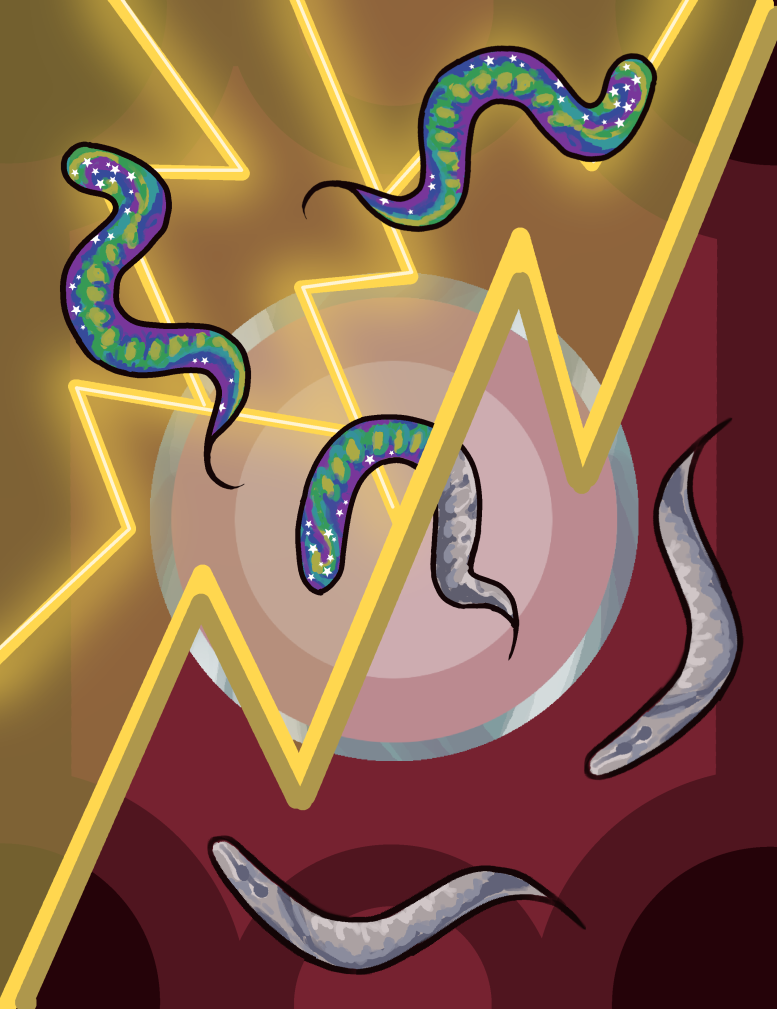
Interestingly, the team also found that this “running” response persisted for 1-2 minutes even after the electrical stimulation for a few seconds was terminated.
In animals in general, when a stimulus is stopped, the response to that stimulus usually ceases immediately. (Otherwise, the perception of stimuli such as sounds or visual scenes would linger.) Therefore, the reaction of “continuing to run even after the stimulus stops” is exceptional.
Behavioral and Genetic Analysis of Emotional Responses in Worms
Furthermore, during and after the electric stimulation, the team found that the worms ignore their food bacteria, which provide crucial environmental information. This suggests that while the presence or absence of their food bacteria is usually crucial, the danger posed by electrical shocks, a survival-threatening stimulus, is even more important.
In other words, when worms sense the dangerous stimulus of an electrical shock, their highest survival priority is to escape from that location. To achieve this, the brain’s functioning seems to persistently change, including ignoring the usually significant “food” in order to escape danger.
This suggests that the phenomenon of “worms continuing to run due to short-term electrical stimulation” reflects basic “emotions.”
Implications for Understanding Human Emotions
Furthermore, through genetic analysis, particularly leveraging the advantages of worms, the team revealed that mutants unable to produce neuropeptides, equivalent to our hormones, exhibited a longer duration of continuous running in response to electrical stimulation compared to normal worms.
This result indicates that the continuous state in response to danger is regulated to end at the appropriate time.
Indeed, if we experience excitement or fear that persists for a very long period, it disrupts our daily lives. Therefore, the findings suggest that our emotions, such as “excitement,” “happiness,” or “sadness,” induced by stimuli, may not be naturally destined to fade away with time, but are controlled by an active mechanism involving genes.
This study demonstrates that using worms can offer detailed insights into the genetic mechanisms underlying primitive “emotions”. Many of the genes at work in worms are known to have counterparts in humans and other organisms, so studying worms can offer significant clues about the genes involved in the basis of “emotions.”
Specifically, conditions like depression, classified as mood disorders, can be interpreted as states where negative emotions are excessively and persistently maintained due to the inability to effectively process experienced stimuli. If novel genes related to emotions are discovered through worm research, these genes could potentially become targets for new treatments of emotional disorders.
Reference: “Electric shock causes a fleeing-like persistent behavioral response in the nematode Caenorhabditis elegans” by Ling Fei Tee, Jared J Young, Keisuke Maruyama, Sota Kimura, Ryoga Suzuki, Yuto Endo and Koutarou D Kimura, 18 August 2023, Genetics.
DOI: 10.1093/genetics/iyad148
The study was funded by the Japan Society for the Promotion of Science, Grant-in-Aid for Research in Nagoya City University, the National Institutes of Natural Sciences, the Toyoaki Scholarship Foundation, the Japanese Government (MEXT) Scholarship, and the RIKEN Center for Advanced Intelligence Project (to K.D.K).
Never miss a breakthrough: Join the SciTechDaily newsletter.
Follow us on Google and Google News.
1 Comment
If I understand this article correctly, a worm can have a “Bad hair day.”