
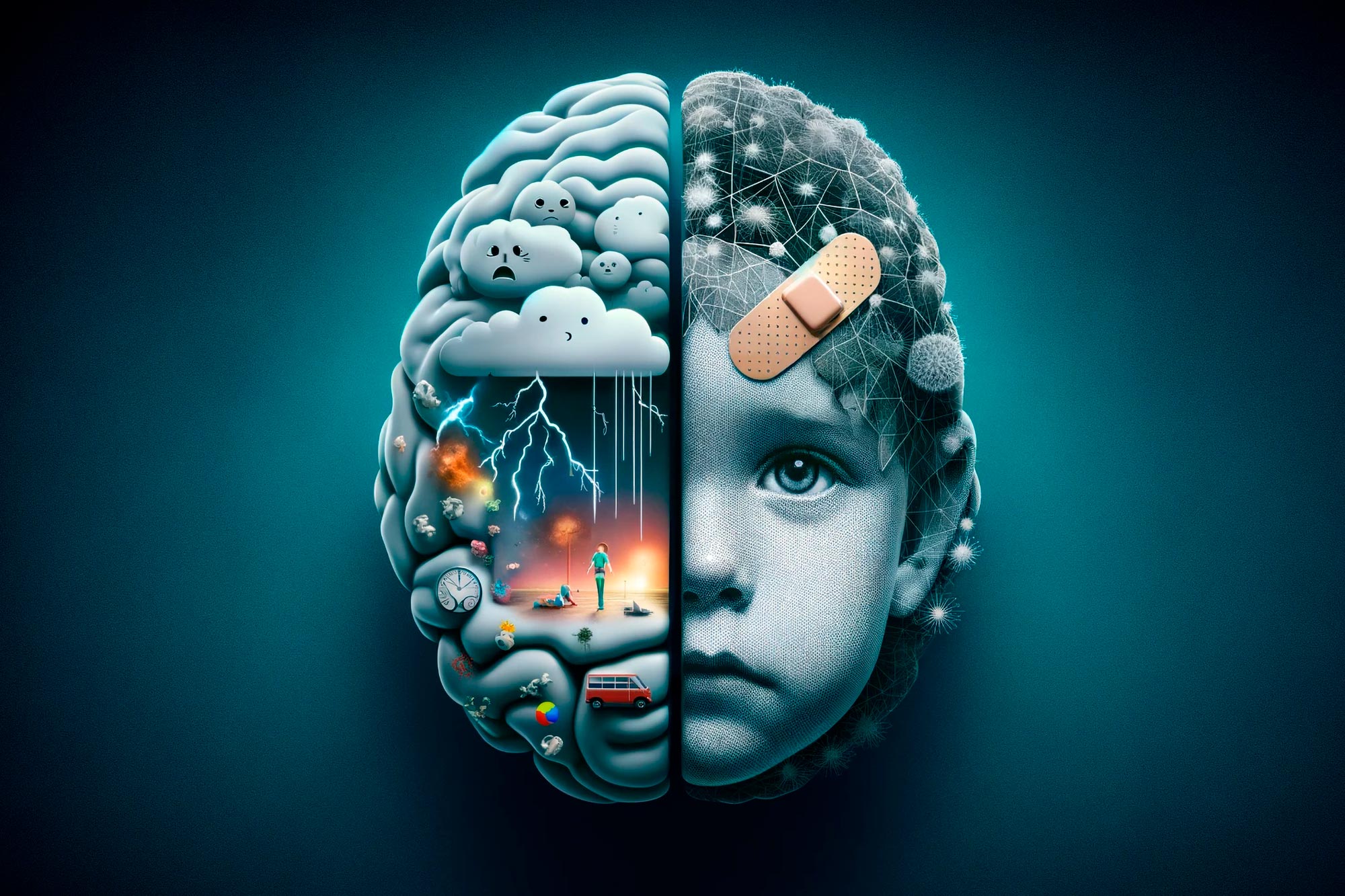
In Animal Study, Childhood Stress Linked to Adult Risk-Taking
A surprising thing happened when researchers began exploring whether early-life stress compounds the effects of a childhood head injury on health and behavior later in life: In an animal study, stress changed the activation level of many more genes in the brain than were changed by a bump to the head.
It’s already known that head injuries are common in young kids, especially from falling, and can be linked to mood disorders and social difficulties that emerge later in life. Adverse childhood experiences are also very common, and can raise the risk for disease, mental illness, and substance misuse in adulthood.
Adverse Childhood Experiences (ACEs)
Adverse Childhood Experiences (ACEs) are potentially traumatic events that occur in childhood. ACEs can include violence, abuse, and growing up in a family with mental health or substance use problems. Toxic stress from ACEs can change brain development and affect how the body responds to stress. ACEs are linked to chronic health problems, mental illness, and substance misuse in adulthood. However, ACEs can be prevented.
Preventing ACEs can help children and adults thrive and potentially:
- Lower risk for conditions like depression, asthma, cancer, and diabetes in adulthood.
- Reduce risky behaviors like smoking and heavy drinking.
- Improve education and employment potential.
- Stop ACEs from being passed from one generation to the next.
Research Methodology and Findings
“But we don’t know how those two things can interact,” said senior study author Kathryn Lenz, associate professor of psychology at The Ohio State University. “We wanted to understand whether experiencing a traumatic brain injury in the context of early life stress circumstances could modulate the response to the brain injury. And using an animal model allows us to really get into the mechanisms through which these two things might be impacting brain development as it’s occurring.”
This first set of experiments in rats suggests early life stress’s potential to lead to a lifetime of health consequences may not be fully appreciated, Lenz said.
“We found many, many, many more genes were differentially expressed as a result of our early life stress manipulation than our traumatic brain injury manipulation,” Lenz said. “Stress is really powerful, and we shouldn’t understate the impact of early-life stress on the developing brain. I think it tends to get dismissed – but it’s an incredibly important public health topic.”
The research poster was presented on November 12, 2023, at Neuroscience 2023, the annual meeting of the Society for Neuroscience.
Researchers temporarily separated newborn rats from their mothers daily for 14 days to induce stress mimicking the effects of adverse childhood experiences, which include a variety of potentially traumatic events. On day 15, a time when rats are developmentally equivalent to a toddler, stressed and non-stressed rats were given either a concussion-like head injury under anesthesia or no head injury. Three conditions – stress alone, head injury alone, and stress combined with head injury – were compared to uninjured, non-stressed rats.
Key Findings and Implications
First author Michaela Breach, a graduate student in Lenz’s lab, examined the gene expression changes in the hippocampal region of the animals’ brains later in the juvenile period using single-nuclei RNA sequencing.
Stress alone and stress combined with traumatic brain injury (TBI) produced a few noteworthy results. Both conditions activated pathways in excitatory and inhibitory neurons associated with plasticity, which is the brain’s ability to adapt to all kinds of changes – mostly to promote flexibility, but sometimes, when the changes are maladaptive, resulting in negative outcomes.
“This may suggest that the brain is being opened up to a new period of vulnerability or is actively changing during this period of time when it could program later life deficits,” Breach said.
Both conditions also had an effect on signaling related to oxytocin, a hormone linked to maternal behavior and social bonding. Stress alone and combined with TBI activated this oxytocin pathway, but brain injury alone inhibited it.
“Both stress and TBI are linked to abnormal social behavior, but we’re finding these differing effects with the oxytocin signaling,” Breach said. “That demonstrates that the effect of stress might modulate how TBI is changing the brain since the combination treatment was different from TBI on its own. Oxytocin is involved in the response to stress and repair, so that may mean it could be an interesting modulator for us to pursue in the future.”
In behavior tests in rats that had aged into adulthood, only animals that experienced early-life stress were prone to more frequently entering a wide-open space – a location that typically makes rodents feel vulnerable to predators.
“Overall, that suggests they might be taking more risks later in life, which is consistent with human data showing that early life stress can increase the risk for certain conditions like ADHD, which can be characterized by risk-taking behavior or substance use disorders,” Breach said.
The behavior data pointing to detrimental effects of early-life stress provides further evidence of the need to address adverse childhood experiences, Lenz said.
“Things like social support and enrichment can buffer the effects of early-life stress – that has been shown in animal models and in people,” she said. “I don’t think it can be over-emphasized how damaging early-life stressors can be if they’re not dealt with.”
Additional co-authors include Ethan Goodman, Jonathan Packer, Ale Zaleta Lastra, Habib Akouri, Zoe Tapp-Poole, Cole Vonder Haar, Jonathan Godbout and Olga Kokiko-Cochran.
This work was supported by Ohio State’s Chronic Brain Injury Institute, the Brain Injury Association of America and a National Science Foundation Graduate Research Fellowship.
Poster: PSTR159.22 / II6 – Examining the impact of early life stress and pediatric TBI on the developing hippocampal transcriptome and behavioral development in rats.
Never miss a breakthrough: Join the SciTechDaily newsletter.
Follow us on Google and Google News.