
Close Menu
    Facebook X (Twitter) Instagram
    SciTechDaily
    • Biology
    • Chemistry
    • Earth
    • Health
    • Physics
    • Science
    • Space
    • Technology
    Facebook X (Twitter) Pinterest YouTube RSS
    SciTechDaily
    Home»Space»“Amazing!” – Black Hole’s Heart Still Beating
    Space

    “Amazing!” – Black Hole’s Heart Still Beating

    By Chinese Academy of SciencesJune 16, 20201 Comment3 Mins Read
    Facebook Twitter Pinterest Telegram LinkedIn WhatsApp Email Reddit
    Share
    Facebook Twitter LinkedIn Pinterest Telegram Email Reddit
    Black Hole Heartbeat Signal
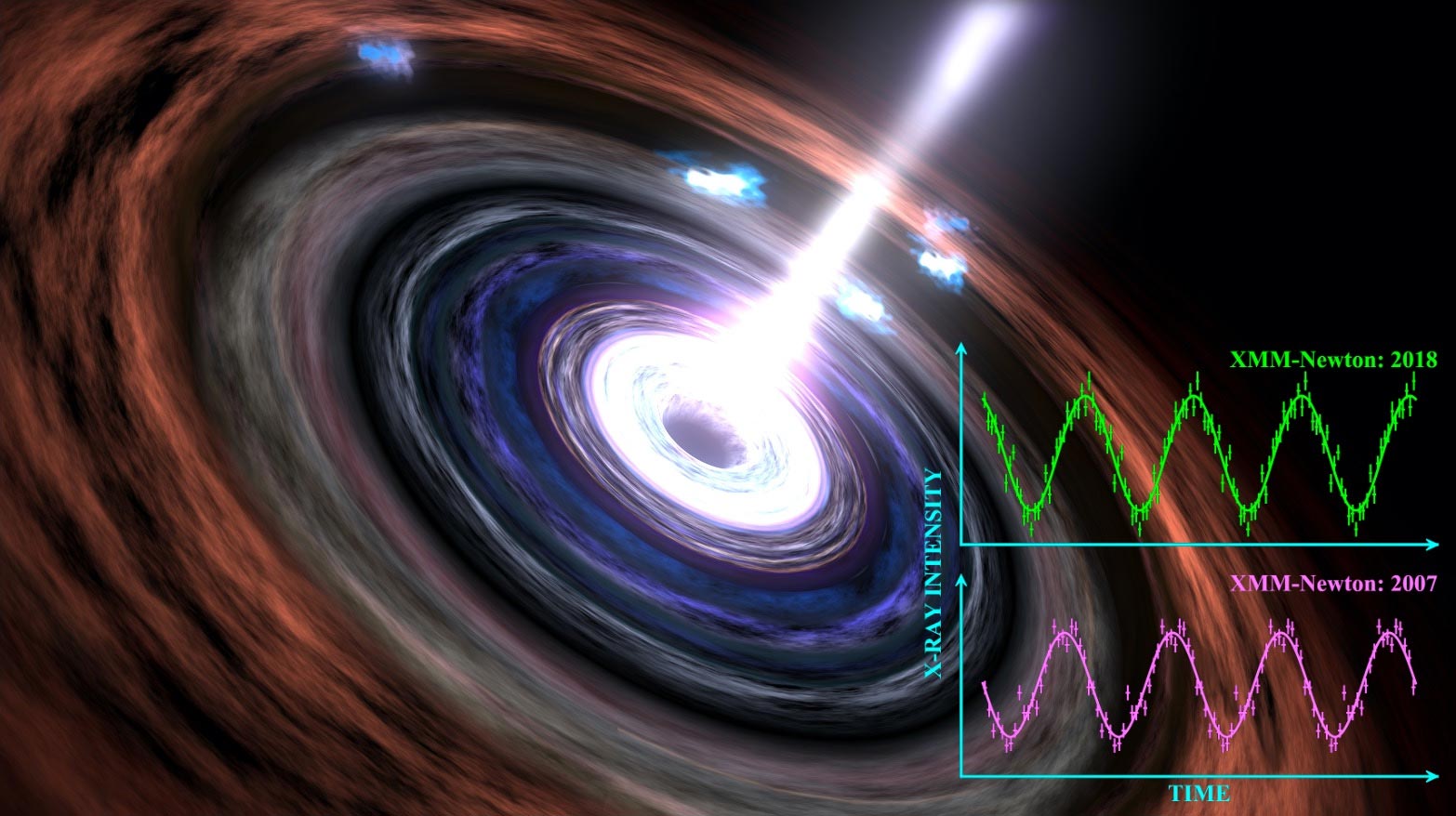
    A black hole including the heartbeat signal observed in 2007 and 2018. Credit: Dr Chichuan Jin, of the National Astronomical Observatories, Chinese Academy of Sciences and NASA/Goddard Space Flight Center Conceptual Image Lab

    The first confirmed heartbeat of a supermassive black hole is still going strong more than ten years after first being observed.

    X-ray satellite observations spotted the repeated beat after its signal had been blocked by our Sun for a number of years.

    Astronomers say this is the most long lived heartbeat ever seen in a black hole and tells us more about the size and structure close to its event horizon – the space around a black hole from which nothing, including light, can escape.

    The research, by National Astronomical Observatories of Chinese Academy of Sciences, China, and Durham University, UK, was published in the journal Monthly Notices of the Royal Astronomical Society.

    The black hole’s heartbeat was first detected in 2007 at the center of a galaxy called RE J1034+396, which is approximately 600 million light years from Earth.

    The signal from this galactic giant repeated every hour and this behavior was seen in several snapshots taken before satellite observations were blocked by our Sun in 2011.

    In 2018, the European Space Agency’s XMM-Newton X-ray satellite was able to finally re-observe the black hole and to scientists’ amazement the same repeated heartbeat could still be seen.

    Matter falling on to a supermassive black hole as it feeds from the accretion disc of material surrounding it releases an enormous amount of power from a comparatively tiny region of space, but this is rarely seen as a specific repeatable pattern like a heartbeat.

    The time between beats can tell us about the size and structure of the matter close to the black hole’s event horizon.

    Prof. Chris Done, in Durham University’s Centre for Extragalactic Astronomy, collaborated on the findings with colleague Prof. Martin Ward, Temple Chevallier Chair of Astronomy.

    “The main idea for how this heartbeat is formed is that the inner parts of the accretion disc are expanding and contracting,” said Prof. Done. “The only other system we know which seems to do the same thing is a 100,000 times smaller stellar-mass black hole in our Milky Way, fed by a binary companion star, with correspondingly smaller luminosities and timescales. This shows us that simple scalings with black hole mass work even for the rarest types of behavior.”

    “This heartbeat is amazing! It proves that such signals arising from a supermassive black hole can be very strong and persistent. It also provides the best opportunity for scientists to further investigate the nature and origin of this heartbeat signal,” said Dr. JIN Chichuan from the National Astronomical Observatories of the Chinese Academy of Sciences, lead author of the study.

    The next step in the research is to perform a comprehensive analysis of this intriguing signal, and compare it with the behavior of stellar-mass black holes in our Milky Way.

    For more on this story, read First Confirmed Heartbeat of a Supermassive Black Hole Is Still Beating.

    ###

    Reference: “Reobserving the NLS1 galaxy RE J1034+396 – I. The long-term, recurrent X-ray QPO with a high significance” by Chichuan Jin, Chris Done and Martin Ward, 10 June 2020, Monthly Notices of the Royal Astronomical Society.
    DOI: 10.1093/mnras/staa1356

    The research was supported by the National Natural Science Foundation of China, the Strategic Pioneer Program on Space Science of Chinese Academy of Sciences, and the Science and Technology Facilities Council, UK.

    Never miss a breakthrough: Join the SciTechDaily newsletter.
    Follow us on Google and Google News.

    Astronomy Astrophysics Black Hole Chinese Academy of Sciences XMM-Newton
    Share. Facebook Twitter Pinterest LinkedIn Email Reddit

    Related Articles

    XMM-Newton Spacecraft Detects Black Hole Winds Hindering Star Formation

    Supermassive Black Hole’s Spin Verified – Einstein’s General Theory of Relativity Shines

    Ripped Apart: A Gigantic Black Hole Destroys a Massive Star

    Unveiling the Magnetic Mysteries of Black Holes: How Does “MAD” Accretion Form Around a Black Hole?

    Mysterious ASASSN-14li: Massive Star Obliterated by a Giant Black Hole

    Black Hole Unmasked: Astronomers Capture First Image of Accretion Ring and Relativistic Jet

    Light Echo From Behind a Black Hole Confirms Einstein’s Theory of General Relativity

    Astrophysicists Discover Energetic Hot Wind from Low-luminosity Active Galactic Nucleus

    Cause of Jupiter’s X-Ray Aurora Revealed – Mystery Has Puzzled Scientists for 40 Years

    1 Comment

    1. John-Paul Hunt on June 16, 2020 3:49 pm

      cough up black vile.

      Reply
    Leave A Reply Cancel Reply

    • Facebook
    • Twitter
    • Pinterest
    • YouTube

    Don't Miss a Discovery

    Subscribe for the Latest in Science & Tech!

    Trending News

    Once-in-a-Century Impact: NASA Just Found a Massive New Crater on the Moon

    Anak Krakatau Just Blasted Ash 50,000 Feet Into the Sky

    NASA’s Chandra Reveals Galaxies Being Torn Apart, Blasted by Black Holes, and Reborn in Stars

    Ozempic’s Active Ingredient Shows Surprising Anti-Aging Effects

    Scientists Discover Canada’s First Dinosaur Tracks From a Rarely Documented Cretaceous Age

    Astronomers Just Caught a Giant Planet in the Act of Forming

    Two Dead Stars Are Racing Around Each Other Every 6.2 Minutes

    Natural Compound May Help Protect the Brain and Heart From Excess Salt

    Follow SciTechDaily
    • Facebook
    • Twitter
    • YouTube
    • Pinterest
    • Newsletter
    • RSS
    SciTech News
    • Biology News
    • Chemistry News
    • Earth News
    • Health News
    • Physics News
    • Science News
    • Space News
    • Technology News
    Recent Posts
    • Scientists Put Anti-Aging Treatments to the Test – These Ones Actually Changed Biological Age
    • A Quantum Prediction From 1931 Has Finally Come to Life
    • Scientists Just Watched a Single Quantum of Sound Vanish for the First Time
    • New Satellite Engine Could Use Earth’s Atmosphere as Fuel To Stay in Orbit Indefinitely
    • Vitamin C Supplements Tied to Fewer Deaths in Blood Disorder Trial
    Copyright © 1998 - 2026 SciTechDaily. All Rights Reserved.
    • Science News
    • About
    • Contact
    • Editorial Board
    • Privacy Policy
    • Terms of Use

    Type above and press Enter to search. Press Esc to cancel.