
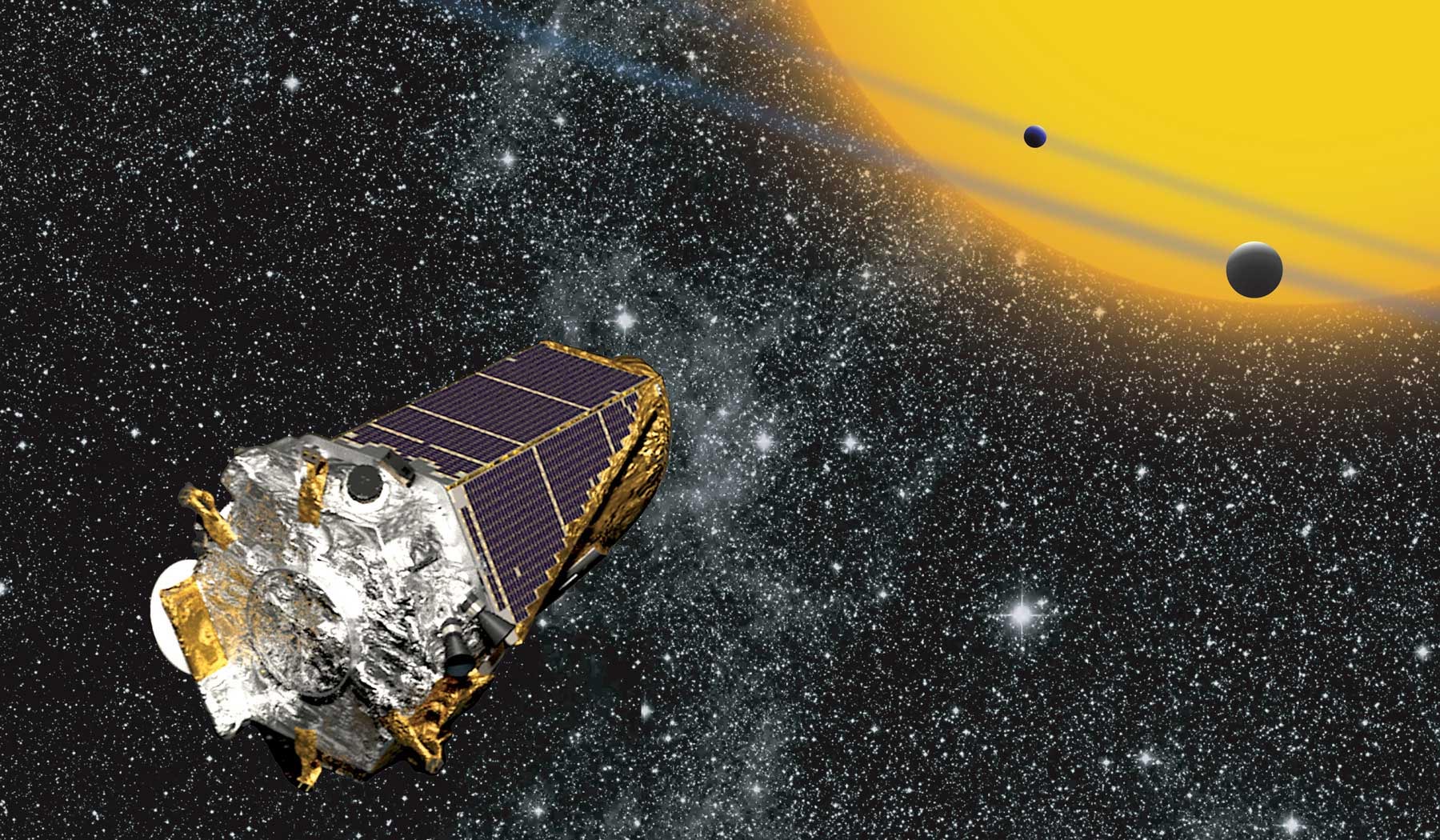
There may be as many as one Earth-like planet for every five Sun-like stars in the Milky Way Galaxy, according to new estimates by University of British Columbia astronomers using data from NASA’s Kepler mission.
To be considered Earth-like, a planet must be rocky, roughly Earth-sized, and orbiting Sun-like (G-type) stars. It also has to orbit in the habitable zones of its star—the range of distances from a star in which a rocky planet could host liquid water, and potentially life, on its surface.
Estimating how common different kinds of planets are around different stars can provide important constraints on planet formation and evolution theories.
“My calculations place an upper limit of 0.18 Earth-like planets per G-type star,” says UBC researcher Michelle Kunimoto, co-author of the new study in The Astronomical Journal. “Estimating how common different kinds of planets are around different stars can provide important constraints on planet formation and evolution theories, and help optimize future missions dedicated to finding exoplanets.”
According to UBC astronomer Jaymie Matthews: “Our Milky Way has as many as 400 billion stars, with seven percent of them being G-type. That means less than six billion stars may have Earth-like planets in our Galaxy.”
Previous estimates of the frequency of Earth-like planets range from roughly 0.02 potentially habitable planets per Sun-like star to more than one per Sun-like star.
Typically, planets like Earth are more likely to be missed by a planet search than other types, as they are so small and orbit so far from their stars. That means that a planet catalog represents only a small subset of the planets that are actually in orbit around the stars searched. Kunimoto used a technique known as ‘forward modeling’ to overcome these challenges.
“I started by simulating the full population of exoplanets around the stars Kepler searched,” she explained. “I marked each planet as ‘detected’ or ‘missed’ depending on how likely it was my planet search algorithm would have found them. Then, I compared the detected planets to my actual catalog of planets. If the simulation produced a close match, then the initial population was likely a good representation of the actual population of planets orbiting those stars.”
Kunimoto’s research also shed more light on one of the most outstanding questions in exoplanet science today: the ‘radius gap’ of planets. The radius gap demonstrates that it is uncommon for planets with orbital periods less than 100 days to have a size between 1.5 and two times that of Earth. She found that the radius gap exists over a much narrower range of orbital periods than previously thought. Her observational results can provide constraints on planet evolution models that explain the radius gap’s characteristics.
Previously, Kunimoto searched archival data from 200,000 stars of NASA’s Kepler mission. She discovered 17 new planets outside of the Solar System, or exoplanets, in addition to recovering thousands of already known planets.
For more on this research, read Are We Alone? Discovery of Billions of Earth-Like Planets May Hold the Answer.
Reference: “Searching the Entirety of Kepler Data. II. Occurrence Rate Estimates for FGK Stars” by Michelle Kunimoto and Jaymie M. Matthews, 4 May 2020, The Astronomical Journal.
DOI: 10.3847/1538-3881/ab88b0
Never miss a breakthrough: Join the SciTechDaily newsletter.
Follow us on Google and Google News.
9 Comments
Calculating odds on the back of a menu, is not “Kepler revealing” anything. Either they see and count the planets or they’re just off gassing their bad lunch, and noone needs to hear it.
They are estimating from observations, and astrobiologists and other interested definitely need to hear it.
Your beside-the-point comments, not so much.
Most of the stars in the galaxy are within the intense radiation zone of the galactic core and are not going to be suitable for life regardless. I’d like to see realistic estimates of star systems in volumes of the galaxy that are not within the potentially deadly radiation zones. It is likely the earth like fraction will drop dramatically.
I don’t have access to the full text of the study article, only the abstract. However, it does explicitly state that the <.18 planets per star was an 84.1th percentile upper limit. Naturally the authors of a summary article for general consumption would want to highlight the most sensational information in such a study.
I’m not sure what you mean by “most stars” and “core”. The galactic center is ~ 1 pc, but contains “only” 10 million stars [ https://en.wikipedia.org/wiki/Galactic_Center ].
The real problem for planets seem to be dense stellar clusters, where the first generation(s) of massive stars inhibit planet formation for ~ 2/3 of the stars in the cluster core [ http://www.sci-news.com/astronomy/westerlund-2-core-08479.html ; see what I did there? Numbers! References!]
How many within 100 light years? Because really, what’s the point unless we can go there someday? The milky way galazy is 52,000 light years in size … most all of it is too far that it will be accessible even without warp drive tech which will always likely be just sci fi.
Oy! The obvious point is what is done right here – science in order to increase knowledge.
Why do you think it would be possible or desirable to go there?
And then suddenly instant LIFE!? You know like there’s just GOT to be life out there.in the cosmos somewhere, right?
Could this universe be the result of God’s orgasm, which produced this ONE earth?
Your I-Amness of being must be God, for there cannot be another.
Most of us have been raised/brainwashed to believe in the fantasy star trek universe that is teeming with life.
Our world, our universe is us pushed out onto the screen of space. The one observer YOU fragmented into the many.
You are the source of all life. You are God who is clad in a seamless garment dipped in blood, walking the Earth with total amnesia about your true identity.
As beautiful and magnificent the earth n universe is, comparatively speaking, it is but a shadow world.
Yes only a shadow, cast forth from a dimensionally larger universe, where you will one day return to, greatly enhanced by this 6000 year sleep, in a vegetable world, where everything waxes and wains, only to die once more.
This is a schoolroom, this is not your home! You are the Eternal Dreamer who is dreaming these non-eternal dreams.
Drake and Fermi do not play well together in the sandbox!
We live in the 3rd dimension. What would living in a vastly greater, 8th dimensional universe be like, where there is only one being?
Is that One the very one, who is playing all of these seemingly separate parts, in this shadow world of death and horrors?
The star trek universe teeming with life is false. It and all ‘e.t. life’ sci-fi fantasy movies sidestep the question, what is life?
Are we really just ‘Flatland’ scientists here trying to describe an orange?
I believe that you, yes you the observer, are the source of all life. This is but a waking dream that you are having.
A six thousand year sleep, on a couch of gold, according to Blake, in his poem, Jerusalem.
Life just does not appear on some planet orbiting in the Goldilocks Zone around a star system.
You are the source of eternal life, and the light to all you perceive in your outer world.
It is a mystery for sure, but there is only one consciousness of being involved here. For, there cannot be another.
To think that there is another creates duality, religiosity and a superstition belief in a God apart from your own wonderful human imagination.
I think that Highlander got it right when it said,
‘There can be only ONE!’
https://gifimage.net/wp-content/uploads/2017/10/highlander-quickening-gif-4.gif
very good thank you