
Thinking Small: New Ideas in the Search for Dark Matter
Since the 1980s, researchers have been running experiments in search of particles that make up dark matter, an invisible substance that permeates our galaxy and universe. Coined dark matter because it gives off no light, this substance, which constitutes more than 80 percent of matter in our universe, has been shown repeatedly to influence ordinary matter through its gravity. Scientists know it is out there but do not know what it is.
So researchers at Caltech, led by Kathryn Zurek, a professor of theoretical physics, have gone back to the drawing board to think of new ideas. They have been looking into the possibility that dark matter is made up of “hidden sector” particles, which are lighter than particles proposed previously, and could, in theory, be found using small, underground tabletop devices. In contrast, scientists are searching for heavier dark matter candidates called WIMPs (weakly interacting massive particles) using large-scale experiments such as XENON, which is installed underground in a 70,000-gallon (265-cubic-meter) tank of water in Italy.
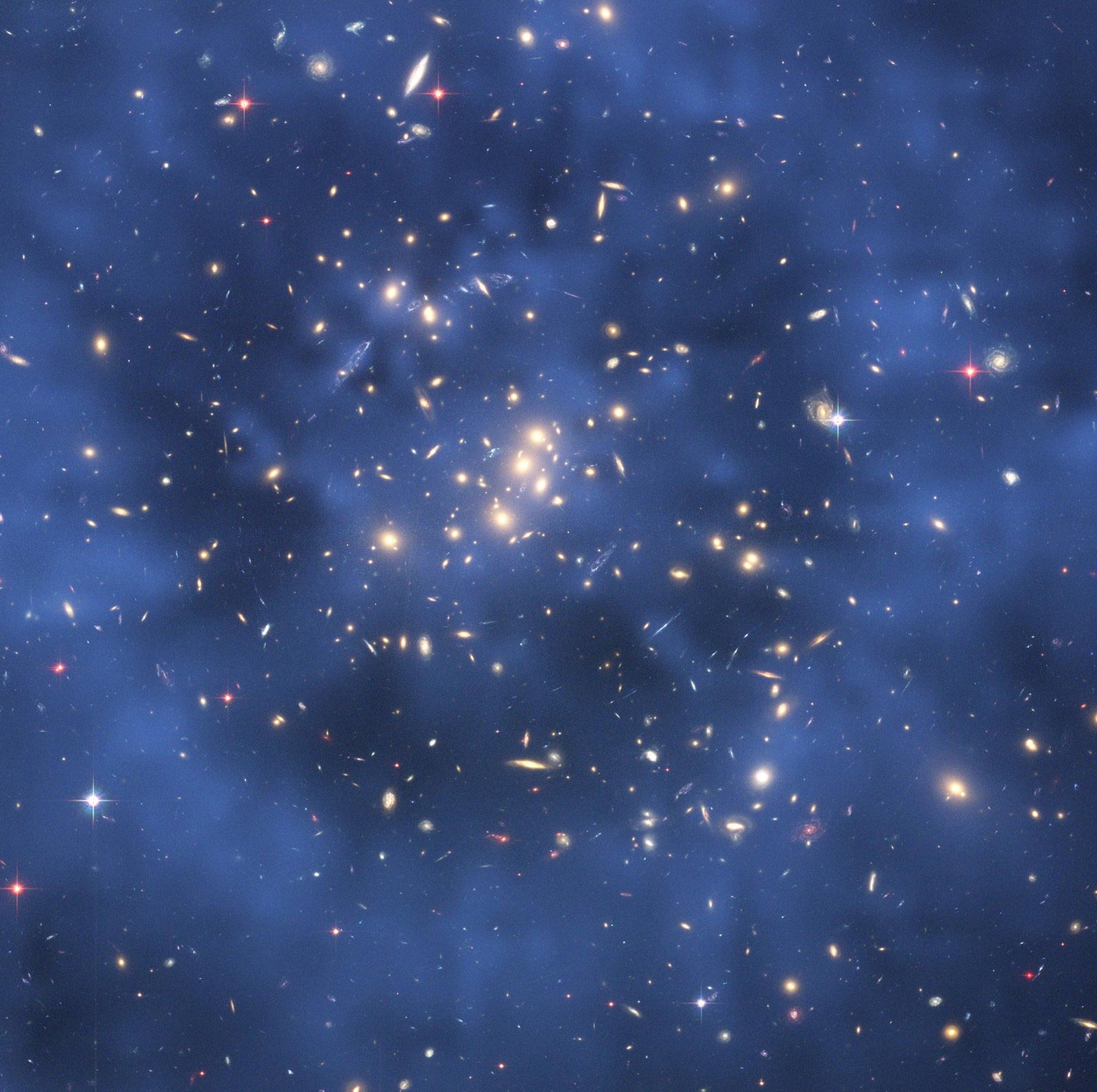
“Dark matter is always flowing through us, even in this room,” says Zurek, who first proposed hidden sector particles over a decade ago. “As we move around the center of the galaxy, this steady wind of dark matter mostly goes unnoticed. But we can still take advantage of that source of dark matter, and design new ways to look for rare interactions between the dark matter wind and the detector.”
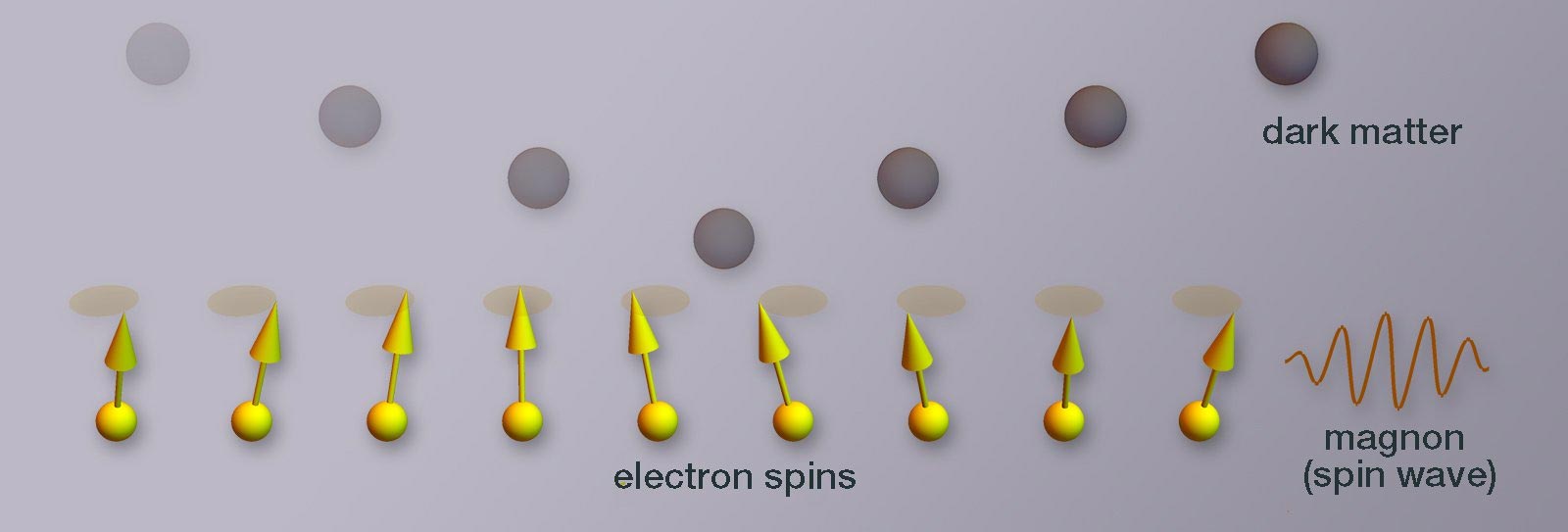
In a new paper accepted for publication in the journal Physical Review Letters, the physicists outline how the lighter-weight dark matter particles could be detected via a type of quasiparticle known as a magnon. A quasiparticle is an emergent phenomenon that occurs when a solid behaves as if it contains weakly interacting particles. Magnons are a type of quasiparticle in which electron spins—which act like little magnets—are collectivity excited. In the researchers’ idea for a tabletop experiment, a magnetic crystallized material would be used to look for signs of excited magnons generated by dark matter.
“If the dark matter particles are lighter than the proton, it becomes very difficult to detect their signal by conventional means,” says study author Zhengkang (Kevin) Zhang, a postdoctoral scholar at Caltech. “But, according to many well-motivated models, especially those involving hidden sectors, the dark matter particles can couple to the spins of the electrons, such that once they strike the material, they will induce spin excitations, or magnons. If we reduce the background noise by cooling the equipment and moving it underground, we could hope to detect magnons generated solely by dark matter and not ordinary matter.”
Such an experiment is only theoretical at this point but may eventually take place using small devices housed underground, likely in a mine, where outside influences from other particles, such as those in cosmic rays, can be minimized.
One telltale sign of a dark matter detection in the table-top experiments would be changes to the signal that depends on the time of day. This is due to the fact that the magnetic crystals that would be used to detect the dark matter can be anisotropic, meaning that the atoms are naturally arranged in such a way that they tend to interact with the dark matter more strongly when the dark matter comes in from certain directions.
“As Earth moves through the galactic dark matter halo, it feels the dark matter wind blowing from the direction into which the planet is moving. A detector fixed at a certain location on Earth rotates with the planet, so the dark matter wind hits it from different directions at different times of the day, say, sometimes from above, sometimes from the side,” says Zhang. “During the day, for example, you may have a higher detection rate when the dark matter comes from above than from the side. If you saw that, it would be pretty spectacular and a very strong indication that you were seeing dark matter.”
The researchers have other ideas about how dark matter may reveal itself, in addition to through magnons. They have proposed that the lighter dark matter particles could be detected via photons as well as with another type of quasiparticle called a phonon, which is caused by vibrations in a crystal lattice. Preliminary experiments based on photons and phonons are underway at UC Berkeley, where the team was based prior to Zurek joining the Caltech faculty in 2019. The researchers say that the use of these multiple strategies to look for dark matter is crucial because they complement each other and would help confirm each other’s results.
“We’re looking into new ways to look for dark matter because, given how little we know about dark matter, it’s worth considering all the possibilities,” says Zhang.
The study, titled, “Detecting Light Dark Matter with Magnons,” was funded by the Department of Energy (DOE) and the National Science Foundation (NSF). Another co-author of the study is Tanner Trickle, a graduate student at UC Berkeley.
Reference: “Detecting Light Dark Matter with Magnons” by Tanner Trickle, Zhengkang Zhang and Kathryn M. Zurek, 15 May 2020, Physical Review Letters.
DOI: 10.1103/PhysRevLett.124.201801
arXiv: 1905.13744v2
Never miss a breakthrough: Join the SciTechDaily newsletter.
Follow us on Google and Google News.
15 Comments
Since this experiment with little detectors is still only theoretical, let’s look at another theory.
A view of String Theory suggests that Dark Matter appears to us as an effect of string/anti-string annihilations, and this effect may also be the Higgs Boson. As you may know, quantum mechanics requires that strings must be formed as pairs in the quantum foam – a string and an anti-string – that immediately annihilate each other. Quantum mechanics also requires both the string and anti-string to be surrounded by “jitters” that reduce their monstrous vibrating energies. What if this jitter remains for a fraction of an instant after their string/anti-string annihilations? This temporary jitter would be seen by us as matter for that instant before it too returns to the foam. That’s why we never see it – the “mass” lasts only for that instant but is repeated over and over and over, all over. Specifics on this can be found in my YouTube at https://www.youtube.com/watch?v=24WyRKT8t4w
Self promotion.
We have been over this before. It is unlikely string theory is viable, since the natural supersymmetry dark matter WIMPs did not turn up in LHC or ACME.
And there is no “quantum foam” of space, since relativity must hold on all scales. I suspect you mean the quantum fluctuations of fields, which you try to map to string theory. But these fluctuations of “virtual particle” pairs is a misnommer, since they aren’t real particles – say, if you calculate their mass it comes out imaginary. That isn’t dark matter, which is particles and has real mass.
Misnommer – misnomer. Seems Spelling Cat was around and played with my keyboard …
I say my dear Watson, this sounds like an experiment designed by my good old friends Michaelson and Morley.
Except of course Michelson and Morley got a negative result and ushered in relativity physics. Which eventually gave us dark matter and dark energy, since we know understand the basic physics of the universe as a system.
In this case we expect a negative result, in which case no new physics will come about.
“Know” – now. I’ll drink my coffee now…
Since there are magnetic forces on earth, do the other planets have it as well? Does dark matter have the opposite magnetic force to keep the planets from running into each other?
Maybe we should try to keep planets and dark matter versus magnets apart to prevent them running into each other.
Gravity keeps planets in orbit. If you want to discuss stability of the solar system over its lifetime, it turns out that relativity makes all the difference between a system that had a 60 % risk of destabilizing and a system that had a 1 % risk (and hence is the system we see) [ http://www.scholarpedia.org/article/Stability_of_the_solar_system ].
Magnetic field are a universal property of nature. And in fact, planets that doesn’t have a strong geodynamo – like Earth – may have an induced field due to solar win interaction – like Mars [ https://www.nasa.gov/press-release/goddard/2020/mars-electric-currents/ ].
Dark matter is a positron that spins. When two are squeezed to the volume of one electron they give off light when it happens. When an electron collides with a positron the electron and positron are supposedly destroyed but actually the electron splits into two magnetic particles that are the smallest and most fundamental particles, Dark Matter being of such, these particles are so far the most fundamental particles. Waves of changing polarity of the particles can be seen as light when the waves are moving at the right length and/or frequency. Our eyes can see these particles as darkness. The poles move in this Mass such that the moving the particles by introducing mass changes both the EMF and GRAVITY. You must have these particles that are the vehicle of light and are by existing, the real cause of gravity squeezing the things we see. The more dense matter has less of these particles aligning their polarity with those in space, and more of these particles squeezed within and aligned to be combined to be mass.
“Dark matter is a positron” – let me stop you there: no, see the article.
Tell your copywriters that if they don’t put “Caltech” in the lead graf your idiot headline writers will screw up the CaPiTaLiZaTiOn.
It always looks easy once everything is over…
New ideas, old results: dark matter is visibly only interacting gravitationally, so far.
Fake News. Dark Matter is unproven.
very good thank you