
Close Menu
    Facebook X (Twitter) Instagram
    SciTechDaily
    • Biology
    • Chemistry
    • Earth
    • Health
    • Physics
    • Science
    • Space
    • Technology
    Facebook X (Twitter) Pinterest YouTube RSS
    SciTechDaily
    Home»Space»A “Novel” Discovery: NASA’s Curiosity Rover Finds a Book-Like Rock on Mars
    Space

    A “Novel” Discovery: NASA’s Curiosity Rover Finds a Book-Like Rock on Mars

    By NASAMay 10, 20232 Comments3 Mins Read
    Facebook Twitter Pinterest Telegram LinkedIn WhatsApp Email Reddit
    Share
    Facebook Twitter LinkedIn Pinterest Telegram Email Reddit
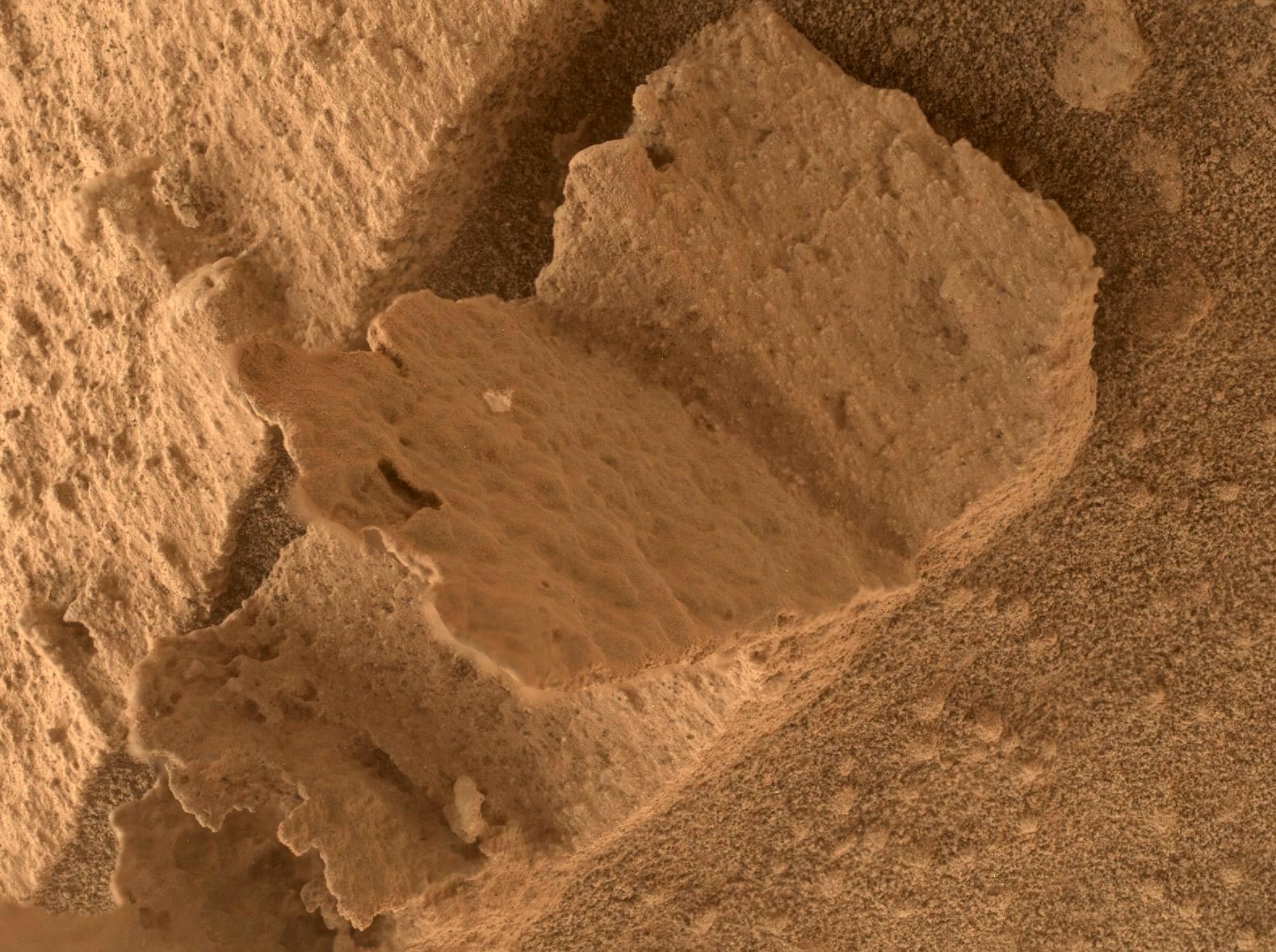
    NASA's Curiosity Mars Rover Finds a Book-Like Rock
    NASA’s Curiosity Mars rover took this close-up view of a rock nicknamed “Terra Firme” that looks like the open pages of a book, on April 15, 2023, the 3,800th Martian day, or sol, of the mission, using the Mars Hand Lens Imager (MAHLI) on the end of its robotic arm. The rock is about an inch across (2.5 centimeters). Credit: NASA/JPL-Caltech/MSSS

    On its 3,800th sol, NASA’s Curiosity Mars rover photographed a book-like rock, “Terra Firme,” a result of water depositing harder minerals and wind erosion shaping it over time.

    NASA’s Curiosity Mars rover took this close-up view of a rock nicknamed “Terra Firme” that looks like the open pages of a book, on April 15, 2023, the 3,800th Martian day, or sol, of the mission, using the Mars Hand Lens Imager (MAHLI) on the end of its robotic arm. The rock is about an inch across (2.5 centimeters).

    Rocks with unusual shapes are common on Mars, and often were formed by water seeping through cracks in a rock in the ancient past, bringing harder minerals along with them. After eons of being sand-blasted by the wind, softer rock is carved away and the harder materials are all that’s left.
    NASA Curiosity Mars Rover Header
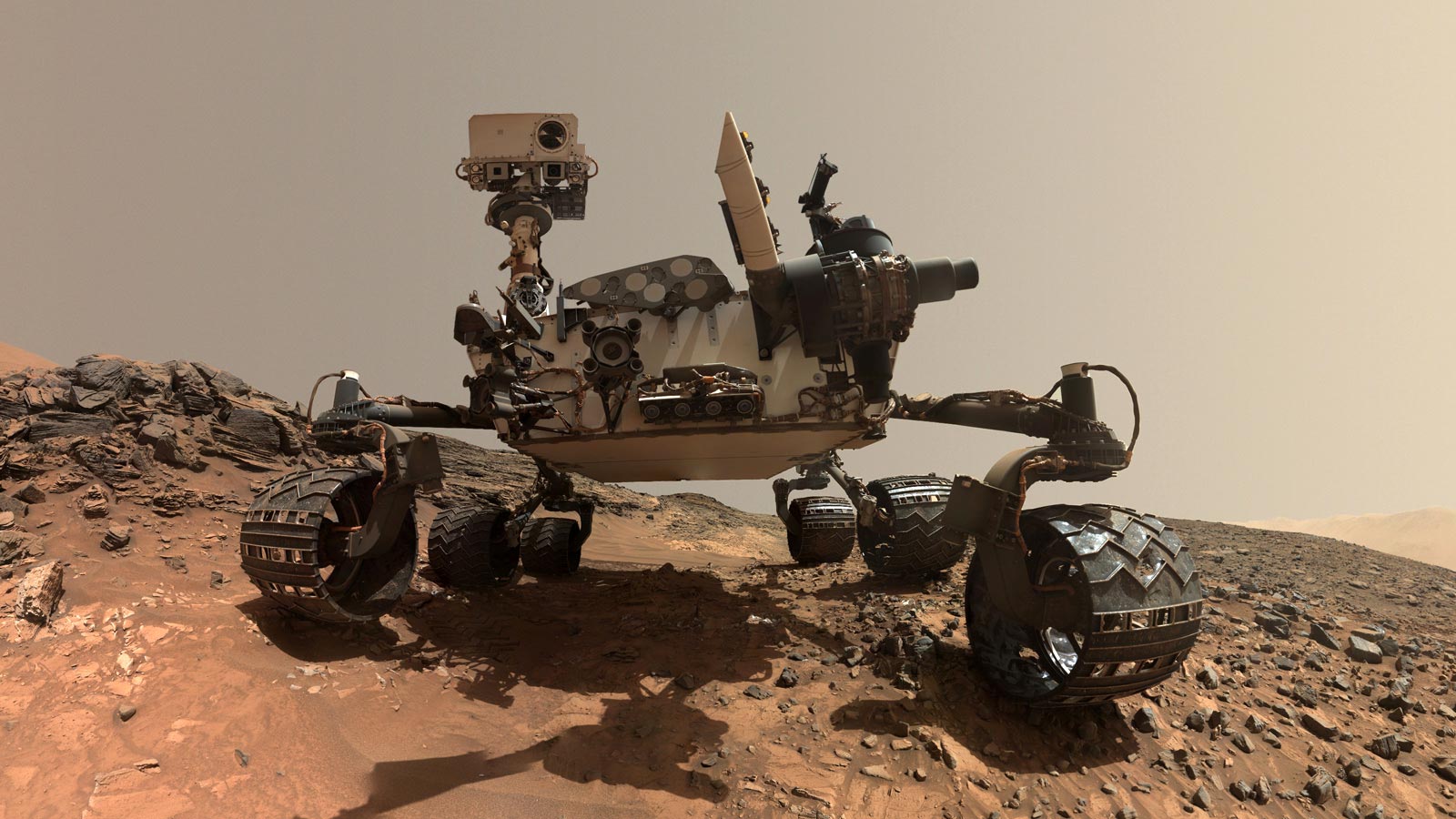
    Curiosity set out to answer the question: Did Mars ever have the right environmental conditions to support small life forms called microbes? Early in its mission, Curiosity’s scientific tools found chemical and mineral evidence of past habitable environments on Mars. It continues to explore the rock record from a time when Mars could have been home to microbial life. Credit: NASA

    NASA’s Curiosity Mars rover is a car-sized, mobile laboratory that was launched in November 2011 and successfully landed on Mars in August 2012. It is part of NASA’s Mars Science Laboratory (MSL) mission, designed to explore the Gale Crater on Mars and analyze its climate, geology, and the potential for past and present habitability. Equipped with state-of-the-art scientific instruments, including cameras, spectrometers, and sensors, Curiosity has been conducting experiments and collecting data to help scientists understand the planet’s history and evolution. Its most significant discoveries include evidence of ancient riverbeds and the presence of organic molecules, which suggest the possibility that Mars once harbored microbial life.

    NASA’s Jet Propulsion Laboratory (JPL), a division of the California Institute of Technology (Caltech) in Pasadena, California, leads the Curiosity mission. Curiosity captured the image using a camera called the Mars Hand Lens Imager (MAHLI), located on the end of its robotic arm. It is essentially the rover’s version of the magnifying hand lens that geologists usually carry with them into the field. MAHLI was built by Malin Space Science Systems in San Diego.

    Never miss a breakthrough: Join the SciTechDaily newsletter.
    Follow us on Google and Google News.

    Curiosity Rover JPL Mars NASA Popular
    Share. Facebook Twitter Pinterest LinkedIn Email Reddit

    Related Articles

    Curiosity 2.0: NASA’s Mars Rover Software Upgrade Revs Up Performance

    NASA’s Curiosity Rover Views First Dazzling “Sun Rays” on Mars

    NASA’s Curiosity Rover Discovers Surprise Clues to Ancient Water on Mars

    Tantalizing Science and Dangerous Hazards: NASA’s Curiosity Mars Rover Reaches Long-Awaited Salty Region

    NASA’s Curiosity Mars Rover Still Going 10 Years After Landing – What It’s Learned

    NASA’s Curiosity Rover Measures Key Life Ingredient on Mars for First Time

    NASA’s Curiosity Rover Captures Stunning Mars Views – Unlocking Mysteries of Ancient Past

    NASA’s Curiosity Rover Spots a “Doorway” on Mars

    NASA’s Curiosity Mars Rover Reroutes Away From Knife-Edged “Gator-Back” Rocks

    2 Comments

    1. Ken Towe on May 11, 2023 1:41 pm

      It speaks volumes when a rover equipped with state-ot-the-art technology is reduced to taking pictures of silly little things of little real scientific value. As far as can be ascertained there have only been two in-depth studies of the mineralogy of martian sediments by Curiosity. And none by Perseverance. Mineralogy, petrology and chemical composition should be a priority not landscape “postcard” photos or photos that look like something they obviously are not.

      Reply
    2. Sum Dum Gai on May 11, 2023 6:39 pm

      “lt speaks volumes” lolol 🙂

      Reply
    Leave A Reply Cancel Reply

    • Facebook
    • Twitter
    • Pinterest
    • YouTube

    Don't Miss a Discovery

    Subscribe for the Latest in Science & Tech!

    Trending News

    Don’t Miss: A Brilliant Venus and Glowing Harvest Moon Light Up the Sky

    New Twist on the Einstein Problem Reveals Unexpected Physics

    JWST Captures Stunning Evidence of How Supermassive Black Holes Feed

    Early Exercise May Permanently Change How Much Energy the Body Uses To Move

    New Molecule Wipes Out Aggressive Lymphoma Tumors in Mice in Just 11 Days

    The Human Family Tree May Need a Major Rewrite

    Scientists Find a Surprising Cancer-Fighting Effect in Dark Sweet Cherries

    New AI Detects Hidden Warning Signs of Solar Eruptions Hours Before They Emerge

    Follow SciTechDaily
    • Facebook
    • Twitter
    • YouTube
    • Pinterest
    • Newsletter
    • RSS
    SciTech News
    • Biology News
    • Chemistry News
    • Earth News
    • Health News
    • Physics News
    • Science News
    • Space News
    • Technology News
    Recent Posts
    • Scientists May Have Finally Explained Why Astronauts Get Constipated in Space
    • Pomegranates Could Unlock a New Treatment for Heart Failure
    • Africa’s Giant Herbivores Were Disappearing Millions of Years Before Humans Could Hunt Them
    • This Utah Mountain Is Hiding Enough Ice To Fill 600 Olympic Pools
    • Vagus Nerve Stimulation Could Unlock the Brain’s Hidden Learning Potential
    Copyright © 1998 - 2026 SciTechDaily. All Rights Reserved.
    • Science News
    • About
    • Contact
    • Editorial Board
    • Privacy Policy
    • Terms of Use

    Type above and press Enter to search. Press Esc to cancel.