
Close Menu
    Facebook X (Twitter) Instagram
    SciTechDaily
    • Biology
    • Chemistry
    • Earth
    • Health
    • Physics
    • Science
    • Space
    • Technology
    Facebook X (Twitter) Pinterest YouTube RSS
    SciTechDaily
    Home»Space»Hubble Views Abell2744 Y1, One of the Most Distant Known Galaxies
    Space

    Hubble Views Abell2744 Y1, One of the Most Distant Known Galaxies

    By Whitney Clavin, Jet Propulsion Laboratory; NASAFebruary 10, 2014No Comments3 Mins Read
    Facebook Twitter Pinterest Telegram LinkedIn WhatsApp Email Reddit
    Share
    Facebook Twitter LinkedIn Pinterest Telegram Email Reddit
    Hubble Views Galaxy Cluster Abell 2744
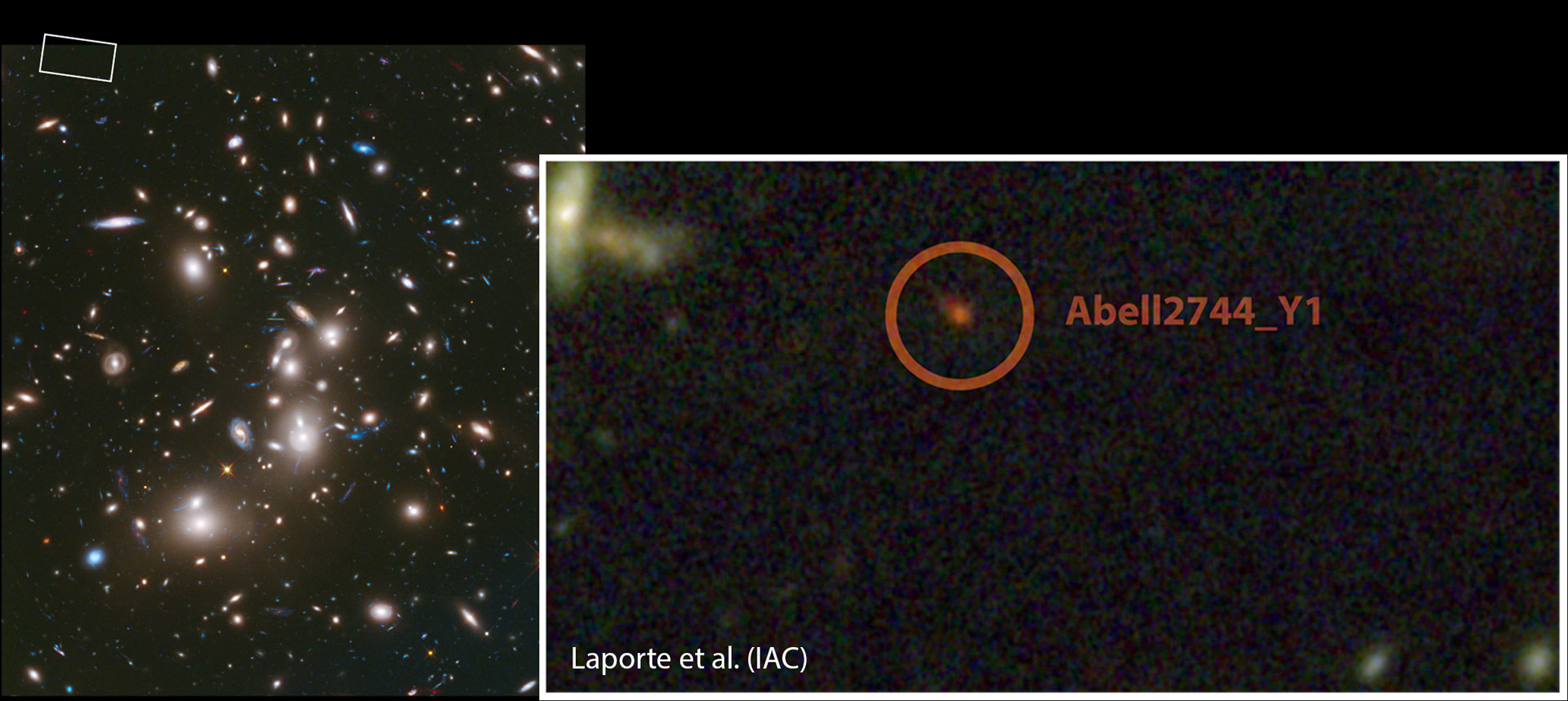
    This image of the galaxy cluster Abell 2744 was obtained with NASA’s Hubble Space Telescope. The zoomed image shows the region around the galaxy Abell2744_Y1, one of the most distant galaxy candidates known, harkening back to a time when the universe was 650 million years old. NASA’s Spitzer Space Telescope helped to narrow in on the galaxy’s great distance. Credit: NASA/ESA/STScI/IAC

    Using the Hubble and Spitzer Space Telescopes, astronomers discovered one of the most distant galaxies known — Abell2744 Y1.

    NASA’s Spitzer and Hubble Space Telescopes have spotted what might be one of the most distant galaxies known, harkening back to a time when our universe was only about 650 million years old (our universe is 13.8 billion years old). The galaxy, known as Abell2744 Y1, is about 30 times smaller than our Milky Way galaxy and is producing about 10 times more stars, as is typical for galaxies in our young universe.

    The discovery comes from the Frontier Fields program, which is pushing the limits of how far back we can see into the distant universe using NASA’s multi-wavelength suite of Great Observatories. Spitzer sees infrared light, Hubble sees visible and shorter-wavelength infrared light, and NASA’s Chandra X-ray Observatory sees X-rays. The telescopes are getting a boost from natural lenses: they peer through clusters of galaxies, where gravity magnifies the light of more distant galaxies.

    The Frontier Fields program will image six galaxy clusters in total. Hubble images of the region are used to spot candidate distant galaxies, and then Spitzer is needed to determine if the galaxies are, in fact, as far as they seem. Spitzer data also helps determine how many stars are in the galaxy.


    Abell2744_Y1 is of the most distant galaxies in the early Universe discovered in the Hubble Frontier Fields. Credit: Gabriel Pérez – SMM (IAC)

    These early results from the program come from images of the Abell 2744 galaxy cluster. The distance to this galaxy, if confirmed, would make it one of the farthest known. Astronomers say it has a redshift of 8, which is a measure of the degree to which its light has been shifted to redder wavelengths due to the expansion of our universe. The farther a galaxy, the higher the redshift. The farthest confirmed galaxy has a redshift of more than 7. Other candidates have been identified with redshifts as high as 11.

    “Just a handful of galaxies at these great distances are known,” said Jason Surace, of NASA’s Spitzer Science Center at the California Institute of Technology, Pasadena. “The Frontier Fields program is already working to find more of these distant, faint galaxies. This is a preview of what’s to come.”

    The findings, led by astronomers from the Instituto de Astrofísica de Canarias and La Laguna University, are accepted for publication in the scientific journal Astronomy and Astrophysics Letters.

    References:

    “The first Frontier Fields cluster: 4.5mum excess in a z-8 galaxy candidate in Abell 2744” by N. Laporte, A. Streblyanska, B. Clement, I. Pérez-Fournon, D. Schaerer, H. Atek, F. Boone, J.-P. Kneib, E. Egami, P. Martínez-Navajas, R. Marques-Chaves, R. Pelló and J. Richard, 13 February 2014, Astronomy & Astrophysics.
    DOI: 10.1051/0004-6361/201323179

    “Probing the z>6 Universe with the first Hubble Frontier Fields cluster Abell 2744” by Hakim Atek, Johan Richard, Jean-Paul Kneib, Benjamin Clement, Eiichi Egami, Harald Ebeling, Mathilde Jauzac, Eric Jullo, Nicolas Laporte, Marceau Limousin, and Priyamvada Natarajan, 16 April 2014, The Astrophysical Journal.
    DOI: 10.1051/0004-6361/201323179
    arXiv:1311.7670

    Read the full European news release from the Instituto de Astrofísica de Canarias

    Never miss a breakthrough: Join the SciTechDaily newsletter.
    Follow us on Google and Google News.

    Astronomy Hubble Space Telescope Spitzer Space Telescope
    Share. Facebook Twitter Pinterest LinkedIn Email Reddit

    Related Articles

    NASA Discovers Pair of Super-Earths With 1,000-Mile-Deep Oceans

    Magnetic Winds From a Young Star in the Orion Nebula

    Herschel Discovers Massive Merging of Two Galaxies

    Mysterious Infant Star Unleashes Strobe-Like Flashes of Light

    Hubble & Spitzer See Weather Patterns in a Brown Dwarf

    New Study Revives Doubted Exoplanet Fomalhaut b

    NASA Telescopes Spot Ultra-Distant Galaxy, MACS 1149-JD

    Hubble Spots Extremely Rare Gravitational Arc

    Infant Galaxy Showcases Star Systems in the Early Universe

    Leave A Reply Cancel Reply

    • Facebook
    • Twitter
    • Pinterest
    • YouTube

    Don't Miss a Discovery

    Subscribe for the Latest in Science & Tech!

    Trending News

    These Toads Are Surviving a Deadly Fungus – Scientists May Finally Know Why

    These Brain Cells May Explain Why We Eventually Have To Sleep

    Tomatoes Contain an Invisible Ingredient With Surprising Effects on Liver Health

    World’s First Heat-Powered Cooling System Turns Waste Heat Into Cold

    Antarctica Gained a Record 695 Billion Tons of Ice in Just Two Years

    Don’t Miss: A Brilliant Venus and Glowing Harvest Moon Light Up the Sky

    New Twist on the Einstein Problem Reveals Unexpected Physics

    JWST Captures Stunning Evidence of How Supermassive Black Holes Feed

    Follow SciTechDaily
    • Facebook
    • Twitter
    • YouTube
    • Pinterest
    • Newsletter
    • RSS
    SciTech News
    • Biology News
    • Chemistry News
    • Earth News
    • Health News
    • Physics News
    • Science News
    • Space News
    • Technology News
    Recent Posts
    • Scientists Discover a Hidden Defect That Could Explain Why IBD Keeps Coming Back
    • Millions Take Blood Pressure Drugs, but Many May Be Missing Their Heart-Protective Benefits
    • Could Alien Life Be Conscious in Ways We Can’t Imagine?
    • Scientists Develop a Fruit Wash That Removes Pesticide Residues and Keeps Produce Fresh Longer
    • Scientists May Have Finally Explained Why Astronauts Get Constipated in Space
    Copyright © 1998 - 2026 SciTechDaily. All Rights Reserved.
    • Science News
    • About
    • Contact
    • Editorial Board
    • Privacy Policy
    • Terms of Use

    Type above and press Enter to search. Press Esc to cancel.