
Close Menu
    Facebook X (Twitter) Instagram
    SciTechDaily
    • Biology
    • Chemistry
    • Earth
    • Health
    • Physics
    • Science
    • Space
    • Technology
    Facebook X (Twitter) Pinterest YouTube RSS
    SciTechDaily
    Home»Space»Magnetic Winds From a Young Star in the Orion Nebula
    Space

    Magnetic Winds From a Young Star in the Orion Nebula

    By Harvard-Smithsonian Center for AstrophysicsJuly 1, 2013No Comments3 Mins Read
    Facebook Twitter Pinterest Telegram LinkedIn WhatsApp Email Reddit
    Share
    Facebook Twitter LinkedIn Pinterest Telegram Email Reddit
    Magnetic Fields Influence the Properties of Massive Young Stars
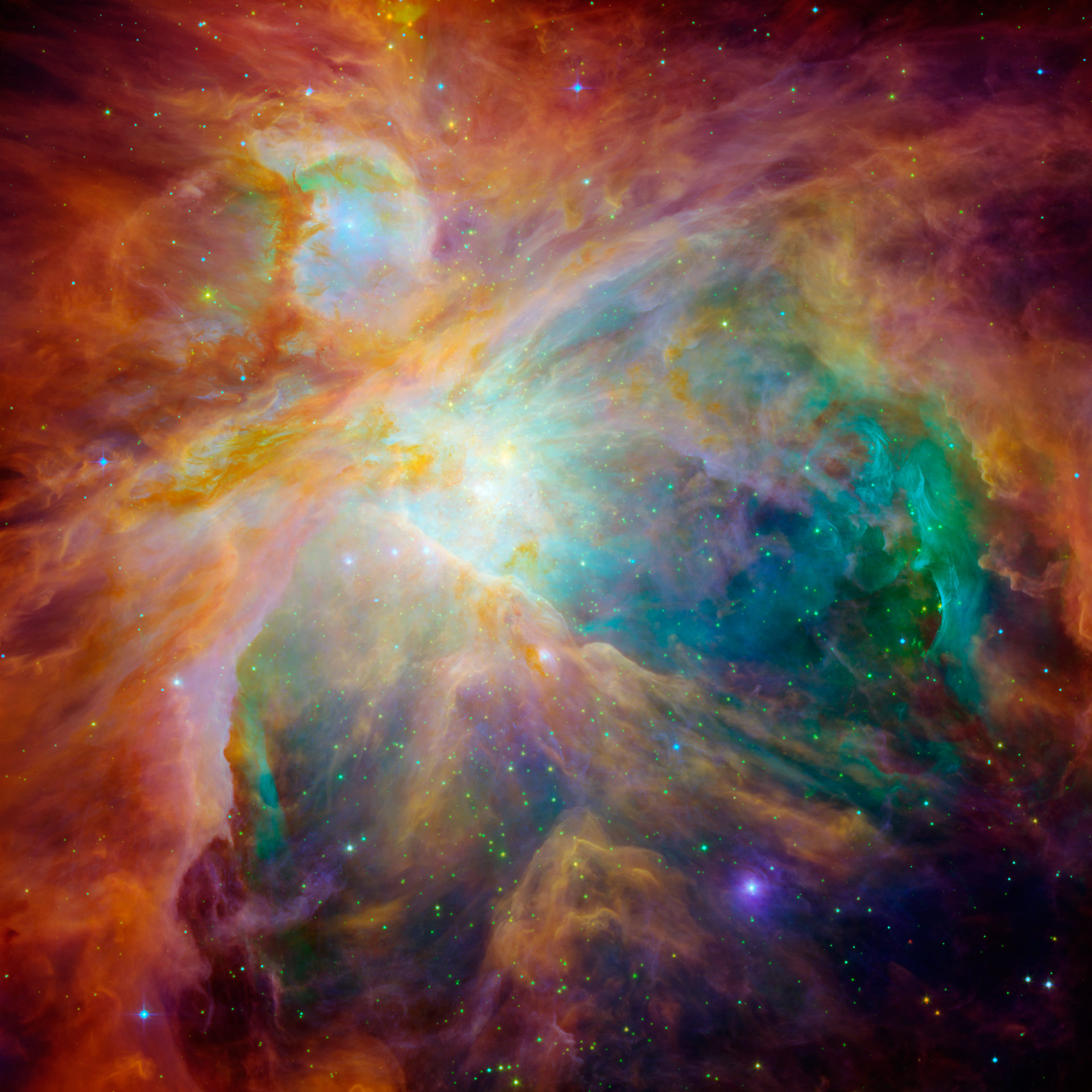
    A false-color image of the Orion Nebula as seen in the combined optical and infrared with the Hubble and Spitzer Space Telescopes. A new study of a very young, massive star embedded in the region finds evidence for magnetic fields that have shaped and helped collimate the bipolar jets. Credit: NASA; Hubble and Spitzer

    Astronomers used the Very Large Array radio telescopes to track the motions of the gas near radio Source I in the Orion Nebula for over nine years, adding an important link to the chain of evidence for the role of magnetic fields in influencing the properties of massive young stars.

    The Orion Nebula, one of the most famous sights in the night sky, contains several clusters of hot young stars, whose intense ultraviolet radiation prompts the gas and dust to glow brightly. The nebula is about 1360 light-years away, making it the closest nursery of massive stars and one of the best-studied such regions. But despite its fame, brightness, and proximity, astronomers still do not understand it very well. It contains dramatic outflows of material, for example, that may be driven by a single star or perhaps by a cluster of stars — astronomers are not sure. The reason for this ignorance is in part because the nebula is so crowded with stars, and in part because its dust obscures many regions from optical view.

    The brightest object in the nebula shines with as much light as 100,000 suns. In the past decade astronomers found that this source was itself comprised of several smaller ones, including an intense radio source called “Source I.” It is enigmatic, to put it mildly. Its motions suggest that it may have been ejected from another system just a few hundred years ago; other evidence suggests it is surrounded by a circumstellar disk of material containing natural masers (radio wavelength analogs of lasers). Such masers typically signal dense material around young stars.

    CfA astronomer Lincoln Greenhill and four of his colleagues have been tracking the motions of the gas near Source I for over nine years using the Very Large Array radio telescopes. The facility is capable of resolving distances at Orion of only about twenty astronomical units (AU) – smaller than our solar system (the average distance of Uranus from the Sun is 19 AU). The goal of their research was to unravel the relative roles of the three principal processes driving massive star formation: gravity, radiation pressure, and magnetism. The effects of these processes are somewhat mysterious because it is so difficult to study the densely packed regions of activity near the surface of the star where stellar winds are launched and collimated (not to mention that the region is heavily obscured by dust).

    The astronomers report finding a dynamically active, bipolar flow in the source, with strong shocks, motions of over 45,000 miles  (72,000 kilometers) per hour, a mass loss rate equivalent to about one Earth-mass per year, and (perhaps most significantly) evidence for the influence of magnetic fields in the collimation and rotation of the material over a scale between about 10-1000 AU. The results add an important link to the chain of evidence for the role of magnetic fields in influencing the properties of massive young stars.

    Reference: “Dynamical Evidence for a Magnetocentrifugal Wind from a 20 Msun Binary Young Stellar Object” by L. J. Greenhill, C. Goddi, C. J. Chandler, L. D. Matthews and E. M. L. Humphreys, 4 June 2013, The Astrophysical Journal Letters.
    DOI: 10.1088/2041-8205/770/2/L32
    arXiv:1305.4150


    Never miss a breakthrough: Join the SciTechDaily newsletter.
    Follow us on Google and Google News.

    Astronomy Astrophysics Harvard-Smithsonian Center for Astrophysics Hubble Space Telescope NASA Popular Spitzer Space Telescope
    Share. Facebook Twitter Pinterest LinkedIn Email Reddit

    Related Articles

    NASA Discovers Pair of Super-Earths With 1,000-Mile-Deep Oceans

    How Habitable Are Planets That Orbit Red Dwarfs – The Most Common Type of Stars in the Galaxy?

    Astronomers Build Incredible 3D Visualization of Exploded Star Using NASA’s Great Observatories [Video]

    Astronomers Discover “Twins” of Eta Carinae in Other Galaxies

    New Study Revives Doubted Exoplanet Fomalhaut b

    Scientists Search for Quasar’s “Missing” Galaxy

    Measuring the Expansion of Universe – A Newly Refined Value for the Hubble Constant

    Pr0201b and Pr0211b Orbiting Sun-Like Stars in the Beehive Cluster

    NASA Data Reveals Significant Changes in Exoplanet’s Atmosphere

    Leave A Reply Cancel Reply

    • Facebook
    • Twitter
    • Pinterest
    • YouTube

    Don't Miss a Discovery

    Subscribe for the Latest in Science & Tech!

    Trending News

    Artificial Sweeteners May Harm Future Generations, Study Suggests

    Splashdown! NASA Artemis II Returns From Record-Breaking Moon Mission

    What If Consciousness Exists Beyond Your Brain

    Scientists Finally Crack the 100-Million-Year Evolutionary Mystery of Squid and Cuttlefish

    Beyond “Safe Levels”: Study Challenges What We Know About Pesticides and Cancer

    Researchers Have Found a Dietary Compound That Increases Longevity

    Scientists Baffled by Bizarre “Living Fossil” From 275 Million Years Ago

    Your IQ at 23 Could Predict Your Wealth at 27, Study Finds

    Follow SciTechDaily
    • Facebook
    • Twitter
    • YouTube
    • Pinterest
    • Newsletter
    • RSS
    SciTech News
    • Biology News
    • Chemistry News
    • Earth News
    • Health News
    • Physics News
    • Science News
    • Space News
    • Technology News
    Recent Posts
    • What if Dark Matter Has Two Forms? Bold New Hypothesis Could Explain a Cosmic Mystery
    • Researchers Expose Hidden Chemistry of “Ore-Forming” Elements in Biology
    • Geologists Reveal the Americas Collided Earlier Than We Thought
    • 20x Difference: Study Reveals True Source of Airborne Microplastics
    • Scientists Uncover Hidden Force Powering Yellowstone’s Supervolcano
    Copyright © 1998 - 2026 SciTechDaily. All Rights Reserved.
    • Science News
    • About
    • Contact
    • Editorial Board
    • Privacy Policy
    • Terms of Use

    Type above and press Enter to search. Press Esc to cancel.