
Scientists from the Tata Institute of Fundamental Research and The Institute of Mathematical Science have predicted the existence of a dibaryon particle, built entirely from bottom quarks. This particle, termed D6b, is predicted to have a binding energy 40 times stronger than that of the only known stable dibaryon, deuteron. This discovery, made possible through Quantum Chromodynamics on space-time lattices, could provide valuable insights into the nature of strong forces and quark mass interactions.
Dibaryons are subatomic particles composed of two baryons. Their formation, which occurs through interactions between baryons, is fundamental in big-bang nucleosynthesis, nuclear reactions including those happening within stars, and bridges the gap between nuclear physics, cosmology, and astrophysics. Fascinatingly, the strong force, responsible for the formation and the majority of the mass of nuclei, facilitates the formation of a plethora of different dibaryons with diverse quark combinations.
Nevertheless, these dibaryons are not commonly observed — the deuteron is currently the only known stable dibaryon.
To resolve this apparent dichotomy, it is essential to investigate dibaryons and baryon-baryon interactions at the fundamental level of strong interactions. In a recent publication in the journal Physical Review Letters, physicists from the Tata Institute of Fundamental Research (TIFR) and The Institute of Mathematical Science (IMSc) have provided strong evidence for the existence of a deeply bound dibaryon, entirely built from bottom (beauty) quarks.
A Dibaryon Built from Bottom Quarks
Using the computational facility of the Indian Lattice Gauge Theory Initiative (ILGTI), Prof. Nilmani Mathur and graduate student Debsubhra Chakraborty from the Department of Theoretical Physics, TIFR, and Dr. M. Padmanath from IMSc have predicted the existence of this subatomic particle. The predicted dibaryon (D6b) is made of two triply bottom Omega (Ωbbb) baryons, having the maximal beauty flavor.
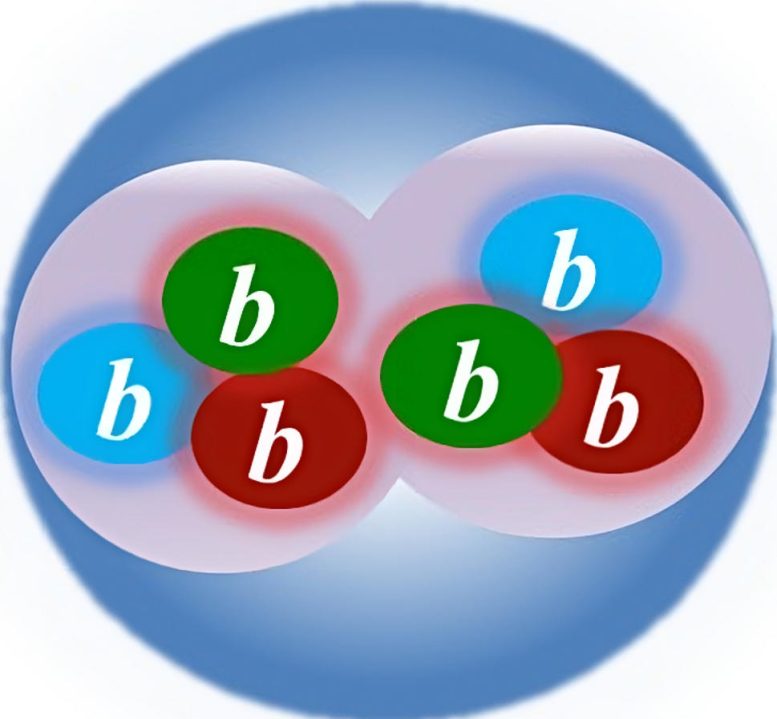
Its binding energy is predicted to be as large as 40 times stronger than that of the deuteron, and hence perhaps entitled it to be the most strongly bound beautiful dibaryon in our visible universe. This finding elucidates the intriguing features of strong forces in baryon-baryon interactions and leads the path for further systematic study of quark mass dependence of baryon-baryon interactions which possibly can explain the emergence of bindings in nuclei. It also brings motivation to search for such heavier exotic subatomic particles in next-generation experiments.
Quantum Chromodynamics and Lattice QCD
Since the strong force is highly non-perturbative in the low energy domain, there is no first-principles analytical solution as yet for studying the structures and interactions of composite subatomic particles like protons, neutrons, and the nuclei they form. Formulation of quantum chromodynamics (QCD) on space-time lattices, based on an intricate amalgamation between a fundamental theory and high-performance computing, provides an opportunity for such study.
Not only does it require a sophisticated understanding of the quantum field-theoretic issues, but the availability of large-scale computational resources is also crucial. In fact, some of the largest scientific computational resources in the world are being utilized by lattice gauge theorists who are trying to solve the mystery of strong interactions of our Universe through their investigations inside the femto-world (within a scale of about one million-billionth of a meter).
Lattice QCD calculations can also play a crucial role in understanding the nuclei formation at the Big Bang, their reaction mechanisms, in aiding the search for the physics beyond the standard model as well as for investigating the matter under the extreme conditions of high temperature and density similar to those at the early stages of the Universe after the Big Bang.
Reference: “Strongly Bound Dibaryon with Maximal Beauty Flavor from Lattice QCD” by Nilmani Mathur, M. Padmanath and Debsubhra Chakraborty, 16 March 2023, Physical Review Letters.
DOI: 10.1103/PhysRevLett.130.111901
Never miss a breakthrough: Join the SciTechDaily newsletter.
Follow us on Google and Google News.
11 Comments
Why
neutrino is a little
smaler than quark ?
You should have made the electron valence brown..then you could have called it the “Big Booty Bottom” baryon..💅
Dibaryon Theory is yet not new,but can be supported by the Universal Plasma Physics to explain magnetic recombination phenomena.Thanks to the autthors for their hypothesis.
The discovery of dibaryon TIFR Physicsts in combination with other Indian scientists is a great step in the field of astrophysics related to plasma.
More studies are required to complete the knowledge to a certain steps on star formation after the big bang,when subatomic particles come to existance and atoms are constituted.
Is the Space , live and a fighter?
Is the Etter is comming back?
Beautiful amazing brilliant
I most say
Thank you xx.
Xx.
Thank you so much for ur help and support.
My formulation of Quantum Mechanics absolutely will do this.
I can calculate the Mass of the Neutron to agree with empirical value from the measurement of Deuterons in a couple of lines.
My model of subatomic particles does not involve Quarks but it is modelled on relativistic shells. Moreover, it does not recognised the Strong Force as fundamental forces as it is aggregation of the values from each Shell and the Shells represent other fundamental forces including Gravity.
To give you some idea, I came up with an iterative solution for the Anomalous Moments of the Proton, Muon and Electron which simultaneously iterated out with the Fine Structure constant. This can be done on about a page in Excel.
There is something deep inside my mind that fuels an inexorable pleasure in reading these articles, it surpasses all woes or obstacles I’ve ever had to get over, or even my downfall spirals. My very profound proclivity of interest has led me to this question, where do I go to learn how to make these calculations myself? Better yet; being poor and impoverished,how do I place myself in a position where I can be part of this research and not just read the articles?How can I position myself in a place where utilizing my greatest love, I can make a difference in humanity with it? These questions are where my mind goes after every article I read. Help is welcome but never available and at the same time never too far but always just out of reach.
Maybe the issues of primordial entanglement and singularity within the structural combinations of gluons and quark interactions should be analyzed using QCD super computer distortion analysis or vector distribution systems within quark shells.Just asking if this analysis has been studied in relationship to this dibaron and deuterium analysis and investigation?