
Close Menu
    Facebook X (Twitter) Instagram
    SciTechDaily
    • Biology
    • Chemistry
    • Earth
    • Health
    • Physics
    • Science
    • Space
    • Technology
    Facebook X (Twitter) Pinterest YouTube RSS
    SciTechDaily
    Home»Chemistry»Beyond the Spectrum: Machine Learning Unlocks Predictive Power in Organic Chemistry Research
    Chemistry

    Beyond the Spectrum: Machine Learning Unlocks Predictive Power in Organic Chemistry Research

    By Institute of Industrial Science, The University of TokyoMay 17, 2023No Comments3 Mins Read
    Facebook Twitter Pinterest Telegram LinkedIn WhatsApp Email Reddit
    Share
    Facebook Twitter LinkedIn Pinterest Telegram Email Reddit
    Machine Learning Lets Researchers See Beyond the Spectrum
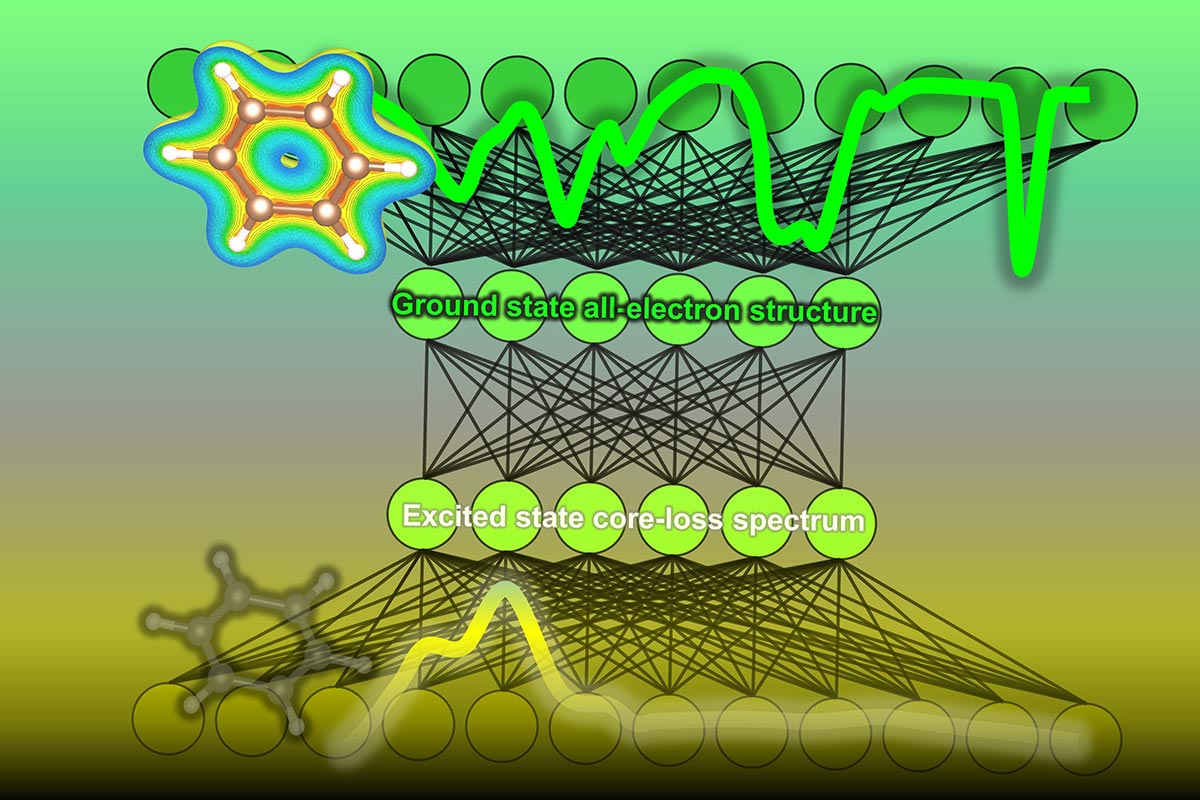
    Researchers at the Institute of Industrial Science, The University of Tokyo, use artificial intelligence to help interpret data generated by material science spectroscopy experiments, which can aid in the development of new drugs and organic conductors. Credit: Institute of Industrial Science, The University of Tokyo

    Scientists have developed a machine-learning algorithm that predicts electron energy levels in organic molecules. This breakthrough, trained on a database of over 22,000 molecules, could accelerate the design of functional molecules like pharmaceuticals.

    Organic chemistry, the study of carbon-based molecules, underlies not only the science of living organisms, but is critical for many current and future technologies, such as organic light-emitting diode (OLED) displays. Understanding the electronic structure of a material’s molecules is key to predicting the material’s chemical properties.

    In a study recently published by researchers at the Institute of Industrial Science, The University of Tokyo, a machine-learning algorithm was developed to predict the density of states within an organic molecule, i.e., the number of energy levels that electrons can occupy in the ground state within a material’s molecules. These predictions, based on spectral data, can be of great help to organic chemists and materials scientists when analyzing carbon-based molecules.

    The experimental techniques often used to find the density of states can be difficult to interpret. This is particularly true for the method known as core-loss spectroscopy, which combines energy loss near-edge spectroscopy (ELNES) and X-ray absorption near-edge structure (XANES). These methods irradiate a beam of electrons or X-rays at a sample of material; the resulting scatter of electrons and measurements of energy emitted by the material’s molecules allow the density of states the molecule of interest to be measured. However, information the spectrum has is only at the electron absent (unoccupied) states of the excited molecules.

    Machine Learning: A Novel Solution for Predicting Electronic Structures

    To address this issue, the team at the Institute of Industrial Science, The University of Tokyo, trained a neural network machine-learning model to analyze the core-loss spectroscopy data and predict the density of electronic states. First, a database was constructed by calculating the densities of states and corresponding core-loss spectra for over 22,000 molecules. They also added some simulated noise. Then, the algorithm was trained on core-loss spectra and optimized to predict the correct density of states of both occupied and unoccupied states at the ground state.

    “We attempted to extrapolate predictions for larger molecules using a model trained by smaller molecules. We discovered that the accuracy can be improved by excluding tiny molecules,” explains lead author Po-Yen Chen.

    The team also found that by using smoothing preprocessing and adding specific noise to the data, the predictions of density of state can be improved, which can accelerate adoption of the prediction model for use on real data.

    “Our work can help researchers understand the material properties of molecules and accelerate the design of functional molecules,” senior author Teruyasu Mizoguchi says. This can include pharmaceuticals and other exciting compounds.

    Reference: “Prediction of the Ground-State Electronic Structure from Core-Loss Spectra of Organic Molecules by Machine Learning” by Po-Yen Chen, Kiyou Shibata, Katsumi Hagita, Tomohiro Miyata and Teruyasu Mizoguchi, 17  May 2023, The Journal of Physical Chemistry Letters.
    DOI:10.1021/acs.jpclett.3c00142

    Never miss a breakthrough: Join the SciTechDaily newsletter.
    Follow us on Google and Google News.

    Machine Learning Organic Chemistry University of Tokyo
    Share. Facebook Twitter Pinterest LinkedIn Email Reddit

    Related Articles

    UCLA Chemists Shatter 100-Year-Old Chemistry Rule – Textbooks Need a Rewrite

    Revolutionary Catalyst Mimics Enzymes for Simpler, More Efficient Production

    Catalyst Magic: Game-Changing Method for Alkane Activation Discovered in Japan

    From Light Waves to Logic: The Cutting-Edge of Optical Computing

    New Samarium Catalyst Reduces Costs and Boosts Pharmaceutical Reaction Efficiency

    AI Cracks the Chemistry Code to Better, Longer-lasting Solar Panels

    Carbenes in Space? New Discovery Could Explain Life’s Cosmic Origins

    Superheated Flow Chemistry: A Leap Forward in Organic Synthesis

    ChemCrow: The Next Frontier in AI-Driven Chemical Synthesis

    Leave A Reply Cancel Reply

    • Facebook
    • Twitter
    • Pinterest
    • YouTube

    Don't Miss a Discovery

    Subscribe for the Latest in Science & Tech!

    Trending News

    This Experimental Drug Repaired the Gut and Reversed Severe Fatty Liver Disease

    Physicists Just Turned a Black Hole Energy Theory Into Reality

    Stanford Scientists Solve a 252-Million-Year-Old Mass Extinction Mystery

    The Ancient Survival Mechanism Making Weight Loss So Difficult

    Just 3,000 Steps a Day May Help Protect the Brain From Alzheimer’s

    “Weird Clams” Reveal a New Invasion Along the U.S. Northeast Coast

    Archaeologists Decapitated Tutankhamun and Glued His Body Back Together

    New Black Hole Theory Solves a 50-Year-Old Problem

    Follow SciTechDaily
    • Facebook
    • Twitter
    • YouTube
    • Pinterest
    • Newsletter
    • RSS
    SciTech News
    • Biology News
    • Chemistry News
    • Earth News
    • Health News
    • Physics News
    • Science News
    • Space News
    • Technology News
    Recent Posts
    • Microplastics Found in 84% of Serious Heart Attack Patients
    • The Oldest Known Right-Handed Animal May Have Lived 550 Million Years Ago
    • MIT’s Tiny Flying Robot Just Learned To Move Like a Real Insect
    • Why Are Bees Struggling To Survive This Summer?
    • Antarctic Meltwater Is Making Glaciers Slide Faster Toward the Ocean
    Copyright © 1998 - 2026 SciTechDaily. All Rights Reserved.
    • Science News
    • About
    • Contact
    • Editorial Board
    • Privacy Policy
    • Terms of Use

    Type above and press Enter to search. Press Esc to cancel.