
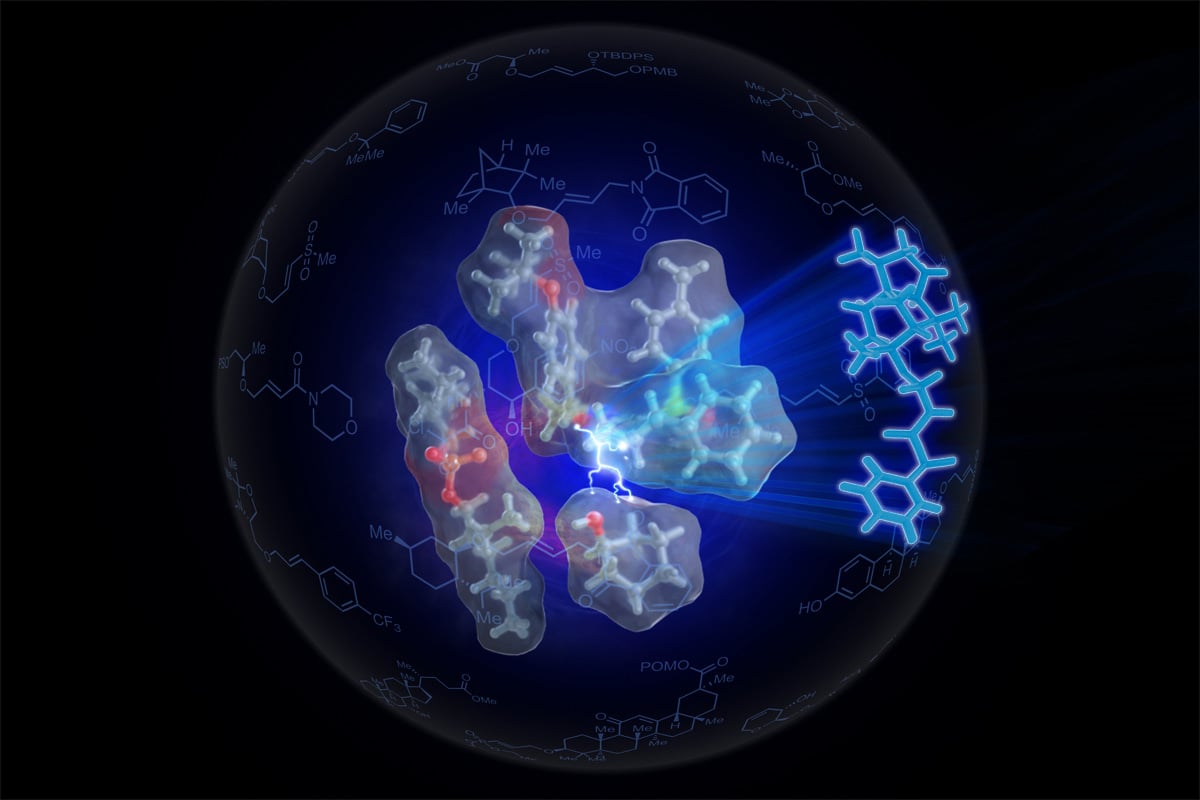
University of Illinois chemists developed an enzyme-inspired catalyst to streamline ether synthesis, making it more efficient and versatile. This breakthrough allows the creation of complex ethers with fewer steps and materials, holding potential for broad applications in chemistry and industry.
Inspired by enzymes, chemists at the University of Illinois Urbana-Champaign have created a catalyst that streamlines the synthesis of ethers, essential components in numerous drugs, foods, personal care products, and other consumer goods. This catalyst aligns the two chemical ingredients in optimal proximity and orientation, enabling them to react without the extra steps and quantities typically needed in conventional synthesis methods.
Led by U. of I. chemistry professor M. Christina White, the researchers published their findings in the journal Science.
“Ethers are very important molecules — they’re in everything — and our approach really streamlines the process for making them, as well as lets us make ethers we couldn’t before,” said White. “We always are inspired by nature. Enzymes showed us the way we could do these reactions better, simpler, and more efficiently.”
Challenges in Ether Synthesis
The ideal ingredient pairing for making an ether is an alcohol and a hydrocarbon called an alkene, but they won’t react on their own if mixed together, said graduate student Sven Kaster, the first author of the study. The textbook protocol involves ripping a proton from the alcohol, which makes it reactive, but results in a mixed cocktail of products from which the desired ether must be extracted. It also requires large amounts of the ingredients to yield enough ether to be useful, which is not practical for complex, valuable components.
“We took a different approach to solving the problem,” Kaster said. “We did not want to activate the alcohol, and we didn’t want to have to use large quantities of the reaction partners.”
The researchers developed self-assembling small-molecule catalysts containing the metal palladium that can cleave a bond between carbon and hydrogen in an alkene to make it react with alcohol. They dubbed the catalysts SOX. However, just making alkenes reactive wasn’t enough to yield the ethers the researchers wanted.
Broad Applications and Future Research
They turned to biology for inspiration, looking at how enzymes catalyze complex reactions in nature: by placing the reaction partners close together and in the right orientation to react, White said. They produced a version of the SOX catalyst, Sven-SOX, with specific geometry and electronic properties so that the activated alkene and the alcohol would align just right to produce the desired ethers.
“It’s like, if two people want to hold hands, they have to be close together. But to do it comfortably, they also have to be facing the right way,” White said. “We brought together those two functions, proximity and position, and kind of built our own self-assembling ‘enzyme,’ but with simple components.”
The Sven-SOX catalyst worked over a broad spectrum of ether-generating reactions. The researchers produced more than 130 ethers, including complex, bulky ones that have thus far been challenging to produce under other means.
“The main advantage to our approach is the generality. We can make a lot of ethers that haven’t been made before, that may have new or useful functions,” Kaster said. “We can make ethers with components that are very bulky and normally hard to put together. Our reaction also has very mild conditions, and because of that, we can tolerate very sensitive groups that normally, under the textbook method, would undergo reactions that we don’t want. Another advantage is that we make these ethers more efficiently, using less material and fewer steps. It’s a procedure a middle schooler could do.”
A video demonstrating the process. Credit: University of Illinois at Urbana-Champaign
Next, the researchers plan to explore other small-molecule catalysts that could have enzyme-like characteristics for making other classes of chemicals. They also will continue to explore ether reactions and how to optimize them.
“This really highlights the importance of basic science and the power of small molecules to perform like an enzyme,” White said. “This work showed us how to think about designing such catalysts in the future and making use of the tools that enzymes use in nature. We want to incorporate that into future catalyst design to solve important problems in chemistry, medicine, and industry.”
Reference: “Palladium-catalyzed cross-coupling of alcohols with olefins by positional tuning of a counteranion” by Sven H. M. Kaster, Lei Zhu, William L. Lyon, Rulin Ma, Stephen E. Ammann and M. Christina White, 5 September 2024, Science.
DOI: 10.1126/science.ado8027
The National Institute of General Medical Sciences of the National Institutes of Health supported this work.
Never miss a breakthrough: Join the SciTechDaily newsletter.
Follow us on Google and Google News.