
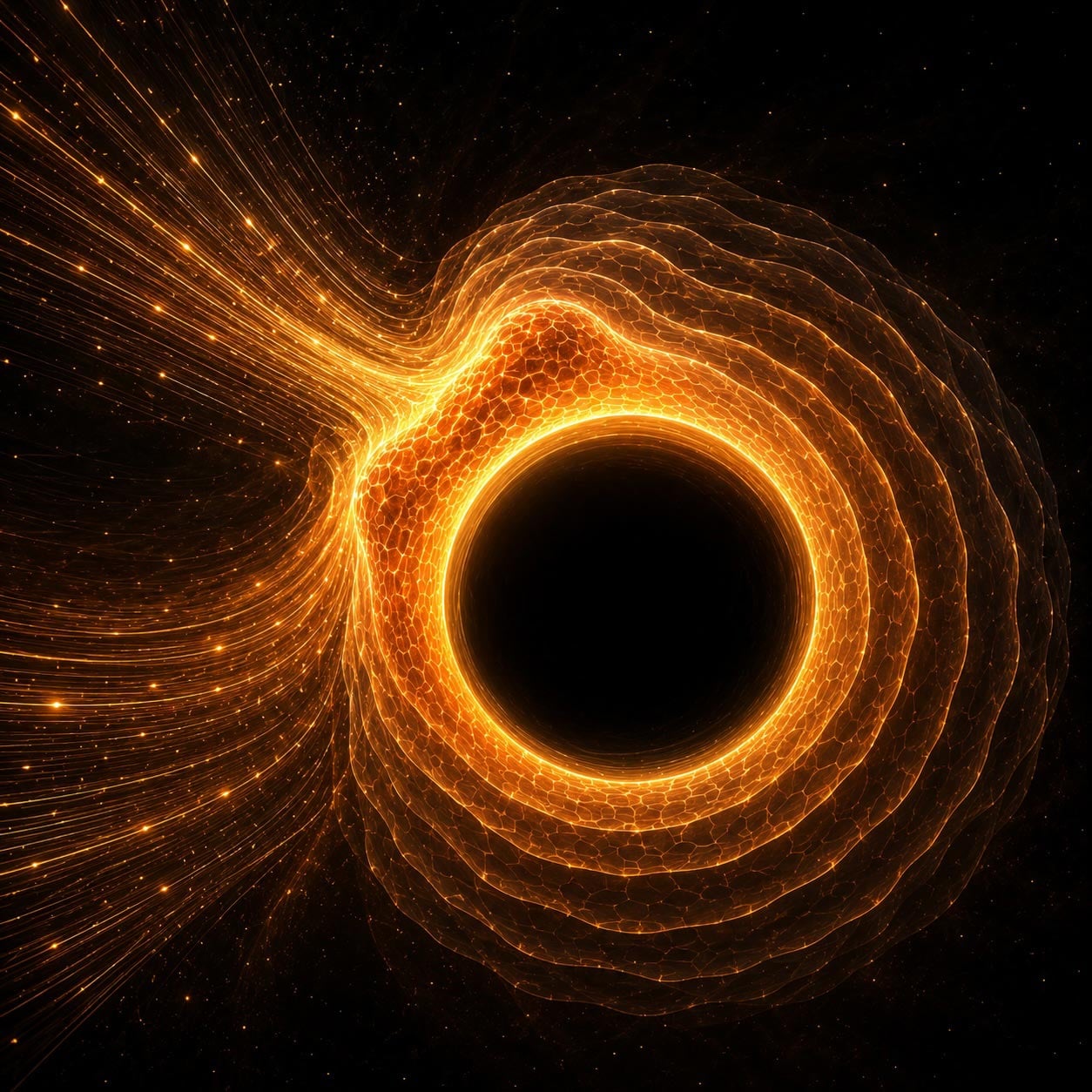
Scientists may have found a more realistic set of thermodynamic rules for black holes that never stop changing.
Black holes are among the most extreme objects known in the universe. They compress enormous amounts of mass into remarkably small regions, creating gravitational fields so powerful that nothing, not even light, can escape once it crosses the boundary.
Physicists describe black holes using equations drawn from Einstein’s theory of general relativity along with ideas from quantum mechanics. In the early 1970s, however, Stephen Hawking and other researchers recognized that black holes appeared to follow rules similar to the laws of thermodynamics, the branch of physics that explains how heat, energy, and disorder behave in ordinary systems, such as water boiling on a stove.
A Major Limitation in Hawking’s Framework
“Hawking’s laws of black hole mechanics provided a satisfying connection between extreme and ordinary physics and have been the paradigm for 50 years, but they have a serious limitation,” said Abhay Ashtekar, Atherton University Professor and Evan Pugh Professor of Physics Emeritus in the Eberly College of Science at Penn State and the leader of the research team. “They were formulated for black holes at equilibrium — or unchanging over time — but black holes are constantly changing; they form, merge, and eventually evaporate. We wanted to find a way to overcome this limitation and extend the laws to black holes that are out of equilibrium.”
Real black holes are rarely static. They can accumulate matter, collide with other black holes, and gradually lose energy through quantum processes. Yet the traditional laws of black hole mechanics were designed primarily for black holes in equilibrium, meaning their properties do not change over time.
A new study led by Ashtekar and published in Physical Review Letters, where it was highlighted as an editor’s suggestion, proposes another way to calculate a black hole’s entropy. Entropy is commonly described as a measure of disorder, and under the second law of thermodynamics, it cannot decrease.
The new definition links entropy more directly to a black hole’s energy and spin. The researchers say this approach could provide a more realistic way to study black holes while they evolve, evaporate, or merge with other black holes.
How Black Holes Entered Thermodynamics
“The laws of black hole mechanics came directly from Einstein’s equations,” said Daniel E. Paraizo, a graduate student in physics at Penn State and an author of the paper. “Because you cannot see into a black hole, it seemed that there could be an infinite number of ways to make a black hole, making their entropy infinite as well. They were also thought to only absorb energy and never radiate, so their temperature was zero.”
Those early assumptions made black holes appear incompatible with thermodynamics. If their entropy were infinite and their temperature were zero, it was difficult to treat them like ordinary physical systems.
That view changed when Hawking used quantum mechanics to show that black holes can emit particles and energy. This phenomenon, now known as Hawking radiation, suggested that black holes can have a temperature and gradually lose mass.
“This changed the thinking about the thermodynamic properties of black holes from a sort of mathematical concept described by equations, to being more of a physical reality,” Paraizo said. “This opened the door to finding analogies in black holes of entropy and temperature used in thermodynamics.”
Hawking proposed that a black hole’s entropy is proportional to the area of its event horizon. The event horizon is the surrounding boundary beyond which gravity prevents even light from escaping. He also argued that the black hole’s temperature is inversely related to a combination of its mass and spin.
Why Event Horizons Create a Problem
Although this framework works well for a stable black hole, it becomes more difficult to apply when a black hole is changing.
“There is a problem, though,” said Jonathan Shu, a graduate student in physics at Penn State and an author of the paper. “These analogies only really work for a black hole that is at equilibrium. In dynamic situations, event horizons can form and grow in what we call flat regions of space-time, where nothing is happening. This makes them teleological — their properties cannot be determined just by the local physics of the black hole but instead rely on prediction of events that may or may not happen in the future. Therefore, the area of event horizons cannot be a measure of the physical entropy of dynamical black holes. If we want to understand black holes that are growing, evaporating, and merging, we need a viable alternative.”
In other words, an event horizon is not determined solely by what is happening around a black hole at a particular moment. Its location can depend on events that occur later. This forward-looking feature makes it difficult to use the event horizon as a direct physical measure of entropy in an evolving black hole.
Dynamical Horizons Offer a New Solution
The researchers propose replacing event horizons with so-called “dynamical horizons,” which are already widely used in computer simulations of black holes.
Unlike an event horizon, a dynamical horizon can be defined using the black hole’s physical properties at a specific moment. It therefore avoids the teleological problem and may offer a more practical way to track entropy as a black hole changes.
“This allows us to extend the first and second laws of thermodynamics to black holes that are not at equilibrium, thereby overcoming the limitations of the paradigm that has been used for over half a century,” Ashtekar said. “We can apply these generalized laws to better understand evaporating black holes in quantum theory and black hole mergers, like those detected by the LIGO-Virgo-KAGRA collaboration using gravitational waves.”
The expanded framework could help physicists interpret black hole mergers observed through gravitational waves and investigate the still mysterious process by which black holes evaporate in quantum theory.
Reference: “Thermodynamics of Black Holes, Far from Equilibrium” by Abhay Ashtekar, Daniel E. Paraizo and Jonathan Shu, 24 June 2026, Physical Review Letters.
DOI: 10.1103/3c1r-v8f1
Funding from the Penn State Atherton Professorship Program and the Penn State Eberly College of Science supported the research.
Never miss a breakthrough: Join the SciTechDaily newsletter.
Follow us on Google and Google News.
4 Comments
Hawking was wrong. Black holes are actively dynamical structures in space that react with our spacetime as dense gravitational wells that are gravitationally coupled to our 4D spacetime but that have sunk into an adjacent less dense dimension. An analog would be the concept of buoyancy where a dense mass that is in equilibrium or greater than the surface tension of the surface of water (or the mass density of air molecules) will float at the stress interface that exists between densities. When the mass density exceeds the boundary conditions that separate dimensional space the mass will sink into the adjacent dimension and remain there, but still be gravitationally coupled to our spacetime and interact with mass across the gravity vortex that we call the event horizon.
What makes you say…. any of that? Sounds kind of interesting. I might read an article on this theory, but it’s definitely a huge step in a different direction, and I never heard of, nor seen it discussed elsewhere, so it must be at least relatively obscure. It sounds more psuedo science-y to me.
Black holes are pseudo science-y, since we cannot ‘know’ any of the information within their event horizon. Black hole theory is just that… theory.
Penn State breakthrough, the real kicker is how they had to handle the horizon of the black hole.
For decades, the standard math treated that boundary like a fixed, frozen line in the sand. But in a dynamic universe, stuff falls in, energy escapes, and the whole system is constantly in flux. By switching to a dynamic model, they basically admitted that the boundary expands and contracts based on the active load—just like adjusting the relief valve on a pressurized tank when the volume changes.
It’s a step closer to looking at the universe as a working, breathing machine instead of a static drawing.