
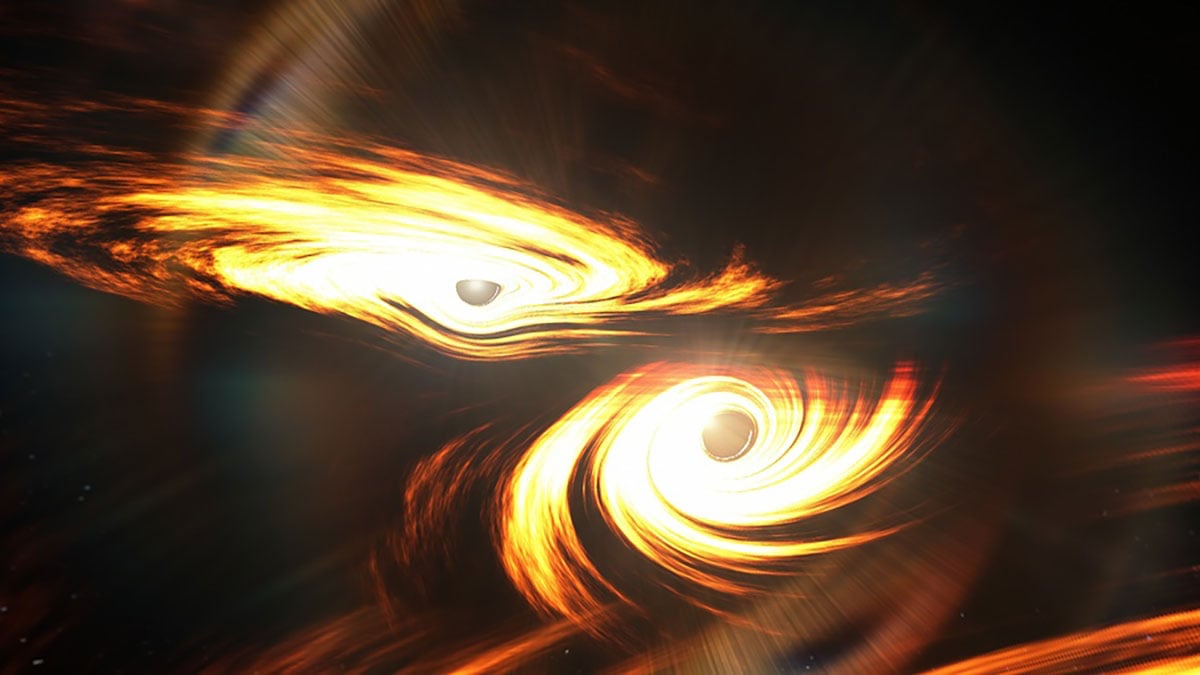
The size of a black hole formed by the merger of two orbiting black holes can be predicted using simple thermodynamics.
Two black holes locked in orbit do not remain apart forever. As they spiral closer, they eventually collide in an extraordinarily energetic event that warps the surrounding universe and sends gravitational waves across billions of light years.
These waves, which are ripples in the fabric of spacetime, can be measured by highly sensitive instruments on Earth. Their signals allow physicists to estimate the properties of the larger black hole left behind after the collision, known as the remnant.
Making those predictions accurately usually requires supercomputers to solve the difficult equations Einstein developed for general relativity. Physicists led by Penn State have now shown that a much simpler thermodynamic principle may closely predict the remnant’s size while also revealing more about the physics hidden within those equations.
The research was published in Physical Review Letters, where it was selected as an “editor’s suggestion.”
“The final black hole after a merger is ringing like a struck bell, and it radiates away more gravitational waves until it settles into a calm, stable state described by just two numbers — its final mass and spin,” said Monica Rincon-Ramirez, a postdoctoral scholar in physics in the Penn State Eberly College of Science and the first author of the paper. “The question we asked is: Can we predict what that final state looks like using arguments from thermodynamics?”
Black holes enter thermodynamics
Thermodynamics describes how energy, heat, and entropy determine the large-scale behavior of systems made from many interacting particles. Its principles apply to everything from gases inside engines and the atmosphere to the physical changes involved in cooking.
General relativity approaches nature differently. It describes gravity as the curvature of spacetime and is essential for explaining astronomical phenomena such as black holes. These objects were once thought to lie outside thermodynamics, until Stephen Hawking demonstrated that black holes could radiate energy.
Another recent Penn State study addressed a limitation in Hawking’s description of black hole mechanics, extending it to changing black holes that form, merge and evaporate.
“The concepts and laws of thermodynamics apply to systems with many particles, like gases,” said Nathan K. Johnson-McDaniel, a postdoctoral researcher at the University of Mississippi who earned a doctorate in physics at Penn State in 2011 and an author of the paper.
“Usually, we are interested in predicting the coarse-grained properties of these gases and not what every molecule is doing. Black holes, on the other hand, are described by the deterministic equations of general relativity and seemingly have no relationship with the gases. But starting in the 1970s, leading physicists found an interesting parallel between the properties of black holes and those of gases. We wanted to extend this analogy to binary black hole systems.”
Entropy points to the final remnant
The researchers considered what remains after gravitational waves carry energy and angular momentum away from a merging pair. Angular momentum measures the rotational motion of the system.
Their calculations suggest that the resulting black hole settles into the state with the greatest possible entropy once those losses are included. Entropy describes how many possible arrangements a system can have and reflects the tendency of physical systems to move toward more probable, less ordered states.
“Entropy is essentially a measure of disorder, or more precisely, of how many ways something can be arranged,” said Vaishak Prasad, a postdoctoral researcher in astronomy and astrophysics at Penn State and an author of the paper. “A messy room has high entropy — there are countless ways things can be strewn about. A perfectly tidy room has low entropy — there are only a few arrangements that count as ‘tidy.’ Nature tends to drift toward high entropy states simply because there are more of them. Our results suggest that black hole mergers do something similar.”
A simple rule matches simulations
The researchers call their proposal the “maximum entropy conjecture for black hole mergers.” The idea closely resembles how ordinary thermodynamics predicts the final condition of familiar physical systems.
“When two hot gases are brought into contact, one does not need to track every microscopic interaction of the molecules in the gases to determine the final state of the combined gas,” said Eugenio Bianchi, professor of physics at Penn State and an author of the paper. “Maximizing entropy, while accounting for other physical laws, predicts the outcome.”
The new conjecture proposes that the same broad rule could determine what remains after two black holes combine.
To test it, the researchers followed how the mass and angular momentum of two merging black holes corresponded to a sequence of possible rotating remnants. They then identified where entropy reached its highest value and compared that point with the remnant independently predicted by numerical relativity simulations.
“The central finding emerged from studying how the merging black holes’ evolving mass and angular momentum map onto those of a sequence of hypothetical rotating black hole remnants,” Rincon-Ramirez said. “Remarkably, we observe that the entropy of this sequence reaches a maximum at values strikingly close to the mass and angular momentum of the actual final remnant predicted independently by numerical relativity simulations. The agreement is within a few percent.”
What the final black hole remembers
After two black holes merge, the resulting object appears to lose nearly all information about the collision that created it. What remains can be described almost entirely through two properties: its mass and spin.
“We found that the most natural way to describe what it does remember can be explained using thermodynamic concepts,” said B.S. Sathyaprakash, Elsbach Professor of Physics and professor of astronomy and astrophysics in the Penn State Eberly College of Science, the leader of the research team.
“This work explores a surprising possibility at the intersection of gravity, black hole physics and thermodynamics that goes beyond the established laws of black hole mechanics and thermodynamics and raises a potentially transformative question: Could entropy maximization be a fundamental organizing principle governing black hole interactions more generally?”
Reference: “Maximum Entropy Conjecture for Black Hole Mergers” by Monica Rincon-Ramirez, Nathan K. Johnson-McDaniel, Eugenio Bianchi, Ish Gupta, Vaishak Prasad and B. S. Sathyaprakash, 7 July 2026, Physical Review Letters.
DOI: 10.1103/hvp6-ydbq
The U.S. National Science Foundation funded the research.
Never miss a breakthrough: Join the SciTechDaily newsletter.
Follow us on Google and Google News.
1 Comment
Все замечательно, за исключением. Горячая плазма звезды притянутая черной дырой Создает Горизонт событий. Где идет совершенно обратный процесс. Масса создает единое тело из всех частиц, время становится вращением Тела, пространство его длиной окружности. что не синхронизировалось отбрасывается, как излучение Хокинга, с нижнего горизонта. Или джет с середины. Сохранение информации, в самой частице, если отдельная имеет собственную массу время и пространство, то тут оно общее. Потому в черной дыре фотонам и переночевать негде, им там нечего делать. И черная дыра может только расти. Расколотить можно только всю и только до исходной частицы. И это сделать весьма непросто. События редкие но способ работает. Теория Спираль Бытия(R).