
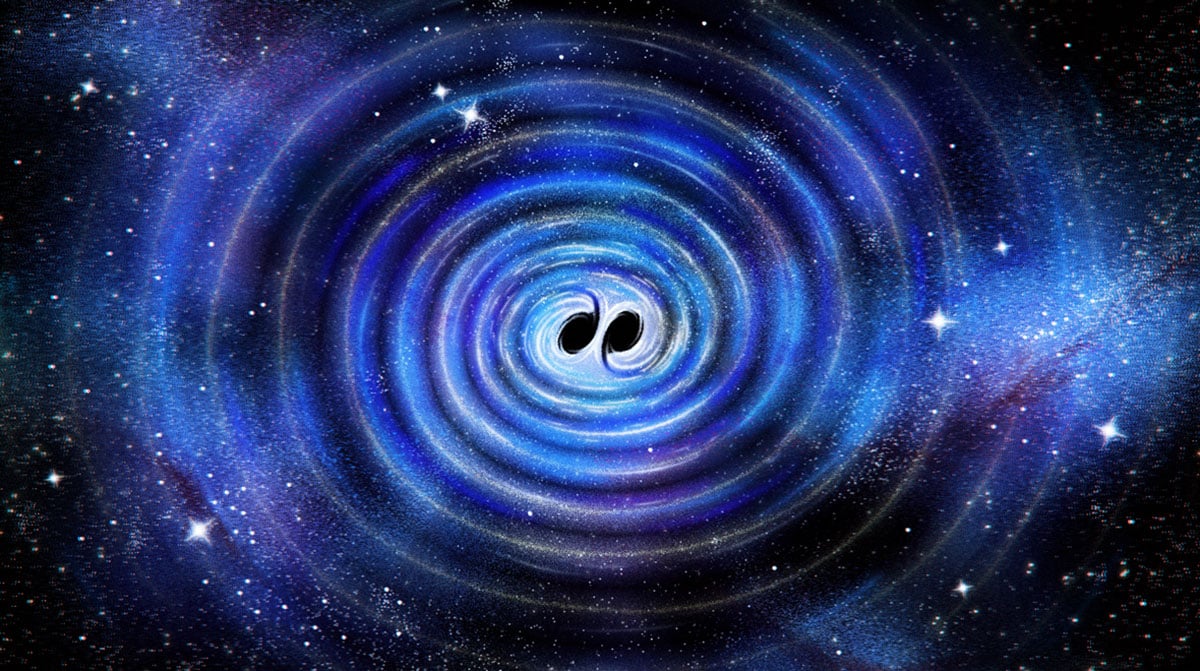
Fresh observations of two merging black holes confirm predictions made by Stephen Hawking based on Albert Einstein’s theory.
A decade after the first detection of gravitational waves from two merging black holes, the LIGO-Virgo-KAGRA collaboration, including Columbia University astronomer Maximiliano Isi, has captured another signal from a nearly identical cosmic event.
Thanks to major advances in detector sensitivity, the team observed the collision with nearly four times greater clarity than before, allowing them to confirm two long-standing theoretical predictions: that black holes formed by mergers never shrink, in line with Stephen Hawking’s theory, and that they “ring” after merging, just as Albert Einstein’s general relativity predicts.
“This unprecedentedly clear signal of the black hole merger known as GW250114 puts to the test some of our most important conjectures about black holes and gravitational waves,” Isi said.
Testing Hawking’s black hole area theorem
In 1971, Stephen Hawking proposed that the event horizon of a black hole—the outer limit beyond which nothing, not even light, can escape—can never shrink.
In 2021, Isi and his colleagues used data from the LIGO gravitational wave observatory to examine high-energy ripples in space-time produced by a black hole collision, providing the first observational confirmation of Hawking’s prediction. At the time, The New York Times noted that if this result had been published before Hawking’s death, it might have earned him a Nobel Prize.
The new findings strengthen that earlier conclusion with much greater precision, confirming that the surface area of the resulting black hole is always at least as large as the combined areas of the two that merged. This improved accuracy was achieved through data collected from both LIGO observatories, one based in Washington state and the other in Louisiana.
Listening to the “ringing” of black holes
The researchers were also able to isolate and analyze the gravitational waves emitted by the black holes after they merged. By measuring the waves’ pitch and duration, they were able to learn more details about the merged black hole’s structure and properties. (The process works in much the same way that analyzing the pitch of a sound emitted by a hollow instrument can tell you about the size and shape of both the instrument and the object that struck it.)
The researchers confirmed that the merged black hole was consistent with what is known as a “Kerr black hole.” The mathematician Roy Kerr, working in the 1960s, solved Einstein’s space-time equations, positing a detailed mathematical solution of what the exact gravity, space, and time of a black hole should be.
Physicists believe that all black holes must be described by Kerr’s solution, but confirming this is famously challenging. By studying the vibrations of the final black hole in this exceptionally clear signal, Isi and the LIGO Collaboration have obtained the most direct evidence yet that black holes behave like Kerr predicted.
“Over the next decade, gravitational wave detectors like LIGO will continue to improve, giving us a sharper view of black holes and their mysteries,” Isi said, “I can’t wait to see what we find out.”
Reference: “GW250114: Testing Hawking’s Area Law and the Kerr Nature of Black Holes” by A. G. Abac, I. Abouelfettouh, F. Acernese, K. Ackley, C. Adamcewicz, S. Adhicar, D. Adhikari, N. Adhikari, R. X. Adhikari, et al. (LIGO Scientific, Virgo, and KAGRA Collaborations), 10 September 2025, Physical Review Letters.
DOI: 10.1103/kw5g-d732
Never miss a breakthrough: Join the SciTechDaily newsletter.
Follow us on Google and Google News.
9 Comments
But in 1974 he proposed that they do shrink, that they give off radiation, and evaporate.
Sounds like a fake science story.
You are talking about a different process. This article is about shrinkage during a merge of two black holes, not hawking radiation. The article is titled poorly.
It’s poorly titled, and worse-written:
“…black holes formed by mergers never shrink”
even worse:
“In 1971, Stephen Hawking proposed that the event horizon of a black hole—the outer limit beyond which nothing, not even light, can escape—can never shrink.”
The former would lead to the impression that there is something special about merged BHs that precludes Hawking radiation. That latter seals the perceived deal: event-horizons do not shrink, period
Has some hack writer at Columbia U. handed off the responsibility for sound science-exposition to some hack LLM? Or is it plain h u m a n slop?
“That latter…”
*The latter…
I’m glad someone already posted this re: “never”. I came to the comments to say the same thing. Poorly written article.
Greg, black hole evaporation is actually dealt with in the peer reviewed paper.
The authors state, “The area law relies on three conditions. The first is the null-energy condition, a restriction on the properties of matter. It is violated, for example, by Hawking radiation which extracts energy from a black hole and causes its horizon to shrink [46]—in this case, the area law is superseded by a generalized law that considers both the entropy of the black hole and that of the radiation [45,195].”. I haven’t actually run the calculations, but I strongly suspect the effects of such evaporation are negligible over the period in which the merger took place.
The above article links to the paper. It is open access.
Timothy Chase -Thanks for giving that reasonable response to Greg’s comment above. It’s always refreshing to read comments that don’t indulge in insulting, ego-boosting, self-puffery like the one from “danR2222” above (and not his first time).
Today post
I would tell my grandkids: You know, without being shrink, blackholes to be like the picture puzzle game. One day all the blackholes (pieces) come together as shown in the final puzzle game. Then likely it being thrown apart again with new puzzle pieces and the cycle keeps going on.
Again, I could tell them maybe there were no creation of the blackholes at all, just the growth. Black holes did exist by itself during the overall puzzle picture pieces falling apart and during that time, space-time properties come to exist.
Request to review the post In http://scitedaily.com/hawhing-was-right-new-data-confirms-black-holes-never-shrink/#comment-910565
which was removed later by the Columbia University – November 23, 2025. The post which was intended a simple way of explanation for my grandkids, had come across three imaginations: 1 when the universe merged back to the original, all the blackholes lined up like a puzzled picture pieces. 2 when the big bang happened these blackhole puzzle pieces exploded into to different size blackholes again ( assumingly tiny blackholes). 3 if so, blackholes already exist instead.
[ There is no intention of explaining the universe existence here]
Today article of Scientists Finally Explain Mysterious “Impossible” Merger of Two Massive Black Holes provides some inside interesting for the request of reviewing the removal.