
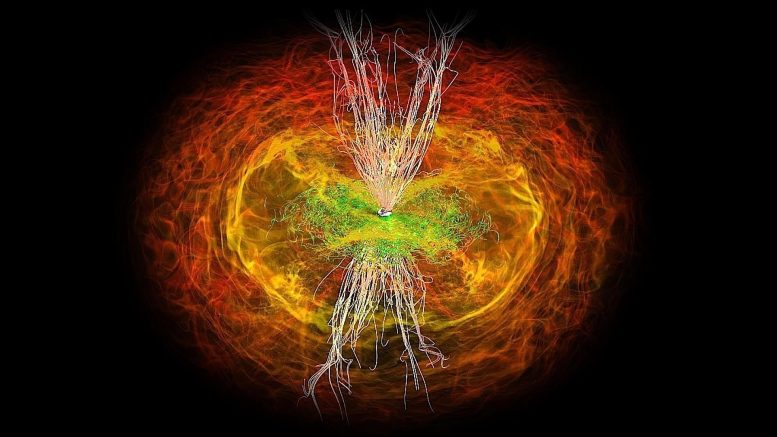
Scientists are using techniques from fusion energy research to study gravitational waves, enabling insights into stars, black holes, and the Big Bang.
Scientists have advanced in discovering how to use ripples in space-time known as gravitational waves to peer back to the beginning of everything we know. The researchers say they can better understand the state of the cosmos shortly after the Big Bang by learning how these ripples in the fabric of the universe flow through planets and the gas between the galaxies.
“We can’t see the early universe directly, but maybe we can see it indirectly if we look at how gravitational waves from that time have affected matter and radiation that we can observe today,” said Deepen Garg, lead author of a paper reporting the results in the Journal of Cosmology and Astroparticle Physics. Garg is a graduate student in the Princeton Program in Plasma Physics, which is based at the U.S. Department of Energy’s (DOE) Princeton Plasma Physics Laboratory (PPPL).
Fusion Energy Research Inspires Technique
Garg and his advisor Ilya Dodin, who is affiliated with both Princeton University and PPPL, adapted this technique from their research into fusion energy, the process powering the sun and stars that scientists are developing to create electricity on Earth without emitting greenhouse gases or producing long-lived radioactive waste. Fusion scientists calculate how electromagnetic waves move through plasma, the soup of electrons and atomic nuclei that fuels fusion facilities known as tokamaks and stellarators.
It turns out that this process resembles the movement of gravitational waves through matter. “We basically put plasma wave machinery to work on a gravitational wave problem,” Garg said.
Gravitational waves, first predicted by Albert Einstein in 1916 as a consequence of his theory of relativity, are disturbances in space-time caused by the movement of very dense objects. They travel at the speed of light and were first detected in 2015 by the Laser Interferometer Gravitational Wave Observatory (LIGO) through detectors in Washington State and Louisiana.
Garg and Dodin created formulas that could theoretically lead gravitational waves to reveal hidden properties about celestial bodies, like stars that are many light years away. As the waves flow through matter, they create light whose characteristics depend on the matter’s density.
A physicist could analyze that light and discover properties of a star millions of light years away. This technique could also lead to discoveries about the smashing together of neutron stars and black holes, ultra-dense remnants of star deaths. They could even potentially reveal information about what was happening during the Big Bang and the early moments of our universe.
The research began without any sense of how important it might become. “I thought this would be a small, six-month project for a graduate student that would involve solving something simple,” Dodin said. “But once we started digging deeper into the topic, we realized that very little was understood about the problem and we could do some very basic theory work here.”
The scientists now plan to use the technique to analyze data in the near future. “We have some formulas now, but getting meaningful results will take more work,” Garg said.
Reference: “Gravitational wave modes in matter” by Deepen Garg and I.Y. Dodin, 10 August 2022, Journal of Cosmology and Astroparticle Physics.
DOI: 10.1088/1475-7516/2022/08/017
This research was supported by the U.S. National Science Foundation through Princeton University.
Never miss a breakthrough: Join the SciTechDaily newsletter.
Follow us on Google and Google News.
2 Comments
“the Beginning of Everything We Know”… How about instead “Everthing we still need to learn”, but that would mean that science isn’t exact, doesn’t have all the answers & we’re not God (although we do sleep on a motel 6 planet).. & thank God we’re not!
“we’re not God, thank God for that.” …. yes if humans had the power of God we would have destroyed ourselves and possibly the entire Milky Way by now. 🙂