
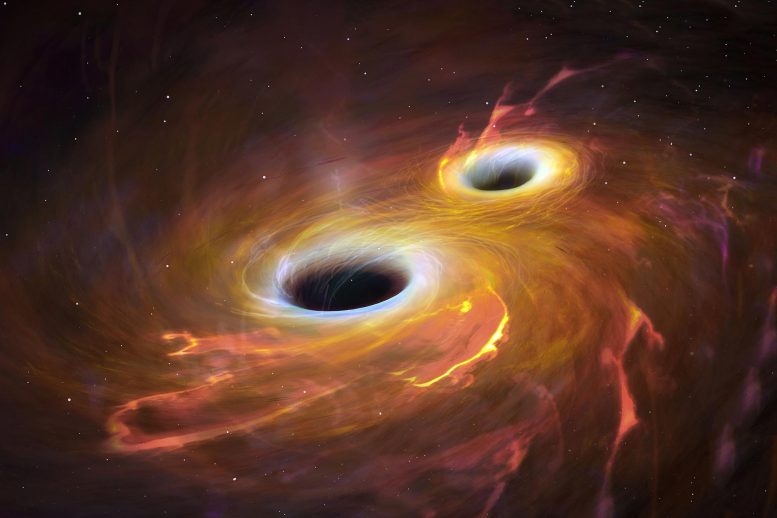
A research paper uses new methods to analyze the waves that black holes emit when they collide.
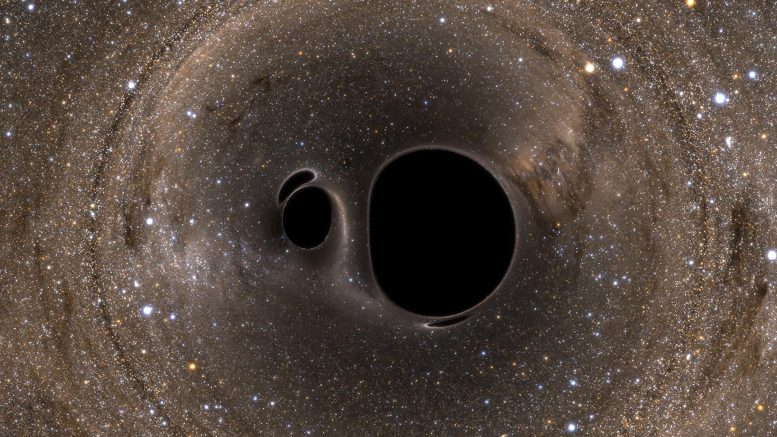
In 2015, scientists for the first time detected gravitational waves, ripples in space-time that occur when major cosmic events—like the collision and merging of two black holes—disrupt the cosmos. The observation of these waves confirmed Einstein’s theory of general relativity, which predicted such waves would occur if space-time worked as he believed it did. In the seven years since, nearly 100 merging black holes have been detected by observing the gravitational waves that these extraterrestrial events emit.
Now, thanks to new research, the ability to model these cosmic events has become more sophisticated. The team of 14 researchers was led by Caltech PhD student and Columbia College alum Keefe Mitman (CC’19), Columbia postdoc Macarena Lagos, Columbia Professor Lam Hui, and University of Mississippi professor Leo Stein. The improved model that they developed paves the way for a deeper understanding of the structure of merging black holes.
In “Nonlinearities in Black Hole Ringdowns,” a new paper published in Physical Review Letters, the team outlines a more complex way to model the signal that gravitational waves emit by including nonlinear interactions in the models. This modeling method will allow scientists to better understand the structure of what’s happening inside of black holes, and will also help test whether Einstein’s theory of general relativity correctly describes the behavior of gravity in extreme astrophysical environments.
“This is a big step in preparing us for the next phase of gravitational wave detection, which will deepen our understanding of gravity and these incredible phenomena taking place in the far reaches of the cosmos,” Lagos, a co-author on the paper, said.
The research comes at an opportune time: This March, LIGO, the observatory that first detected gravitational waves, will be powered on to collect new observations of events taking place in the far reaches of space. The observatory has not operated since 2020, when it was shuttered because of the pandemic. Several other major detectors are expected to start collecting data in the coming years, making it even more important that they have sophisticated models to interpret incoming information.
Gravitational Waves as a Cosmic Detective Tool
Co-author Lam Hui used an analogy to describe the information that gravitational waves can provide: “If I give you a box and ask you what’s in it, the natural thing to do is to shake it. That would tell you whether inside the box are candies or coins. That’s what we’re trying to do with these models, is gather a sense of the inner contents of a black hole by listening to the sound that’s emitted when it’s shaken.” The “shaking” in the case of black holes is the disruption that occurs when two collide and merge. “By listening to the harmonics that it emits, we can assess the space-time structure of the black hole.”
Models of gravitational waves emitted after two black holes merge have to date only included linear interactions, which work well, providing valuable information about black holes’ structure and contents. This new model, however, could offer as much as a 10% improvement in the overall accuracy of black hole models, the paper’s authors said.
To understand the importance of using nonlinearity to describe gravitational waves, the authors described waves in an ocean: A wave that rises and falls without spouting water into the air could be described with a linear equation. But a wave that crests and breaks exhibits nonlinear interactions: While some water swells at the wave’s bottom, other water is simultaneously crashing left, right, up, and down in tendrils and droplets of water above it. A nonlinear model of the wave would allow you to understand how and when all of the water in the wave, including those airborne droplets, is moving. Gravitational waves are similar to water waves, and the new model is able to account for the extraterrestrial equivalent of extra water droplets.
“We’re getting ourselves ready for when we’re going to be gravitational wave detectives, when we’ll be digging deeper to understand everything we can about their nature,” Stein, one of the paper’s authors, said.
Reference: “Nonlinearities in Black Hole Ringdowns” by Keefe Mitman, Macarena Lagos, Leo C. Stein, Sizheng Ma, Lam Hui, Yanbei Chen, Nils Deppe, François Hébert, Lawrence E. Kidder, Jordan Moxon, Mark A. Scheel, Saul A. Teukolsky, William Throwe and Nils L. Vu, 22 February 2023, Physical Review Letters.
DOI: 10.1103/PhysRevLett.130.081402
Never miss a breakthrough: Join the SciTechDaily newsletter.
Follow us on Google and Google News.