
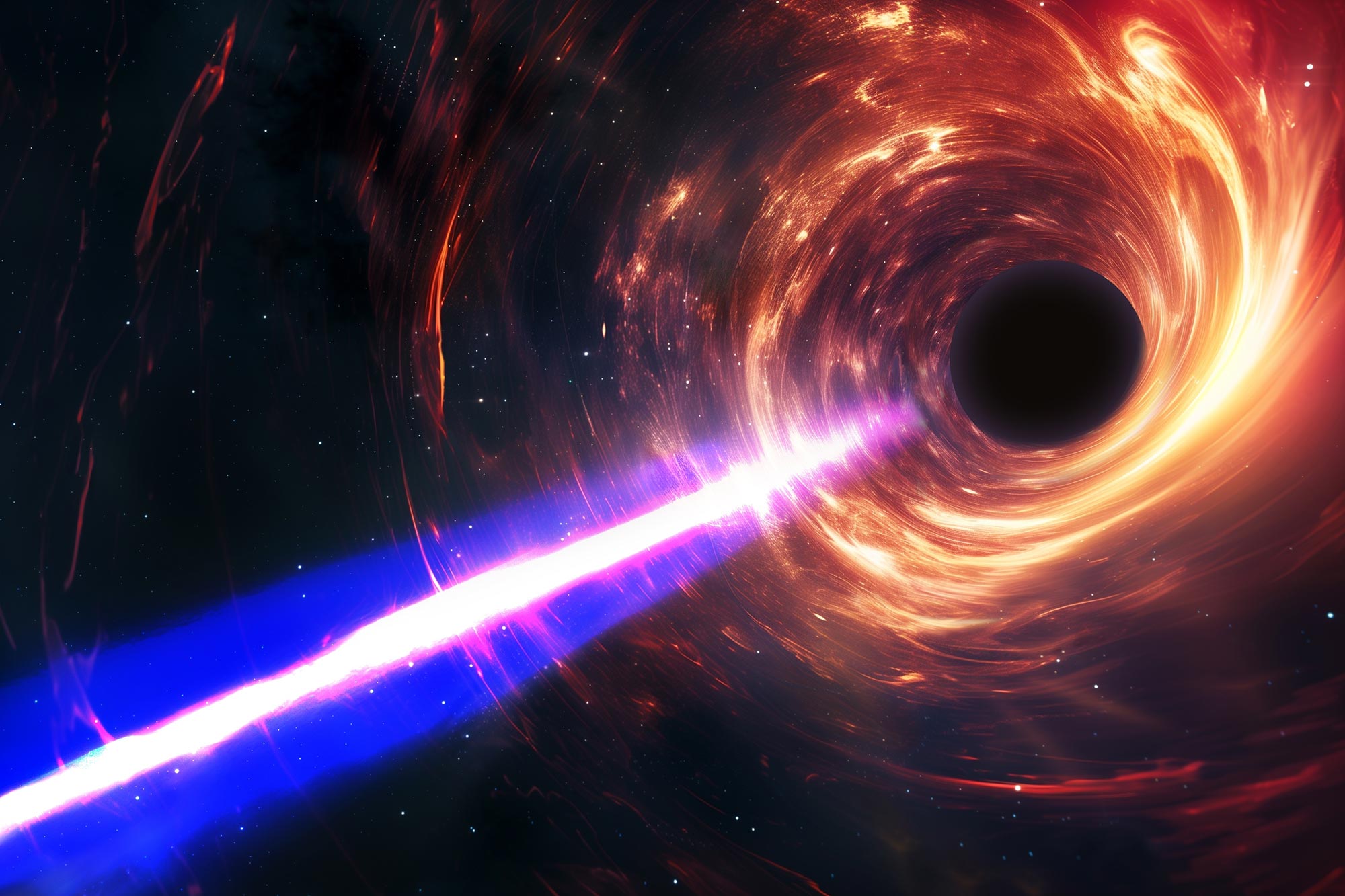
Black holes, once thought to be unknowable, are now under close scrutiny thanks to the Event Horizon Telescope’s groundbreaking images.
Scientists have used these observations to explore whether Einstein’s general relativity truly holds up under extreme conditions. By comparing simulated “shadow” images of black holes predicted by various theoretical models, researchers can test how alternative ideas might differ from Einstein’s framework.
Cosmic Gluttons and the Birth of Black Hole Imaging
Black holes are often described as cosmic gluttons, devouring everything that strays too close—including light itself. This is what makes the groundbreaking images captured by the Event Horizon Telescope (EHT) of the supermassive black holes at the centers of the galaxy M87 and our own Milky Way so remarkable.
“What you see on these images is not the black hole itself, but rather the hot matter in its immediate vicinity,” explains Prof. Luciano Rezzolla, who, along with his team at Goethe University Frankfurt, played a key role in the findings. “As long as the matter is still rotating outside the event horizon – before being inevitably pulled in – it can emit final signals of light that we can, in principle, detect.”
Einstein’s Theory vs. Hypothetical Alternatives
These images essentially capture the black hole’s shadow, opening new ways to explore the science behind these extreme cosmic phenomena. For more than a century, Einstein’s general theory of relativity has served as physics’ most successful explanation of space and time. It predicts the formation of black holes and defines their key feature, the event horizon, a boundary beyond which nothing, not even light, can escape.
“There are, however, also other, still hypothetical theories that likewise predict the existence of black holes. Some of these approaches require the presence of matter with very specific properties or even the violation of the physical laws we currently know,” Rezzolla says.
A New Way to Test Theories of Gravity
In collaboration with colleagues from the Tsung-Dao Lee Institute in Shanghai (China), Rezzolla and his team have proposed a new approach to test such alternative theories, as reported in Nature Astronomy. Until now, scientists have lacked the data needed to confirm or reject these competing ideas – a gap the researchers hope to fill using detailed shadow images of supermassive black holes.
“This requires two things,” Rezzolla explains. “On the one hand, high-resolution shadow images of black holes to determine their radius as accurately as possible, and on the other hand, a theoretical description of how strongly the various approaches deviate from Einstein’s theory of relativity.”
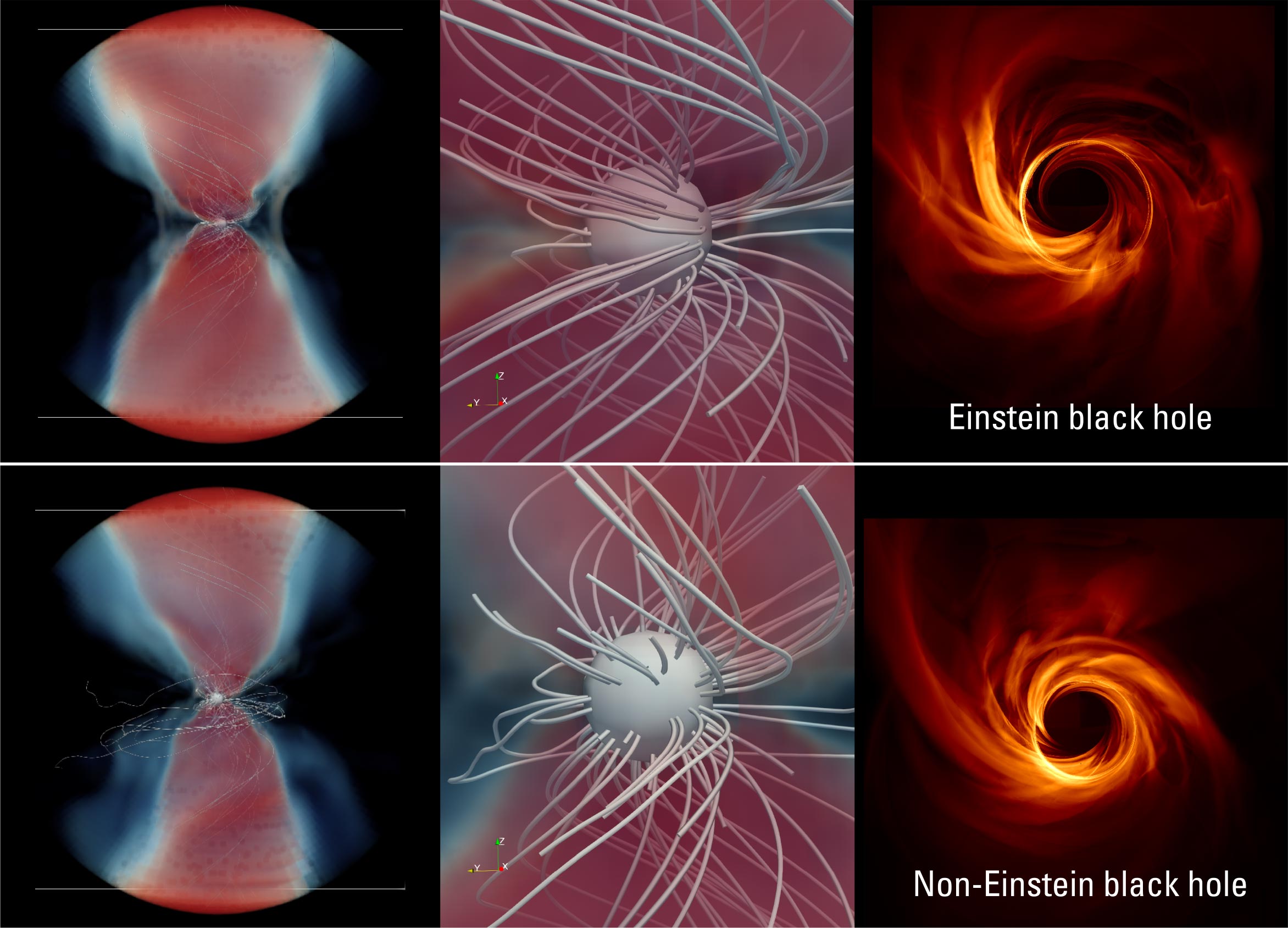
To make this possible, the scientists developed a detailed model showing how different theoretical black holes might deviate from relativity and how those differences would appear in their shadows. They used advanced three-dimensional computer simulations to reproduce how matter and magnetic fields behave in the warped spacetime around black holes. These simulations produced synthetic images of glowing plasma that can be compared to real observations.
Decoding the Differences Between Theories
“The central question was: How significantly do images of black holes differ across various theories?” explains lead author Akhil Uniyal of the Tsung-Dao Lee Institute. From this, they were able to derive clear criteria that, with future high-resolution measurements, could often allow a decision to be made in favor of a specific theory. While the differences in images are still too small with the current resolution of the EHT, they systematically increase with improved resolution. To address this, the physicists developed a universal characterization of black holes that integrates very different theoretical approaches.
“One of the EHT collaboration’s most important contributions to astrophysics is turning black holes into testable objects,” Rezzolla emphasizes. “Our expectation is that relativity theory will continue to prove itself, just as it has time and again up to now.”
So far, the results align with Einstein’s theory. However, the measurement uncertainty is still so high that only a few very exotic possibilities have been ruled out. For instance, the two black holes at the center of M87 and our Milky Way are unlikely to be so-called naked singularities (without an event horizon) or wormholes – just two of the many other theoretical possibilities that need to be checked.
“Even the established theory must be continuously tested, especially with extreme objects like black holes,” the physicist adds. It would be groundbreaking if Einstein’s theory were ever proven invalid.
Sharper Eyes on the Cosmos
The EHT offers outstanding opportunities for such measurements. This collaboration of several large radio telescopes across the globe achieves a resolution equivalent to a telescope the size of Earth, for the first time enabling a sharp view into the immediate surroundings of black holes.
In the future, additional telescopes on Earth are planned to be integrated into the EHT. Scientists are also hoping for a radio telescope in space, which would significantly improve the overall resolution. With such a high-resolution view, it would be possible to subject various theories about black holes to a rigorous test.
As the newly presented study shows, this requires angular resolutions of less than one millionth of an arcsecond – comparable to viewing a coin on the Moon from Earth. While this exceeds today’s capabilities, it is expected to be achievable in a few years.
Reference: “The future ability to test theories of gravity with black-hole shadows” by Akhil Uniyal, Indu K. Dihingia, Yosuke Mizuno and Luciano Rezzolla, 5 November 2025, Nature Astronomy.
DOI: 10.1038/s41550-025-02695-4
Never miss a breakthrough: Join the SciTechDaily newsletter.
Follow us on Google and Google News.