
Close Menu
    Facebook X (Twitter) Instagram
    SciTechDaily
    • Biology
    • Chemistry
    • Earth
    • Health
    • Physics
    • Science
    • Space
    • Technology
    Facebook X (Twitter) Pinterest YouTube RSS
    SciTechDaily
    Home»Space»Heart Transplant, NASA Style: Roman Space Telescope Gets Its Core
    Space

    Heart Transplant, NASA Style: Roman Space Telescope Gets Its Core

    By Ashley Balzer, NASA’s Goddard Space Flight CenterMay 21, 2023No Comments3 Mins Read
    Facebook Twitter Pinterest Telegram LinkedIn WhatsApp Email Reddit
    Share
    Facebook Twitter LinkedIn Pinterest Telegram Email Reddit
    NASA Nancy Grace Roman Space Telescope Detectors
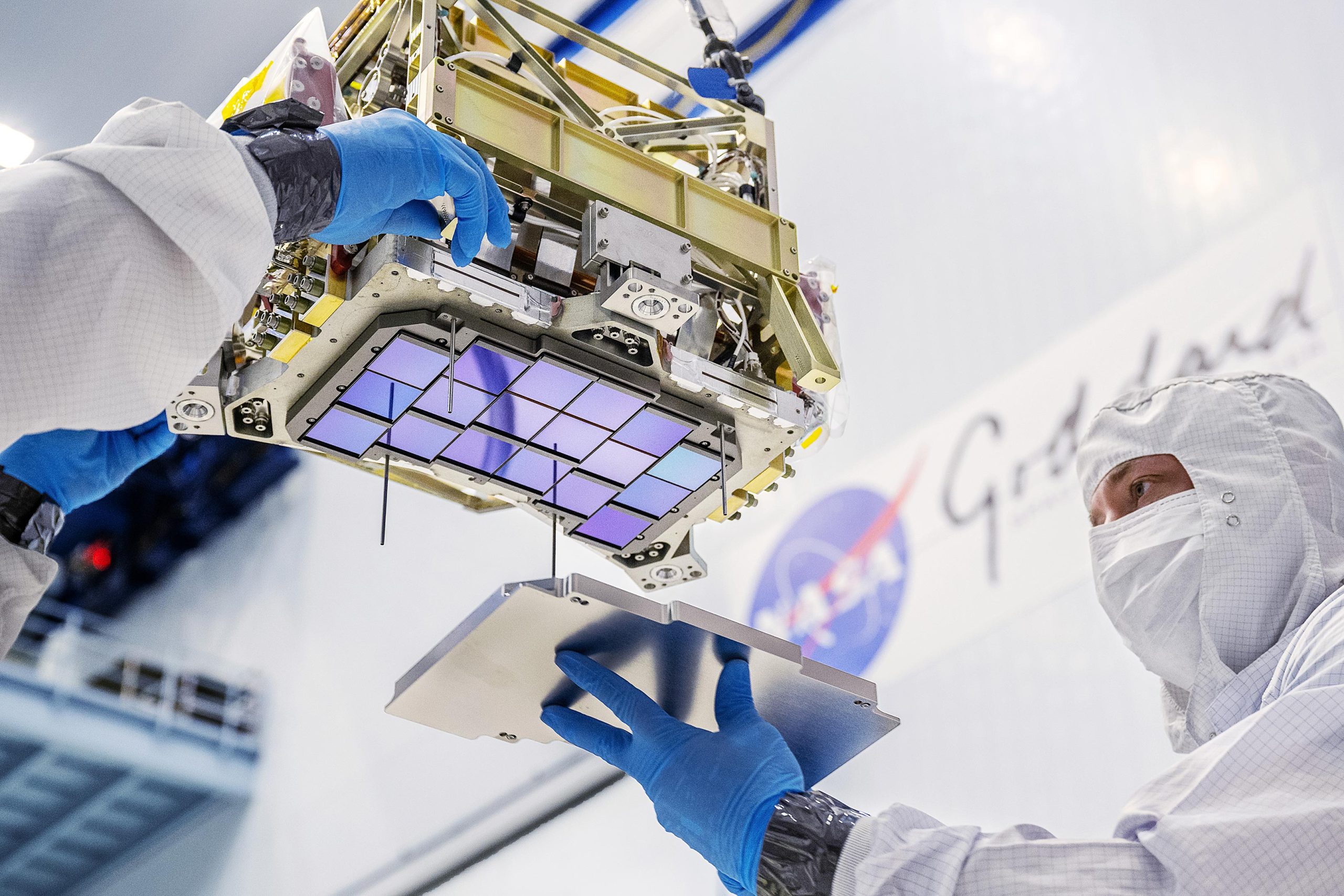
    Principal technician Billy Keim installs a cover plate over the detectors for NASA’s Nancy Grace Roman Space Telescope. Credit: NASA/Chris Gunn

    NASA’s Focal Plane System, a key part of the Nancy Grace Roman Space Telescope, has arrived at Ball Aerospace for assembly into the Wide Field Instrument. This system, with 18 detectors and state-of-the-art electronics, will provide high-resolution images for studying dark matter, dark energy, and exoplanets. The complete instrument is expected to be ready for integration into the observatory by Spring 2024, with a launch targeted for May 2027.

    The heart of NASA’s Nancy Grace Roman Space Telescope was recently delivered to Ball Aerospace in Boulder, Colorado, for integration into the WFI (Wide Field Instrument). Called the FPS (Focal Plane System), it serves as the core of Roman’s camera. When the mission launches by May 2027, astronomers will use this system to gather exquisite images to help unravel the secrets of dark energy and dark matter, discover exoplanets, and explore many topics in infrared astrophysics.

    The FPS is made up of a large detector array and its associated electronics. The detectors were developed by engineers at NASA’s Goddard Space Flight Center in Greenbelt, Maryland, and Teledyne Scientific & Imaging in Camarillo, California. The Goddard team also developed the electronics and assembled the FPS. Each of Roman’s 18 detectors has 16.8 million tiny pixels, which will provide the mission with remarkable image resolution. Through these “eyes,” we will be able to peer through dust and across vast stretches of the cosmos, creating high-resolution panoramas of the universe.


    In order to know how the universe will end, we must know what has happened to it so far. This is just one mystery NASA’s forthcoming Nancy Grace Roman Space Telescope mission will tackle as it explores the distant cosmos. The spacecraft’s giant camera, the Wide Field Instrument (WFI), will be fundamental to this exploration.

    “Roman’s focal plane array is one of the biggest that has ever flown onboard a space-based observatory,” said Mary Walker, the Roman WFI manager at Goddard. “Its creation is the product of many years of innovation from a very dedicated team – one that is eagerly anticipating the incredible science Roman will yield.”

    Once the FPS is installed in the spacecraft’s WFI – its camera – technicians will continue the build by integrating the instrument’s radiators.

    “For optimal performance, the detectors must be operated at minus 288 degrees Fahrenheit, or minus 178 degrees Celsius,” said Greg Mosby, a research astrophysicist and Roman detector scientist at Goddard. “Roman’s detectors are so sensitive that nearby components in the Wide Field Instrument must also be cooled, otherwise their heat would saturate the detectors, effectively blinding the observatory.” The radiators will redirect waste heat from the instrument’s components away from the detectors out into cold space, ensuring that Roman will be sensitive to faint signals from distant galaxies and other cosmic objects.

    After the radiators are installed, Roman’s camera will be complete and ready for thermal vacuum tests this summer. The team expects the entire WFI to return to Goddard in the spring of 2024, where it will ultimately be integrated into the rest of the observatory.

    Never miss a breakthrough: Join the SciTechDaily newsletter.
    Follow us on Google and Google News.

    NASA NASA Goddard Space Flight Center Roman Space Telescope
    Share. Facebook Twitter Pinterest LinkedIn Email Reddit

    Related Articles

    NASA’s Roman Telescope Will Search 100 Million Stars for New Worlds

    NASA’s Roman Space Telescope Could Finally Find the Milky Way’s Missing Neutron Stars

    NASA’s Roman Telescope Set to Map Billions of Galaxies and Hunt Rogue Planets

    Major Milestone for NASA’s Roman Space Telescope Mission

    Next-Generation NASA Space Telescope Named for ‘Mother of Hubble’ Nancy Grace Roman

    Roman Space Telescope Will Detect Exoplanets Using Warped Space-Time

    Roman Space Telescope Universe-Studying, Planet-Finding Mission Greenlit by NASA

    Unlocking the True Nature of Dark Matter With NASA’s Roman Space Telescope

    NASA’s Roman Space Telescope Will Study Dark Energy and Help Uncover the Universe’s Fate [Video]

    Leave A Reply Cancel Reply

    • Facebook
    • Twitter
    • Pinterest
    • YouTube

    Don't Miss a Discovery

    Subscribe for the Latest in Science & Tech!

    Trending News

    Bees Have a Hidden Nutritional Superpower, Oxford Study Reveals

    A Century-Old Belief About Diamond Has Just Been Overturned

    The Universe Can Expand Faster Than Light Without Breaking Physics

    The Exercise Paradox: Why Workouts Don’t Guarantee Weight Loss

    This Ancient Sea Animal Fights Viruses in the Opposite Way Humans Do

    39 Sweeteners Put to the Test Produced Surprising Gut Changes

    This Experimental Drug Repaired the Gut and Reversed Severe Fatty Liver Disease

    Physicists Just Turned a Black Hole Energy Theory Into Reality

    Follow SciTechDaily
    • Facebook
    • Twitter
    • YouTube
    • Pinterest
    • Newsletter
    • RSS
    SciTech News
    • Biology News
    • Chemistry News
    • Earth News
    • Health News
    • Physics News
    • Science News
    • Space News
    • Technology News
    Recent Posts
    • Rare “Super-Jupiter” Discovered on an Extraordinary 180-Day Orbit
    • First Sugar Ever Found in Interstellar Space Could Help Explain Life’s Origins
    • James Webb Telescope Discovers Hidden Giant Planet in Famous Star System
    • Scientists Watch Chemistry Unfold Atom by Atom
    • 20 Years in the Making: Physicists Confirm Long-Standing Quantum Prediction
    Copyright © 1998 - 2026 SciTechDaily. All Rights Reserved.
    • Science News
    • About
    • Contact
    • Editorial Board
    • Privacy Policy
    • Terms of Use

    Type above and press Enter to search. Press Esc to cancel.