
Close Menu
    Facebook X (Twitter) Instagram
    SciTechDaily
    • Biology
    • Chemistry
    • Earth
    • Health
    • Physics
    • Science
    • Space
    • Technology
    Facebook X (Twitter) Pinterest YouTube RSS
    SciTechDaily
    Home»Space»Roman Space Telescope Universe-Studying, Planet-Finding Mission Greenlit by NASA
    Space

    Roman Space Telescope Universe-Studying, Planet-Finding Mission Greenlit by NASA

    By NASA's Goddard Space Flight CenterMarch 3, 2020No Comments3 Mins Read
    Facebook Twitter Pinterest Telegram LinkedIn WhatsApp Email Reddit
    Share
    Facebook Twitter LinkedIn Pinterest Telegram Email Reddit
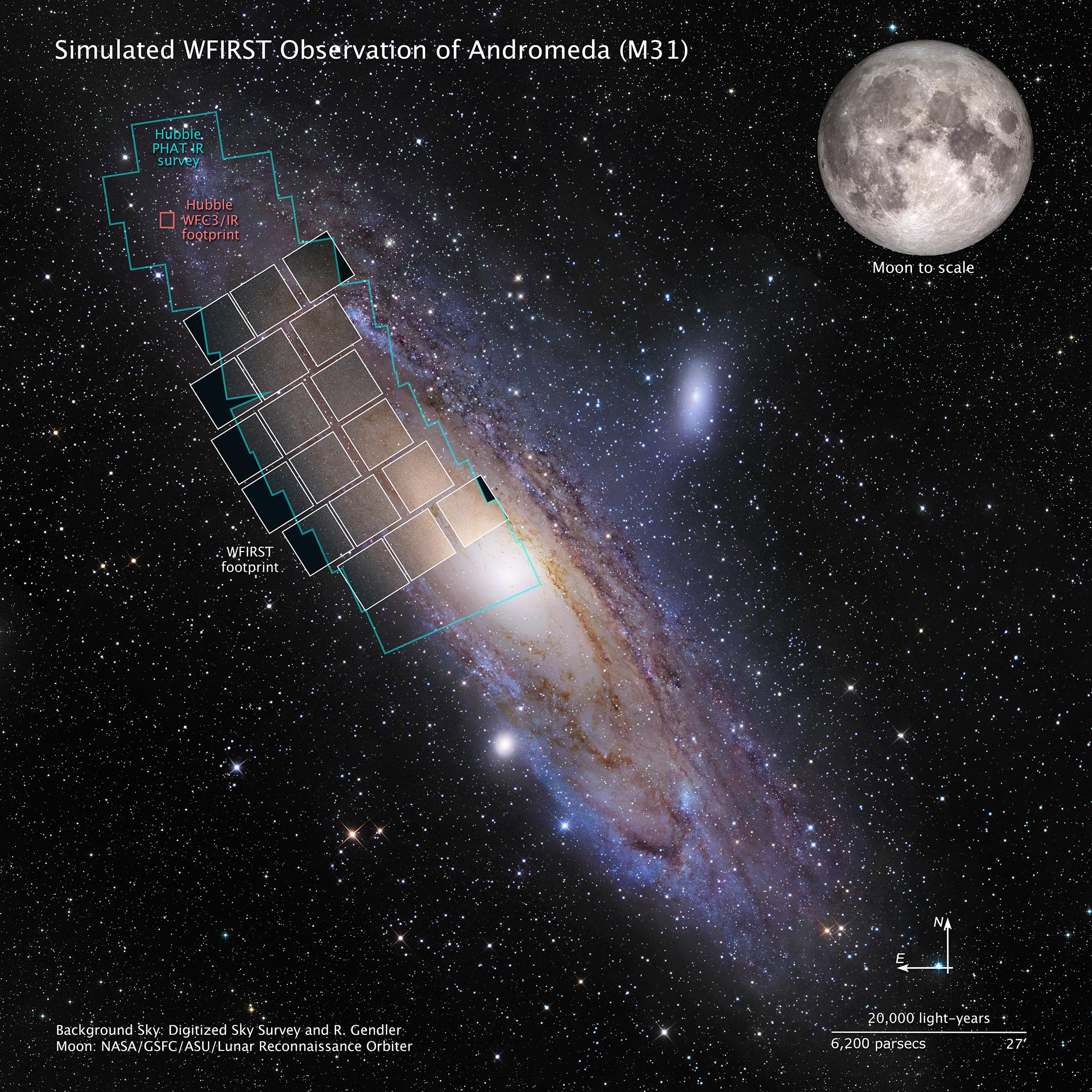
    WFIRST Observation of M31
    This graphic shows a simulation of a WFIRST observation of M31, also known as the Andromeda galaxy. Hubble used more than 650 hours to image areas outlined in blue. Using WFIRST, covering the entire galaxy would take only three hours. Credit: DSS, R. Gendle, NASA, GSFC, ASU, STScI, B. F. Williams

    [Editor’s Note: The Wide Field Infrared Survey Telescope (Nancy Grace Roman Space Telescope on May 20, 2020.]

    NASA’s Wide Field Infrared Survey Telescope (WFIRST) project has passed a critical programmatic and technical milestone, giving the mission the official green light to begin hardware development and testing.

    The WFIRST space telescope will have a viewing area 100 times larger than that of NASA’s Hubble Space Telescope, which will enable it to detect faint infrared signals from across the cosmos while also generating enormous panoramas of the universe, revealing secrets of dark energy, discovering planets outside our solar system (exoplanets), and addressing a host of other astrophysics and planetary science topics.

    WFIRST’s design already is at an advanced stage, using components with mature technologies. These include heritage hardware — primarily Hubble-quality telescope assets transferred to NASA from another federal agency — and lessons learned from NASA’s James Webb Space Telescope – the agency’s flagship infrared observatory, targeted for launch next year.

    With the passage of this latest key milestone, the team will begin finalizing the WFIRST mission design by building engineering test units and models to ensure the design will hold up under the extreme conditions during launch and while in space.

    WFIRST has an expected development cost of $3.2 billion. Including the cost of five years of operations and science, and a ride-along technology demonstration instrument capable of imaging planets around other stars, brings the maximum cost of WFIRST to $3.934 billion.

    The FY2020 Consolidated Appropriations Act funds the WFIRST program through September 2020.  The FY2021 budget request proposes to terminate funding for the WFIRST mission and focus on the completion of the James Webb Space Telescope, now planned for launch in March 2021. The Administration is not ready to proceed with another multi-billion-dollar telescope until Webb has been successfully launched and deployed.

    WFIRST is managed at Goddard, with participation by the Jet Propulsion Laboratory (JPL) in Pasadena, California, the Space Telescope Science Institute in Baltimore, the Infrared Processing and Analysis Center, also in Pasadena, and a science team comprised of members from U.S. research institutions across the country.

    Never miss a breakthrough: Join the SciTechDaily newsletter.
    Follow us on Google and Google News.

    Astronomy JPL NASA NASA Goddard Space Flight Center Roman Space Telescope
    Share. Facebook Twitter Pinterest LinkedIn Email Reddit

    Related Articles

    NASA’s Roman Space Telescope Will Probe Galaxy’s Core for Hot Jupiters and Brown Dwarfs

    NASA’s Roman Space Telescope Primary Mirror Completed – Field of View 100 Times Greater Than Hubble

    “Our Solar System May Be Unusual”: Rogue Planets Unveiled With NASA’s Roman Space Telescope

    Major Milestone for NASA’s Roman Space Telescope Mission

    Next-Generation NASA Space Telescope Named for ‘Mother of Hubble’ Nancy Grace Roman

    Roman Space Telescope Will Detect Exoplanets Using Warped Space-Time

    Earth-Size Habitable-Zone World Found by NASA Planet Hunter [Video]

    Roman Space Telescope Fitted for ‘Starglasses’ [Video]

    A Closer Look at Titan’s Chemical Production

    Leave A Reply Cancel Reply

    • Facebook
    • Twitter
    • Pinterest
    • YouTube

    Don't Miss a Discovery

    Subscribe for the Latest in Science & Tech!

    Trending News

    Millions Take These IBS Drugs, But a New Study Finds Serious Risks

    Scientists Unlock Hidden Secrets of 2,300-Year-Old Mummies Using Cutting-Edge CT Scanner

    Bread Might Be Making You Gain Weight Even Without Eating More Calories

    Scientists Discover Massive Magma Reservoir Beneath Tuscany

    Europe’s Most Active Volcano Just Got Stranger – Here’s Why Scientists Are Rethinking It

    Alzheimer’s Symptoms May Start Outside the Brain, Study Finds

    Millions Take This Popular Supplement – Scientists Discover a Concerning Link to Heart Failure

    The Universe Is Expanding Too Fast and Scientists Can’t Explain Why

    Follow SciTechDaily
    • Facebook
    • Twitter
    • YouTube
    • Pinterest
    • Newsletter
    • RSS
    SciTech News
    • Biology News
    • Chemistry News
    • Earth News
    • Health News
    • Physics News
    • Science News
    • Space News
    • Technology News
    Recent Posts
    • Simple Blood Test May Predict Alzheimer’s Years Before Brain Scans Show Signs
    • Scientists Say Adding This Unusual Seafood to Your Diet Could Reverse Signs of Aging
    • U.S. Waste Holds $5.7 Billion Worth of Crop Nutrients
    • Scientists Say a Hidden Structure May Exist Inside Earth’s Core
    • Doctors Surprised by the Power of a Simple Drug Against Colon Cancer
    Copyright © 1998 - 2026 SciTechDaily. All Rights Reserved.
    • Science News
    • About
    • Contact
    • Editorial Board
    • Privacy Policy
    • Terms of Use

    Type above and press Enter to search. Press Esc to cancel.