
Close Menu
    Facebook X (Twitter) Instagram
    SciTechDaily
    • Biology
    • Chemistry
    • Earth
    • Health
    • Physics
    • Science
    • Space
    • Technology
    Facebook X (Twitter) Pinterest YouTube RSS
    SciTechDaily
    Home»Chemistry»Using Nanoparticles to Convert CO2 Into Valuable Resources
    Chemistry

    Using Nanoparticles to Convert CO2 Into Valuable Resources

    By Ruhr-University BochumSeptember 29, 2019No Comments3 Mins Read
    Facebook Twitter Pinterest Telegram LinkedIn WhatsApp Email Reddit
    Share
    Facebook Twitter LinkedIn Pinterest Telegram Email Reddit

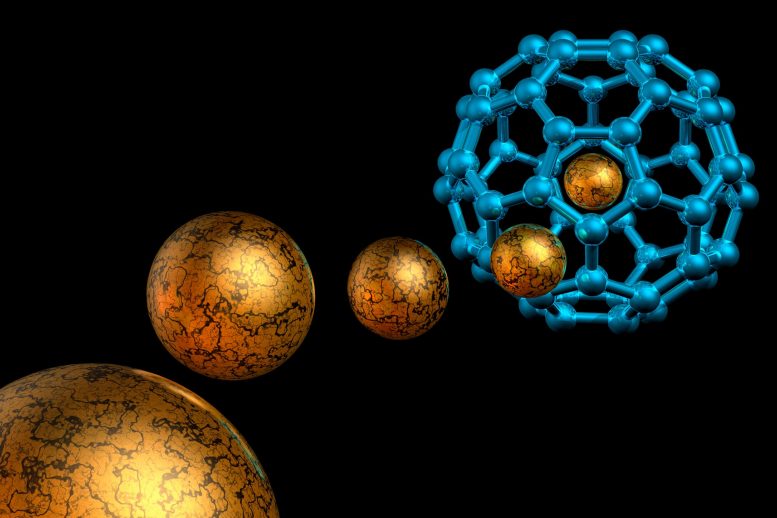
    Nanoparticles Illustration

    Enzymes use cascade reactions to produce complex molecules from comparatively simple raw materials. Researchers have now copied this principle.

    An international research team has used nanoparticles to convert carbon dioxide into valuable raw materials. Scientists at Ruhr-Universität Bochum in Germany and the University of New South Wales in Australia have adopted the principle from enzymes that produce complex molecules in multi-step reactions. The team transferred this mechanism to metallic nanoparticles, also known as nanozymes. The chemists used carbon dioxide to produce ethanol and propanol, which are common raw materials for the chemical industry.

    The team led by Professor Wolfgang Schuhmann from the Center for Electrochemistry in Bochum and Professor Corina Andronescu from the University of Duisburg-Essen, together with the Australian team led by Professor Justin Gooding and Professor Richard Tilley, reported in the Journal of the American Chemical Society on August 25, 2019.

    “Transferring the cascade reactions of the enzymes to catalytically active nanoparticles could be a decisive step in the design of catalysts,” says Wolfgang Schuhmann.

    Particle with two active centers

    Enzymes have different active centers for cascade reactions, which are specialized in certain reaction steps. For example, a single enzyme can produce a complex product from a relatively simple starting material. In order to imitate this concept, the researchers synthesized a particle with a silver core surrounded by a porous layer of copper. The silver core serves as the first active center, the copper layer as the second. Intermediate products formed at the silver core then react in the copper layer to form more complex molecules, which ultimately leave the particle.
    Peter O'Mara and Patrick Wilde
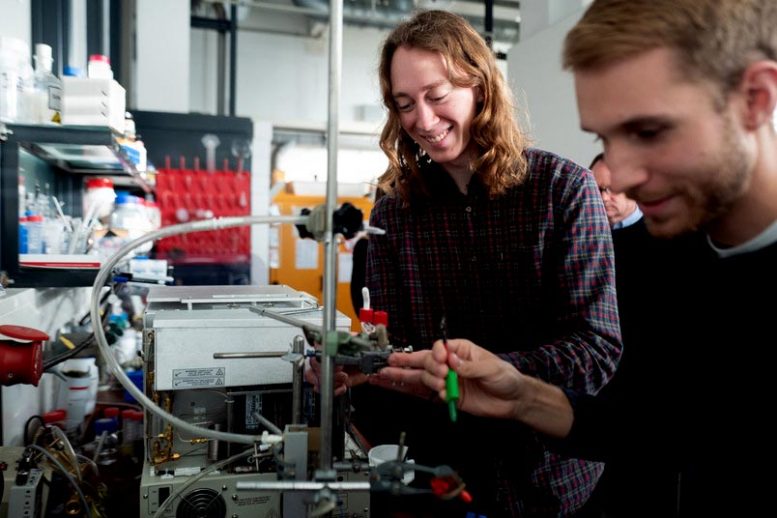
    Peter O’Mara from Sydney (on the left) and Patrick Wilde from Bochum working with an electrochemical cell for CO2 reduction. © RUB, Kramer

    In the present work, the German-Australian team showed that the electrochemical reduction of carbon dioxide can take place with the help of the nanozymes. Several reaction steps on the silver core and copper shell transform the starting material into ethanol or propanol.

    “There are also other nanoparticles that can produce these products from CO2 without the cascade principle,” says Wolfgang Schuhmann. “However, they require considerably more energy.”

    The researchers now want to further develop the concept of the cascade reaction in nanoparticles in order to be able to selectively produce even more valuable products such as ethylene or butanol.

    Reference: “Cascade Reactions in Nanozymes: Spatially Separated Active Sites inside Ag-Core–Porous-Cu-Shell Nanoparticles for Multistep Carbon Dioxide Reduction to Higher Organic Molecules” by Peter B. O’Mara, Patrick Wilde, Tania M. Benedetti, Corina Andronescu, Soshan Cheong, J. Justin Gooding, Richard D. Tilley and Wolfgang Schuhmann, 25 August 2019, Journal of the American Chemical Society.
    DOI: 10.1021/jacs.9b07310

    Never miss a breakthrough: Join the SciTechDaily newsletter.
    Follow us on Google and Google News.

    Greenhouse Gas Nanoparticles Ruhr-University Bochum
    Share. Facebook Twitter Pinterest LinkedIn Email Reddit

    Related Articles

    Butterfly Wings Inspire Breakthrough in Catalyst Design

    Italian Scientists Develop New System for Producing Green Hydrogen Cheaply and Efficiently

    One-Pot Wonder: The New Nanosheet Method Catalyzing a Green Energy Revolution

    Revolutionizing Industries With Super-Durable Gold Catalysts

    Unveiling the Power of Air in Revolutionary “Plasmonic Black Gold” Catalysis

    Unlocking the Secrets of Catalysts: How Tiny Traces Revolutionize Chemical Reactions

    Converting CO2: Breakthrough Catalyst Flips Climate Change Enemy Into Valuable Resource

    The Best Catalyst Particles: Cubes Outperform Spheres

    Working to Recycle Greenhouse Gases

    Leave A Reply Cancel Reply

    • Facebook
    • Twitter
    • Pinterest
    • YouTube

    Don't Miss a Discovery

    Subscribe for the Latest in Science & Tech!

    Trending News

    Millions Take This Joint Supplement but Scientists Found a Concerning Alzheimer’s Link

    Why Evolution Stalled for Millions of Years Before Suddenly Exploding

    New Feathered Dinosaur May Have Solved a 120-Million-Year-Old Fossil Mystery

    Ozempic and Similar Drugs Linked to Dramatic Drop in Addiction Rates

    Ancient Meteorite Reveals a Forgotten Planet That Existed 4.5 Billion Years Ago

    Scientists Reveal What Happened When 12 People Were Trapped Together in Antarctica for 10 Months

    The “Impossible” Earthquake Beneath Utah Was Real After All

    A Major Update Just Hit Cholesterol Guidelines – Here’s What Every Adult Needs To Know

    Follow SciTechDaily
    • Facebook
    • Twitter
    • YouTube
    • Pinterest
    • Newsletter
    • RSS
    SciTech News
    • Biology News
    • Chemistry News
    • Earth News
    • Health News
    • Physics News
    • Science News
    • Space News
    • Technology News
    Recent Posts
    • Your Diet Could Be Missing the Key Ingredient for Heart Protection
    • New Study Reveals Unexpected Way To Destroy Pancreatic Cancer Cells
    • Researchers Warn Widely Prescribed Blood Pressure Drugs Could Be Harming Diabetic Kidneys
    • JUNO’s First Results Bring the Neutrino Mass Mystery Into Focus
    • Astronomers Confirm Dark Energy After Shock Challenge Rocked Cosmology
    Copyright © 1998 - 2026 SciTechDaily. All Rights Reserved.
    • Science News
    • About
    • Contact
    • Editorial Board
    • Privacy Policy
    • Terms of Use

    Type above and press Enter to search. Press Esc to cancel.