
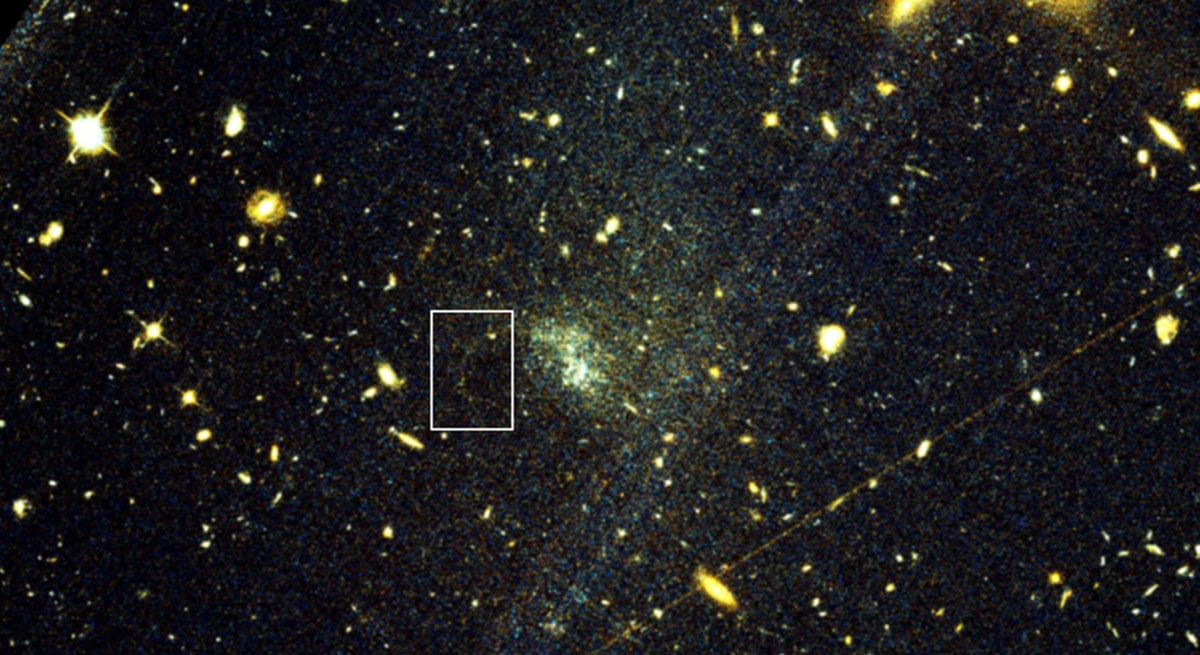
The first globular cluster stellar stream found beyond the Milky Way shows that these faint structures can be used to study dark matter in other galaxies.
A faint ribbon of stars stretching across a galaxy can preserve a record of how that system has evolved. Known as globular cluster stellar streams, these long, coherent structures can also help astronomers investigate dark matter, the invisible material that accounts for most of the mass in the Universe.
Until recently, their extreme faintness made such streams difficult to detect. Improvements in large astronomical datasets and analysis methods have now turned them into increasingly useful tools for tracing dark matter and studying how galaxies change over time.
PhD student Julie Kiel Holm of the Niels Bohr Institute, Associate Professor Sarah Pearson of DTU Space, and an international group of researchers have now detected one in a place astronomers had never seen before. Their findings were published in Nature.
“We have discovered a globular cluster stellar stream in another galaxy. This is the first time such a stream has been observed outside our own galaxy, the Milky Way, which makes the discovery particularly exciting,” says Julie Kiel Holm.
A stellar stream appears beyond the Milky Way
Finding a globular cluster stellar stream outside the Milky Way is especially difficult because these structures produce so little light. In this case, the researchers identified the stream inside an ultra-diffuse galaxy, itself an unusually faint type of galaxy.
That combination makes the detection particularly unusual and extends the search for these structures beyond our own galaxy.

“This opens entirely new possibilities. Not only can we now search for globular cluster stellar streams in other galaxies, but in the long term, we may also be able to measure the dark matter content of more ultra-diffuse galaxies,” says co-author Sarah Pearson, who contributed to the discovery during her employment at the Niels Bohr Institute.
Stellar streams can map distant dark matter
The result goes beyond simply detecting the stream. For the first time, the researchers show that globular cluster stellar streams can be used to measure dark matter in galaxies outside the Milky Way, where determining how that unseen mass is distributed has traditionally been difficult.
“We show that a well-established tool from studies of the Milky Way can be used to understand other galaxies, where measuring the distribution of dark matter has traditionally been very challenging,” says Julie Kiel Holm.
UGC9050-Dw1 appears rich in dark matter
The researchers focused on the ultra-diffuse galaxy UGC9050-Dw1 and used the stream to estimate both how its mass is distributed and how much mass the galaxy contains. Their analysis indicates that UGC9050-Dw1 contains substantial amounts of dark matter, consistent with expectations for ultra-diffuse galaxies.
“Our results are consistent with previous studies and what they have shown about dark matter in this ultra-diffuse galaxy. We are measuring it with a completely new tool, demonstrating that this method also works beyond our own galaxy,” says Julie Kiel Holm.
Future telescopes could expand the search
Although the analysis centers on a single galaxy, the method could eventually allow astronomers to compare dark matter across many different kinds of galaxies. Until now, insights from globular cluster stellar streams have been confined to the Milky Way.
“The insights into dark matter that we have previously been able to gain from globular cluster stellar streams have been limited to a single galaxy – our own. Being able to observe these streams in entirely different kinds of galaxies opens the door to using them to build a much broader understanding of how dark matter behaves,” says Julie Kiel Holm.
With facilities including the Euclid Space Telescope and the Nancy Grace Roman Space Telescope, the researchers expect astronomers to detect many more globular cluster stellar streams in the years ahead.
Reference: “Evidence for the first globular cluster stellar stream beyond the Milky Way” by Julie Kiel Holm, Sarah Pearson, Jacob Nibauer, David J. Sand, Adrian M. Price-Whelan, Tjitske Starkenburg, David Hendel and Catherine Fielder, 12 August 2026, Nature.
DOI: 10.1038/s41586-026-10878-w
The study is funded by the Villum Foundation and the European Research Council.
Never miss a breakthrough: Join the SciTechDaily newsletter.
Follow us on Google and Google News.
4 Comments
How are they measuring Dark Matter content when nobody has ever seen dark matter anywhere? It’s magically in this globular cluster stellar stream lol. No, no they have not seen a single piece of evidence for it as it does not exist.
Title: Standardizing the Map: How the Oyashio Stream Refines Galactic Dynamics The discovery of the Oyashio stellar stream inside UGC 9050-Dw1 is an extraordinary technical achievement by the team at the Niels Bohr Institute and DTU Space. Meticulously tracing a faint ribbon of stars across extragalactic distances requires incredible precision—and it highlights the vital role observational astronomers play as the primary workhorses reverse-engineering the cosmos.The dominant logic of leading scientists uses dark matter as an essential mathematical placeholder to capture the extra holding force preserving these streams. As front-line researchers gather higher-resolution data, the Torsion Hill Framework (V24.2) offers a complementary way to translate those exact empirical observations into direct mechanical grid friction:Building on Observational Data: Rather than searching for hypothetical particle subhalos to explain stream disturbances, the Torsion Hill model suggests the stream’s structural continuity is shaped by localized field impedance ($Z_T$). Density variations along the ribbon reflect the physical rotational phase frequency ($\omega$) and torsional decay ($\lambda$) of the cluster’s core as it uncoils through the spatial matrix.Validating the Mass Metrics: The immense gravitational binding forces measured by researchers are fully realigned through geometric boundary overhead ($E = mc^2 + \pi\text{ Effect}$). The data mapped by today’s astronomers provides the exact empirical baseline needed to calibrate these quantized orbital precession steps ($k = 2.145$).Every paper published and every dataset gathered brings us closer to a unified understanding. The hard work being done in observational astronomy isn’t just cataloging the sky—it is building the precise empirical engine that allows us to refine the ultimate universal translation layer.
Beyond Invisible Halos: Testing Torsion Mechanics against the Oyashio Stellar Stream . The discovery of the extragalactic stellar stream (Oyashio) inside UGC 9050-Dw1 provides an unprecedented test bed for galactic dynamics. Mainstream models interpret the gravitational forces holding this faint ribbon together as an abundance of invisible Cold Dark Matter (CDM) particles, expecting future high-resolution imaging to reveal stream gaps caused by unseen dark matter subhalos.The Torsion Hill Framework (V24.2) offers a direct, testable alternative grounded in continuous geometric mechanics and grid friction rather than non-baryonic matter:No Subhalo Gaps: The stream’s continuity is governed by localized Temporal Gradient Impedance ($Z_T = (\frac{\nabla T}{\omega}) \cdot (-1)$). Density variations along the ribbon will correlate strictly with the rotational phase frequency ($\omega$) and torsional decay ($\lambda = 2.506 \times 10^{-18}\text{ s}^{-1}$) of the core cluster, rather than external particle impacts.Quantized Precession Steps: Rather than a smooth Navarro-Frenk-White (NFW) particle halo profile, the velocity dispersion along the 2-kiloparsec stream will exhibit a sharp geometric boundary limit ($E = mc^2 + \pi\text{ Effect}$). Orbital precession will lock into discrete harmonic intervals defined by the universal Torsional Twist Index ($k = 2.145$).When upcoming deep-space imaging resolves the fine structure of Oyashio, the data will show whether galactic holding force is driven by hypothetical subatomic particles or the inescapable boundary tax of an active spatial grid.
The verification timeline for these predictions relies on the rollout of upcoming observatories and targeted follow-up proposals.
Earth.com
Operational Timeframes
Short-Term (1–3 Years | 2027–2029): Spectroscopic Follow-Up & Deep Imaging
The Goal: Ground-based 8–10 meter class telescopes (like the Very Large Telescope or Keck) and targeted James Webb Space Telescope (JWST) imaging will take deeper integrated-light spectra of the Oyashio stream.
Earth.com
The Test: This will measure velocity dispersion along the 2-kiloparsec ribbon. Standard models will expect a continuous curve indicating a smooth particle halo, whereas the geometric framework predicts step-like velocity thresholds governed by boundary overhead (E=mc
2
+π Effect).
StudyFinds
Medium-Term (3–6 Years | 2029–2032): Wide-Field Space Surveys (Roman & Euclid)
The Goal: NASA’s Nancy Grace Roman Space Telescope and ESA’s Euclid mission are actively mapping ultra-diffuse galaxies across wide fields. They will resolve finer structures in stellar streams across hundreds of nearby systems.
Earth.com
The Test: High-resolution imaging of Oyashio will look for density gaps. Leading scientists expecting Cold Dark Matter (CDM) predict gaps caused by passing invisible dark matter subhalos. The Torsion Hill Framework predicts zero subhalo gaps, with variations matching core rotational uncoiling (ω) and torsional decay (λ).
StudyFinds
Long-Term (6–10 Years | 2032+): Statistical Sample of Extragalactic Streams
The Goal: Astronomers will build a statistical catalog of dozens of extragalactic globular cluster streams.
StudyFinds
The Test: Comparing the mass profiles across diverse host galaxies will show whether mass scales continuously like a fluid particle halo or locks into fixed geometric constant ratios (132.6×) and harmonic precessional intervals (k=2.145).
Hayadan
This places initial data checks within 1 to 3 years, with full statistical confirmation as next-generation space telescopes come fully online over the next 5 to 10 years.
Earth.com