

Scientists are working on a directional dark matter detector that will use strands of DNA and gold in order to detect the elusive non-baryonic matter. A combined team of physicists and biologists are collaborating in order to create a suitable detector that will try and find dark matter, which accounts for much of the universe’s mass.
Dark matter cannot be seen but its effects can be inferred thanks to its gravitational influence on baryonic matter and the structure of the universe. Most of the models of dark matter suggest that it exerts itself on galaxy clusters. Earth is hypothetically surrounded by dark matter, and since it rotates around Sol, which it is currently traveling toward the constellation Cygnus as the Sun rotates around the galactic center, Earth should experience a kind of dark matter headwind of sorts. The researchers published their findings via arXiv.
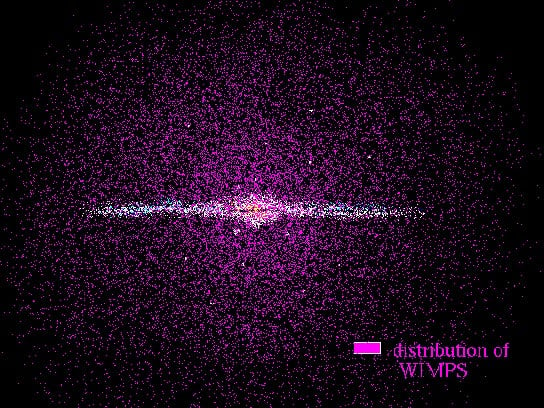
This headwind, or tailwind depending on Earth’s orbit around the sun, emanates from the direction of Cygnus. Many different research groups are working on dark matter detectors, deep in underground caverns using expensive sensors, hiding them from radiation that would pollute the signal. The new team, including astrophysicist Katherine Freese from the University of Michigan and geneticist George Church from Harvard, believes they can overcome the hurdles using DNA to find a specific kind of dark matter particles, WIMPs, or weakly interacting massive particles.
Their detector uses a thin gold sheet with many single strands of DNA hanging from it. It’s hypothesized that particles of dark matter will smash into the heavy gold nucleus, pushing it out of the gold sheet and into the DNA “forest”. This will knock out some of the DNA strands which in turn fall into a collection tray. Each of them has a unique identifier, so it will allow researchers to reconstruct the path of the gold particle with a high degree of precision. The detector has hundreds of thousands of these sheets placed between Mylar sheets. It uses under a kilogram of gold and 100g of single-strand DNA on a square-meter array.
DNA can be used in this process because it will separate the structure vertically with nanometer resolution, up to the nearest nucleotide, the smallest structural unit of DNA. It is better by many orders of magnitude than other detectors. The detector can also work at room temperature and needs no expensive cooling. The Mylar sheets make the detector directional. Higher energy nuclei from background radiation will pass through several of the leaves of Mylar, allowing their identification and exclusion from the process.
This unconventional approach has numerous challenges. It’s not clear how the rapidly moving gold nuclei will interact with the DNA. This will need to be further researched before the detector is built. Also, making the strands long enough will be challenging. At the moment, DNA strands have around 250 bases. The detector will need strands with at least 10,000 bases in order to absorb all of the energy of the gold nucleus. The strands would also have to be straightened, and not curl up.
Reference: “New Dark Matter Detectors using DNA or RNA for Nanometer Tracking” by Andrzej Drukier, Katherine Freese, Alejandro Lopez, David Spergel, Charles Cantor, George Church and Takeshi Sano, 28 June 2012, Astrophysics > Instrumentation and Methods for Astrophysics.
arXiv:1206.6809
Never miss a breakthrough: Join the SciTechDaily newsletter.
Follow us on Google and Google News.
1 Comment
DNA is subject to continuous modulation by x-rays , cosmic rays heat and light etc for billions of years. Since they are having nanometer bases of ACTG.. billions of which make a strand it is possible that WIMPS , the weak interacting massive particles , if any in surroundings can cause mutations embedded in them and it is an indirect method of finding these interacation and hence dark matter. It is a good concept and commended. This experiment can be compared to the detection of massless neutrioinoes all over the world under mountains for getting any possible signals, since neutrino is also massless and does not react with any particle. It is also a weird particle to detect. Thank You.