
Neuroscientists from the Picower Institute for Learning and Memory uncover a fundamental discovery about cortical neurons, showing that inhibitory neuron functionality is not an immutable property of cortical cells, but a consequence of more complex network dynamics.
The two major types of neurons in the brain’s cerebral cortex are connected by intricate cortical circuits that process information. Excitatory neurons, which comprise 80 percent of all neurons in this region, increase activity in target cells. The other 20 percent of neurons are inhibitory, producing the opposite effect.
Inhibitory neurons (interneurons) have long been recognized as critical to understanding distinct kinds of information processing. Specific subtypes of interneurons can regulate response gain (the extent of reaction to stimuli) in excitatory neurons or shape response selectivity in target cells. In a new study scheduled to appear December 11 in Nature Communications, Sami El-Boustani and Mriganka Sur of the Picower Institute for Learning and Memory hypothesize that a particular type of interneuron may influence responses in a context-dependent manner.
Arithmetic controls response
Inhibitory neurons in the visual cortex use division and subtraction to control computations performed by their target cells. Several previous studies suggested that one of the well-defined classes of interneuron, parvalbumin-expressing (PV +) cells, regulates response gain via divisive inhibition, whereas the other major class, somatostatin-positive (SOM +) cells, controls response selectivity via subtractive inhibition.
Divisive inhibition can occur during a range of functions including directed visual attention, orientation, multisensory integration, and value estimation. Subtractive inhibition is thought to sharpen neuronal selectivity, possibly increasing discrimination capability and therefore perhaps enhancing behavioral performance. Based on the findings of earlier research, these functions were thought to be native properties of these cell types, based on structure, connections, and biophysics.
Innovative techniques yield new findings
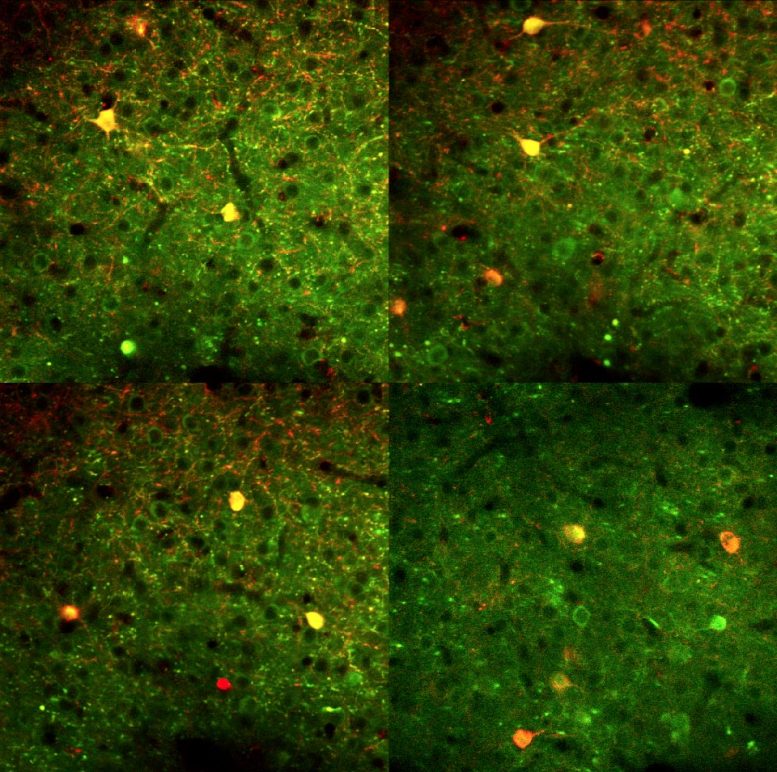
More recent studies, including an in-depth examination by El-Boustani and Sur, indicate that SOM + cells in particular are a key component of the underlying mechanisms that dictate functionality. In order to evoke different response dynamics in interneurons and investigate the nature of inhibition, the Picower neuroscientists employed “an innovative combination of novel visual stimuli, precisely-timed single-pulse optogenetic stimulation, and large-scale recording via two-photon calcium imaging of targeted neuronal responses in mice,” explains Sur, the Newton Professor of Neuroscience and director of the Simons Center for the Social Brain. Using briefly flashed visual stimuli and short pulses rather than prolonged optogenetic activation, the researchers were able to define the response times of PV + and SOM + neurons compared with their target cells, as well as isolate the inhibitory effect of these two types of neurons.
El-Boustani, a postdoctoral fellow in the Sur lab who led the study, was able to show that SOM + neurons can perform either divisive inhibition and regulate response gain or subtractive inhibition and control response selectivity. He found that when stimulation activates the SOM + cells at the same time as their target cells, as is the case when probed with large visual stimuli, they divide responses. When activation of the target cells occurs at a different time — sooner when they respond to small visual stimuli — the SOM + neurons subtract responses. “So neuronal functionality is dynamic; it is governed by firing coordination and the overlap of response timing in the circuits and their target cells,” explains El-Boustani.
The MIT scientists’ ability to demonstrate dramatic and distinct response-dependent switching in the live brain suggests that interneuron functionality is not an immutable property of each cell type, but a consequence of more complex dynamics within cortical networks. Since cortical inhibitory neurons mediate not only information processing but also play a critical role in brain disorders like autism, schizophrenia, and epilepsy, this discovery contributes significant insights to enhance understanding of normal and abnormal brain functionality.
Reference: “Response-dependent dynamics of cell-specific inhibition in cortical networks in vivo” by Sami El-Boustani and Mriganka Sur, 11 December 2014, Nature Communications.
DOI: 10.1038/ncomms6689
Never miss a breakthrough: Join the SciTechDaily newsletter.
Follow us on Google and Google News.
1 Comment
Not sure if this may prove to be a pro or con, but the fact that inhibitory function has been more closely identified is a plus regardless.